

Episode #47 · Mar 31, 2026
Two-Spirit Truth, Decolonized Power, and Righteous Rage with Soul
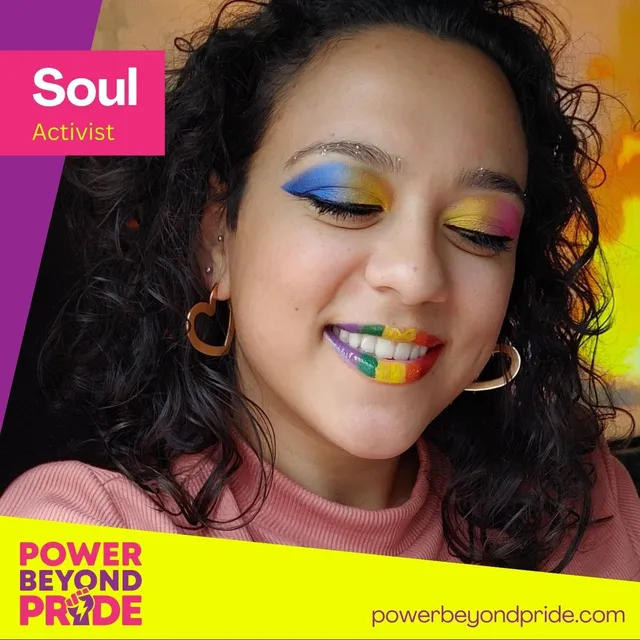
Listen or watch
In this episode
This episode explores Two-Spirit identity as both spiritual and gendered, and how Indigenous frameworks can expand what many people think they know about gender, community, and sacredness. In a discussion with co-hots Melodie KG and Mattie Bynum, Soul connects personal deconstruction from Christianity with a broader decolonizing shift—moving from “invisibility as safety” to visibility that demands new courage and new boundaries. They name how oppression tactics in today’s political climate aren’t new from an Indigenous perspective, and argue that liberation requires listening to Indigenous leadership and supporting sovereignty. Soul also speaks candidly about losing “allies” over political differences, and why long-term ethics matter more than performative belonging. Throughout, Melodie and Mattie hold space for complexity while affirming that pride is more than a parade—it’s daily power.
TranscriptRead the conversationAbout 52 minutes to read · 7,821 words · Soul, Melodie KG, Mattie BynumOpen
- Soul
- When I finally left that religion, it turned my whole world upside down. I knew for sure that there was a creator, but I didn't know how to talk to him or her. I didn't know who my community was. And now that I was on my own, it turns out there's all these amazing people who don't care about that religion at all. It's, uh, also made me so much happier because I feel like myself. I feel like this is what Creator wanted for me. He wasn't saying that you're a bad kid. He was saying, you know what? You have a right to just rage in you. You will learn how to use it.
- Melodie KG
- Hello and welcome to Power Beyond Pride, a weekly queer change making podcast bringing you voices and ideas from across our fierce and fabulous spectrum to transform our world. I'm Melodie KG, a Minneapolis based artivist and provocateur.
- Mattie Bynum
- And I am Mattie, uh, activist, singer, actress, comedian, and just an all around good spirited person to be around. And we are your co hosts today on this Queer Jo. In this episode, we are talking to soul Arizona based Siwikage2spirit, Latin and Afro indigenous activists with an ancestral roots in the Linka and Pipel tribes of El Salvador. Welcome, Soul. Hi.
- Soul
- Thanks for inviting me. Happy to be here. And, uh, it's Pipil. Mattie.
- Mattie Bynum
- Sorry, sorry.
- Melodie KG
- Pipil sounds beautiful. Thanks so much for joining us at Power Beyond Pride Soul. I know today we're going to talk about a lot of different things related to your work, especially around liberation, but I was hoping you could start with just sharing a little bit about Siwa Keech or two Spirit means to you personally.
- Soul
- Yeah, so it's actually something that I grew more familiar with as I started being more active in the indigenous community here in Arizona. I was born and raised in a large Christian family, so gender diversity was not something that was talked about. So when I started branching out on my own, becoming an adult and getting, uh, more in touch with my culture, that's when I started realizing that there's so much more about myself that I wasn't understanding. And there's so much more to my people that I didn't know. So I started learning about two Spirit as it's used in the indigenous community, which it's used as a spiritual as well as gender identity. It does not always imply a different, uh, sexual orientation. And so it implies it is for a being who has both man and woman inside them. And in indigenous culture, a two Spirit person is considered to be very sacred. So they're deemed with respect, they're Deemed with wisdom. They're and they are trusted to be able to make decisions that impact the whole community. So for me, it's something that I have felt inside of me and I just didn't have the words for it. I always felt a strong spiritual connection. I always felt like there was more to me than just the female body I was born into. And recognizing that two spirit was something that felt natural to me. It was just so, uh, so freeing.
- Mattie Bynum
- I love that. Thank you for sharing that. I think a lot of times we don't quite understand how a person could be two spirit, but I thank you for that explanation because it just simplifies it and make it sound so beautiful. And I do want to ask about your journey into coming into who you are today and understanding that you are two spirited. What was it like growing up into in Texas and Arizona, which are two environments that we know that are not very supportive of alternative life or just understanding that you are different. So how has that impacted you?
- Soul
- Yeah, well, it was, it was pretty funny because growing up, I was always a bit of a tomboy. And without realizing it, I think my mom was pretty, uh, supportive of gender diversity, even though she couldn't really call it that. She would say, hey, it's okay if you're a tomboy. It's okay if you don't want to wear a skirt. But then because of the Christian ideals that I was also raised in, she would still mandate, you know, you do have to wear a skirt for this. You do have to wear a dress for this. As a female, you cannot do this or this. So there was always restrictions, restrictions around the way that I wanted to present myself. I felt like I couldn't just be who I wanted to be. I had to conform to some kind of idea of what a woman should be like. And it didn't feel right to me. It felt like something. And it wasn't because I was taught that women are weaker, women are lesser, women aren't smarter. Like I was taught that women are powerful. But I just didn't feel like that's all that I was. It didn't feel like that's what fit with me. So growing up in Texas, I was always a bit more masculine appearing. And yet there were times in my life where I felt very confident in the body that I was born in. And I would reflect that with the way that I would dress. And oftentimes, especially in high school, uh, because I cut my hair into a pixie cut for the first time when I started high school, I would get mistaken for a boy, which I was proud of. I was like, you know what? I'll take it. I'm happy with that. Even though I'm proud of my body sometimes, even though I'm. I know I'm more than just a boy, I'm more than just a girl. I'll take it. You think I'm something different than I am, and that makes me happy. When I finally arrived in Arizona, it was after high school. I started attending college in Arizona. I honestly expected Arizona to be just as quiet about gender diversity as Texas was. I didn't expect to see any of the beautiful people that I ended up seeing. Beautiful men with makeup, uh, women in hot clothes, non binary folks living their best life. I didn't expect to see any of that. And so when I finally did start seeing it, it was revolutionary. And, and when I went to high school in Houston, so you would think that it would be a pretty obvious thing, but it just wasn't. It just wasn't for whatever reason. And so coming to Arizona, one of the first things that I noticed was that the indigenous culture here was so much stronger and so much more obvious. And with that indigenous culture, there was a lot more freedom for people to be who they wanted to be and dress how they wanted to dress. That being said, when I first moved to Arizona, I was in a smaller town. M definitely way more Christian. There wasn't a whole lot of representation in that town itself. But because of the indigenous ties that the state itself just has, even when you enter in, you see the indigenous geometric symbols, you see the way that the buildings are made, they're more adobe, like the earth itself is red. And there's so many beautiful mountains and native plants. Even just seeing those differences in the indigenous culture, it was inspiring. So seeing those different architectural differences, seeing the landscape, how different it was, it inspired me to do more research on what Arizona was like. More research on who these people are that I knew existed. But because I was raised in a conservative Texas area, I was one of those people who thought, oh, Native Americans look like this, but they don't. They look like us and they are us. Doing my research into that, getting to know the fellow people in my community who were there and meeting all the gender diverse people who were in my community really being brave in this tiny Christian community being brave to be themselves, it was just inspiring. It was awe inspiring. And I have a professor in college who changed my life because I swear she was. I don't know, I don't know how she identifies herself but she's a mood. Like, she is a queer mood. So. Yeah.
- Melodie KG
- Yeah, that's awesome. It sounds like you really took your upbringing and kind of turned it on its head a little bit and decided actually this, like, these facets maybe don't feel right. And you really found yourself, uh, sort of reclaiming like, your identity, your roots. I'm wondering, like, what is. How does the rest of your family feel about this sort of like, identity? Are they there with you celebrating their indigeneity as well, or what is that sort of dynamic? Like?
- Soul
- It's, uh, a very nuanced, nuanced idea because my parents are very proud of where they come from. They raised us with a lot of the cultural customs, a lot of the cultural foods, as well as a lot of the. Without realizing it, a lot of the indigenous customs and traditions. But because they were leading us to be raised Christian, it wasn't identified as this is from Mother Earth, this is from nature, this is from Creator. It was identified as this is God, this is Jesus, and this is the Holy Ghost. So I have seven older siblings. I'm, um, the youngest. And I have three siblings that I can comfortably talk about my two spiritness with the rest of them. They've always said that they love me, and I believe that, but it's just not. The acceptance just isn't there. I know I can't express to them, like, hey, I'm feeling more masked today, or hey, I'm, um, thinking about trying a binder, or I'm, um, thinking about top surgery. I can't talk to them about those things because they wouldn't accept it. They wouldn't understand it. So I know they love me, but I know that I can't talk to them about those things. The three siblings that I have that I can talk to about those things, one of them is still Christian, two of them are not. And I think that says something. I think it says something about the way that we were raised and how it's not compatible with us being our truest selves. And I think it says something about how finding my community, even within my own family, has been a matter of knowing who can handle what's true and what they believe is true. So with. With my parents, like how I mentioned, they say they love me and I believe them. I know they've always been there for me in a lot of ways. But when I first told them about myself, they said that I'm confused. They said that I needed to go back to church, that I needed to read my scriptures. More that I needed to pray and ask God to give me wisdom again, that I was losing myself. And no matter how many times I've explained, I'm not confused. This is my truth. This is what feels right, and this is what Creator wanted me to be. He didn't make any mistakes. She didn't make any mistakes. They just don't feel that way. And I still love them. But, uh, it's kind of just me who is really doing that work. To be gender diverse, expressive, at least out loud, you know, and, uh, in terms of indigeneity, my family is proud of where they come from, but I. Sometimes it feels like it's more words than actions.
- Melodie KG
- That's a very queer experience.
- Mattie Bynum
- M. Yeah, most definitely. Most definitely. I was gonna say that conversation, I think, is being had in a lot of queer homes and homes in general. But taking those experiences and also the different layers of your identity of being two spirit and being Latina, Afro indigenous, and growing up Christian or in a spiritual household, how does. How has that shaped your view on worldwide activism and just the world itself?
- Soul
- Something that I always remind myself is that before I started getting in touch with my cultural identity, I was very white centric in the way that I would think. And it's almost embarrassing because, I mean, now I'm like, so proud of who I am and where I come from. Like, I do everything that I can to be decolonized and to think about how I was before. It was just like, man, who are you? Like, why were you doing that? Like, you didn't need to be that way. That was extra. It's just really. It's changed everything about the way that I view people and I view the world. Before, I would feel safe even in places where I wasn't, and it was because I was hidden. I felt safe in my invisibility. And as I started being more visible, I started having experiences where it wasn't actually safe anymore. And I had to learn how to deal with conflict in a way that I had never, ever done before. I started having. I used to be one of those people who'd be like, oh, well, you don't need to have political debates on Facebook. Oh, well, if someone doesn't think the way you do, you can still be friends and. Absolutely not anymore. Absolutely not. So I've cut off people. I've had those debates on Facebook. I've been that person because I just can't stay quiet. I just. I don't know how. I don't know how people can. It just changes everything. And in fact, one of the reasons that I started changing the way that I see things is because I left my religion. I was very dedicated to the Christian religion that my family raised me in. My parents, despite being very Christian, they were also. They were very good people. They didn't make it completely into the cult obsessive thing that we see on television shows and things like that. It was very prominent in our lives. But I also had hobbies outside of that. I had a life outside of that. I had friends who weren't Christian. And when I finally left that religion, it turned my whole world upside down. I knew for sure that there was a Creator, but I didn't know how to talk to him or her. I don't know, I didn't know what they look like. Um, I didn't know who my community was because before I was restricted to people who were within that religion. And now that I was on my own, it turns out there's all these amazing people who don't care about that religion at all. And it felt so different. It was just eye opening. And the more that I have, uh, decolonized, dechristianized the way that I think and the way that I see things, on the one hand, it's made me so much angrier because I hate the way that the people I love, the earth that I love, is being treated. And it's also made me so much happier because I feel like myself. I feel like this is what Creator wanted for me. This is what he was telling me when I would pray at 7 years old, begging for forgiveness because I thought something mean about my mom. Like, he wasn't saying that you're a bad kid. He was saying, you know what? You have a righteous Ra in you. You will learn how to use it. So, I mean, I'm still figuring it out. There's so much still that, especially in terms of spirituality, I'm still trying to feel comfortable with and get a handle on. But now, I mean, I can't stay quiet anymore. And that being the nice Christian way that I was before, not me, never again.
- Melodie KG
- I love that. That's such a powerful answer. And heck yeah. And good for you. That's effing awesome. We are going to take a really short break, but please stay tuned to this really amazing episode of Power Beyond Pride where we're talking with Soul. And we'll come back in just a few short minutes. Welcome back. This is Power Beyond Pride, a queer change making podcast. And I'm Melodie KG here with my co host Mattie, talking With soul. Let's continue where we left off.
- Mattie Bynum
- So I definitely. I'm, um, liking how we're having a conversation about the two spirit. And I wanted to make a quick distinction there that when you made the comment when you left Christianity, I think a lot of times we have the misconception between religion and spirituality because you can be a very spiritual person and not conform to the religion of Christianity, the religion of Islam, the religion of Judaism. So I wanted to ask you real quick, how has that impacted you? Understanding that you could still be very much spiritually connected to the creator God, um, Mother Earth, ocean, wisdom, all these different identities that are there for us, but understanding that as a Christian, I may have learned some things that are not quite accurate, but I can still have my spiritual connection. So how do you. How does that. How do you resonate with that? How do you deal with it?
- Soul
- Well, it's definitely not easy. I actually still currently attend support groups for recovering from religion because that trauma is real and I really need to be able to speak to people who understand that. I wish it could be my family, but, you know, I get it where I can. Let me tell you, I have a lot less guilt. Something about Christianity, the way that I was raised in it, I don't know. I know some Christians are like, oh, no, be who you are and we love you anyway. That was not how I was taught. You have to be a certain way, otherwise you're sinning. You have to be a certain way, otherwise God will be angry and you will not get the blessings of being able to see your family after you die. And that was terrifying. Absolutely terrifying. Everything that I did was a wrong decision. Every. Because he was watching you. He was always listening to you. And now it's, yeah, he's. Whoever he is, whoever she is, they're my homie. They understand. They get it. They're like, hey, you know, you want to be like this? Go for it. Just don't hurt anyone. You know, you want to be like this, go for it. Just take care of my planet, take care of your home. And all of a sudden, being a good person doesn't have so many rules. Being spiritually strong doesn't have to do with conforming to a rule book, doesn't have to do with praying a certain amount of times a day or going to church activities instead of going to a school activity. It doesn't have to do with choosing the missionaries over choosing my friends. And so, just so freeing, so freeing and still, still confident that I have that connection. Because, like, how I mentioned my family without realizing it, uh, was very indigenous. Despite wanting to go more Christian, that connection with the earth, I've always had that. That connection with Creator. I've always had that. Leaving Christianity didn't change that. It just gave it a more malleable feeling. It gave it a more comforting feeling. It feels more like home.
- Melodie KG
- That's incredible. I'm interested. You mentioned earlier being able to find kind of your community, your people, and I want to know who are those people? Who is your community? How are you especially living into this sort of new era of soul. What are you doing in terms of like activism and community work?
- Soul
- Yeah. So I mean, it's been a journey. It's been a journey. I've. I've uh, been living where I'm at now in Arizona for about six years. It's taken me this whole time to really build up a small core of people that I know I can rely on and know I can trust. So for example, I have two professors from college that I know I can go to, that I know I can trust. Because while I was there in college, they were supportive of me. They were there with me. I could ask them questions, I could talk to them after class, and even after college, they've advocated for me in the work that I've done, and they've supported me whenever I've requested their help in furthering my professional career. So starting off in college and it wasn't my peers, it wasn't my peers that I got along with. It was the adults, because they were the teachers. They were the ones who knew what they were teaching. The peers around me, they still had their own stuff to figure out, which is fine because I was there too. So it was the adults that I got along better with. And part of that could be because I was raised with so many older siblings that I'm just more comfortable with adults. But I mean, now I am an adult. So I don't know what the excuse is now. But regardless, it worked out. And then I started working at the uh, nonprofit that I'm at now. And that community has changed over the years as, ah, employ. Employment changes. People's lives change. They move, they, uh, change careers. I've had people throughout the years that I've been here who have been that community during a time that I needed them. So maybe like when I first started, there were two of my co workers who I knew I could be myself. I knew I could ask them for help. I knew I could go to them if I needed something. And I knew they would have my back. Once they were gone, that community wasn't there for a while. And then new people would come in and I would just, as scared as I was, I would just continue being myself, being out loud and proud. And eventually they would find me, they would come to me and they would say, hey, I've noticed that you talk about this even during meetings. I've noticed that you advocate for this, even though my supervisor doesn't do that. And those people now are the people that I can confidently say have my back. And it's been great because I no longer feel like I'm the only one trying to make sure that we're here for everyone in the community. And I know that they gain strength from me just like I gain strength from them. Outside of my work, I do a lot of advocacy in my spare time. Well, whatever spare time I may have, you know, and a lot of that has to do with what my profession entails, which is marketing, public relations, social media, advertising. This isn't, this is not a catch all. But in a lot of our communities, our indigenous communities, they don't really understand what marketing is. They don't really understand what the purpose of advertising is, what the point of a fundraiser platform is, what boosting a post on Instagram means, what, um, what's the purpose of a YouTube short? Like, they don't really, they'll, they will eat up that content, but they're not trying to produce that content.
- Mattie Bynum
- Yeah.
- Soul
- So something that I have really focused on is making sure that I help my community be represented in the way that they want to be represented. So something that I always tell my clients whenever I speak with them is I will not change my values for you. If you are trying to do something that is unethical or manipulative to the audience or the consumers that you're trying to connect with, I won't do it. So I'm not your person. If all you're doing is trying to get a quick buck. If you want to gain trust in the community, if you want to speak to their hearts, if you want to have them feel like they can trust you, I got you. And that's also only if you have values that I believe in. Because if you do something that I don't believe in, I'm not going to work with you. And that has gotten me in hot water a few times where organizations that maybe say that they are for the people do things that are the opposite of that. And because I'm willing to say, hey, that's actually not okay. And that's actually not right. And you should apologize and do better. They don't appreciate that. They don't like that. But then, um, it's overpowered by the amount of people that I work with who appreciate the authenticity, appreciate their voice being heard. And it just, I mean, being able to see an individual or a community get the success they need either for an event, a fundraiser, a program, an organization, a book even, just brings me so much joy. That is you. That is what you needed to share. And now it's out there. I will help you get it as far as you need to get it because you deserve to be heard and your message is powerful and that just brings me so much joy.
- Melodie KG
- That's incredible. It sounds like you're a social entrepreneur. Amazing.
- Mattie Bynum
- Yes. So, uh, we do have to go to break real quick, but. And when we come back from break, I do definitely want to continue talking about what brings you hope and joy. And also too, we want to have a slight conversation on what do you think, especially in the political climate that we're currently in, what are some of the pressing threats to liberation and well being for all of the communities and why we are being targeted. Okay. So please stay tuned with us as we go to a short break. We'll be right back. This is Power Beyond Pride. Hold on one second. Foreign welcome back to Power Beyond Pride. We are here talking with the amazing Soul. I am also accompanied by my wonderful co host, Melodie. There's no words I can't ever say about Melodie because I just. I love you, boo. Like, you are just so sweet.
- Soul
- Oh, I love you too.
- Melodie KG
- And I'm so stoked that we're here with Soul. This is an amazing conversation. Viewers at home, listeners at home. Um, it is Sunday here when we're recording. This feels like just a beautiful, liberatory Sunday sermon. Thank you for being here with us all. Um, Mattie, you had a really good question you wanted to ask them.
- Mattie Bynum
- Yes. So I want to ask you real quick. So with the current political climate that we're in right now, and especially dealing with refugees and immigrants and people in our community in America, how do you feel or, uh, what do you think are the pressing threats to liberation amongst all the communities and the beings of people as we deal with the com. The. I'm not even going to say the complete utter bull, but the regime that is considering to be our president right now.
- Soul
- Good word. Well, it's really, it gets complex because from an indigenous perspective, none of this is new. This is all oppression tactics. Uh, regime that has been here before and has been here since the beginning of what is now called the United States. So this is actually something that I have talked about with some, um, of my community groups that I work with. This isn't. I understand that this is frightening for everyone. This is frightening for me too. I understand that everyone's like, all hands on deck, we need to get started now. But the truth is this has been going on. We've had our hands on the ship, on the deck, holding on for bare life, white knuckling it, trying to figure this out. And what we could really use is some support because. And this is one of the things that I advocate, uh, for the most whenever I am working with my community groups. Immigrants from Mexico or from South America or Central America are indigenous. We are indigenous people. And some of our people don't identify as that. And that's okay. But the truth is that's a colonization tactic. We don't. Our people who don't identify as indigenous, it's because they've been taught that that's bad. They've been taught that that's lesser than. But the truth is we were here. We were here first. We knew this land, we knew this earth, we knew these plants, we knew these waters, we knew these mountains, we knew this sun. So what should be happening is advocating for our people, our indigenous people of all places, to have the sovereignty they need. Federal recognition of tribes is something that I learned more about when I attended college and also started to hate more when I attended college. Because what is blood quantum except something for an animal? Livestock. What is federal recognition except a man in a wig telling us whether or not they think they see us?
- Mattie Bynum
- Mhm.
- Soul
- So there's. There were hundreds, thousands of tribes in our lands and now we have, what, only a couple hundred, according to who and why. So with the current political climate, all I can think is, hey, come back. Come back to what we've been doing. Come back to the people you thought didn't know what they were doing. Come back to the people you thought were savages. Because we have the answers and we've had the answers and we know exactly what to do. Hear our words, pray with us, sacrifice with us and for our allies. And we need your skin color. They're not going to listen to us, so we need you there with us on the front lines. I have lost some, um, supposed allies in my journey because, for example, and maybe this will be controversial, but I voted third party. I didn't vote for either of the two parties because in my opinion, if you're both for genocide, then you're not for me. So I voted anti genocide. I voted third party. And there have been allies, sadly, in the queer community who I have lost because they probably, when the heat of the moment, I'm sure that they're still a good person, they still do good things. But in the heat of the moment, they tell me, the blood of trans people is on your hands, the blood of immigrants is on your hands. And I think to myself, that is, first of all, that is some white privilege. Second of all, that is a very small, limited scope and view of thinking for you to say that to me.
- Mattie Bynum
- Mhm.
- Soul
- So I tell them, you're not my ally anymore. You're not a safe place for me or my people. And in my heart, in my mind, I think that's disappointing. I thought that at least in this community, that you would be genuine, and you're not. So it becomes so complex because even within the communities that are being oppressed, people, I don't know, people say, oh, well, don't make everything into politics. And it's, well, my life is political because, uh, I exist.
- Mattie Bynum
- Mm. Yeah.
- Soul
- All I can ever really tell people is vote for what is right in the long run, because do and do what is right in the long run. If you don't want to vote for whoever you don't want to vote for, cool. If you don't want to protest in the way that other people are protesting, if you want to make a change, if you want to see a change in your community, in your town and your people, start here. Start where your voice is needed. Make an impact here with the people who are, who have been fighting and need your help. And it'll build from there because we've got you, but we need your help. So that's. I mean, it's terrifying. All of it's terrifying. I keep my know your rights cards on me. I give them out to all my friends. I share my political posts, even though people don't like them. Um, I share them to my family, even if they don't want to hear it. I mean, I tell everyone I do all the education I can. I'll. I'll upset people if I have to. And in the end, it's just, how much do you care? How much do you want things to change? Let me see it work.
- Melodie KG
- That is what's up. Um, and so much of what you just said is. Resonates with me for a lot of reasons. The voting situation and having, like, folks who you thought were really allied with you in your community, tell you that your vote choice is the reason for something is just so wild and, like misguided. And we see it, like, especially. I've seen it a lot in online spaces. I mean, uh, the Internet is like chaos right now. But, like, you can boycott systems and sometimes that's the move. Sometimes, like telling the two party system, y' all ain't working, like, that's totally valid. And I'm sorry you had that experience and I'm really glad that you are here and telling us about that because not everyone would be brave enough to just say, I did the thing that the majority tells us we're not supposed to do because of how the thing works. And it's like, the system is the problem, y'. All. It's not individual. Yeah.
- Soul
- Anyway, thank you.
- Melodie KG
- Thank you for your work. I'm a big fan.
- Soul
- It wasn't. It made for us. It wasn't made for us to begin with.
- Mattie Bynum
- M and I was gonna say real quick, Melodie, it reminds me of what we're talking about today. It goes back to my parents when. You know how when we were kids, when your parents used to say, don't do as I do as I say. And I'm looking at people now and I'm like, well, you saying, uh, one thing, but you're doing another one. So now do I need to pay attention to what you do versus what you actually say? Because you say you're an ally, but then you vote it this way. You say you're an ally, but then you make a distinction this way. You say you are an ally or you agree or you're there, but then your actions show me otherwise and it's Sabbath. That's really how we ought to look at people nowadays in all situations. Yeah.
- Melodie KG
- Um, I want to pivot really quickly. I know that we want to get to our speed round of questions, but I really want to know from you, so, like, before we head there, what is your hope for your future? What's coming up for you in the next couple years?
- Soul
- My hope is to continue educating in a way that I can still provide for my family. So I say that in a general sense. I use it in job interviews and work interviews, things like that. Because the truth is, what I want is to be radical, but I want to be radical and get paid for it. And I only need to get paid for it because of the society that we're in, where money is a thing. But honestly, uh, I just want to. I just want to educate and give people the knowledge that I was not raised with. I want them to have it as early on as they can. Despite that, I only want to be a college professor. I don't want to do the whole grade school papers and hormones and all. I love them, love kids, but I don't want to be a teacher in a grade school. I can't do it. Proud of my family members who have done that. Rooting for them, always rooting red for Ed. Just not my goal. So I'm going to be attending college again starting this fall. Actually, I'll, uh, be getting my master's in anthropology. One of my goals is to become an anthropology professor so that I can be as radical as the professor who changed my life. When I first came to Arizona, she was the one that I said, I don't know what her. I don't know what she identifies as, but she is a full mood. She has been my inspiration since day one. She's an anthropology professor, and she is who I want to be. Like, um, and when I attended college getting my bachelor's degree, I had an anthropology professor who was indigenous. And that's a rare find because anthropology is one of those sciences that has constantly screwed indigenous people over. So having an indigenous professor of that study who was holding up the decolonization, holding up the indigenous truths of these sciences, was revolutionary. And, uh, she's still there. She's still doing her work, doing what she does. And I'm so excited to be on the same campus as her again when I go back, because that's how I want to be. I want to be the kind of professor that is in a field that is meant to be for us, and I want it to be the way it should be. I want to educate whoever I'm educating, whether it be adults, youth, whoever, that science is ours, truth is ours, and we make it. We can speak the way that it needs to be spoken. And what they said in 1700s with Sigmund Freud and thinking that women and black people don't have the same amount of pain levels, that's all bullshit. We don't have to listen to that anymore. So besides that, besides my education, besides wanting to be a professor, my goal is to be able to continue, uh, advocating for the community. As the social media landscape, the Internet landscape has grown, my skills are less and less rare, which is great, which is fine. I want people to know how to do these things for themselves. I want folks to feel comfortable doing these things for themselves. That being said, I have a lot of skills, and I'll find whatever I can to help my community. So if someday it turns out that they don't need me to do posts on Facebook for them. Cool. What do you want to do? Do you want to do a podcast? Do you want me to take some pictures for you? Do you want me to design something for you? Whatever, Whatever. It's going to take, using the skills that I have to make sure that, uh, my community's voices are heard. And I'll keep doing that to my last breath, more than likely. Probably on my deathbed, I'll be saying whatever it is I'll be saying, I won't say it here, but you know.
- Melodie KG
- Yes. Okay, cool. Well, we have just a few minutes. I want to, I want to do a few speed questions with you. Uh, if you're up to it.
- Soul
- Yeah, absolutely.
- Melodie KG
- Okay, great. What is your favorite guilty pleasure? Junk food?
- Soul
- Oof. I just got it yesterday too, so it's perfect. You know that brownie Oreo confection from Dairy Queen?
- Mattie Bynum
- Yes.
- Soul
- Oh my God. Listen, I'm lactose intolerant, but I will tolerate that because that is so good.
- Melodie KG
- Yeah.
- Soul
- I have in my notes how much it costs so that I know if I'm feeling some kind of way, this is how much I need to feel better.
- Mattie Bynum
- I love that. I love that. What is the most bizarre dream you've ever had?
- Soul
- Ooh. There was this time when I was really young, I used to have really weird dreams. And now that I'm older, I have dreams just about life. But when I was younger, I had a dream that I was being chased by a werewolf. And this was before Twilight, so I'm not going to be blaming Twilight, but I had a dream I was being chased by a werewolf. And it was like this red aura kind of outdoors area and I was just running for my life and it was one of those old time, maybe it was from Michael Jackson, the Thrill, the Thriller video. Because it was that old timey looking werewolf that stands on two legs. And I don't remember what happened. I just know that I was scared and I was running.
- Mattie Bynum
- Not. You were thinking of Teen Wolf over there. Michael J. Fox.
- Soul
- Yes. Yes.
- Melodie KG
- That's amazing. What song do you listen to that brings you Calm, calm.
- Soul
- So I have this song that I always go to. Part of it is nostalgia. Part of it is because it just feels right. El Chico de la Partamento Cinco Doce by Selena Quintanilla.
- Melodie KG
- Amazing.
- Mattie Bynum
- Mhm.
- Soul
- Go to every time.
- Mattie Bynum
- Okay, so what's the first thing you notice about a person when you first meet them?
- Soul
- I Notice their face. Because I am someone that has been told that I have an rbf, which is funny because I also get told that I'm really smiley. So I guess it depends on the person or it depends on the day, I don't know. But, um, people have comments about my face, so the first thing I notice is a person's face. How do you look? You seem like maybe you're just neutral. You seem like maybe you're stressed out, but I never think you have an rbf. I always think, no, you're probably going through something. You're probably thinking about what your next step is going to be. You're probably thinking, oh, uh, this part was funny. And it's cute because I'll sometimes see people do a little smirk to themselves because they're just thinking they're just doing their thing, living their life. But because I'm paying attention to their face, they'll be just doing their thing. And they'll be like, haha. Huh? Just kind of laugh at themselves. Just kind of look down and smile. And I'm like, yay. Uh, you got that little bit of joy. Good for you. Happy for you. So I just. I love looking at people's faces.
- Mattie Bynum
- All right, fave. Awesome. Okay.
- Melodie KG
- All right, favs. What does Power Beyond Pride mean to you?
- Soul
- Maybe it's a. Maybe it's a bit specific. But power Beyond Pride for me means that we don't need to be a pride parade, we don't need to be a pride festival in order to be proud. Yeah, we can be proud on the daily. We can be proud outside of a festival. We don't need. We don't need the. We don't need that scene. We love that scene. It's fun, it's great, it's worth it, it's got its place. But we don't need that just being who we are. That's the power.
- Melodie KG
- Hell yeah.
- Mattie Bynum
- I like that. I, uh, like that answer. Okay, well, my last question I will have for you today, I will say is, what is the most radical, ostentatious thing on your bucket list that you haven't completed yet?
- Soul
- Oh, uh, man, I really want to go see the. So in El Salvador, there is a dormant volcano that has a lake inside it. And I really want to go see that. That's what I want to go do. And I know it's not. It's probably not that crazy, but that's just where my brain goes, and that's just what I really want to do. And I don't know if I'LL be able to do it because finances this society, having a passport. As a brown person nowadays, there's so many reasons why I probably couldn't do that. So that is my dream.
- Mattie Bynum
- But we're not going to stop that. So we're going to think positive and say, yes, you will get to do that. So we're not going to put no limitations on, uh, it. Yes, you will. You will get to do this. Yes.
- Melodie KG
- Amazing. Sol, thank you so much for being here with us today. We're running out of time for the podcast. We hope you join us again. Um, because this was a really great conversation. Where can people follow you and your work?
- Soul
- Yeah. So after the whole, uh, meta controversy with them being able to say slurs about LGBT people, I have not been on there. I am now on Blue Sky. I'm also on Fan Base, which is a black created and black owned platform. And I'm also on Reddit, which, you know, it's, it's got its levels, but those are the three places that I'm at.
- Mattie Bynum
- All right, perfect. Well, yes, and then like I said, I echo. Melodie, thank you, thank you for coming in. Just join and joining with us in this conversation. The light that you have given us, the wisdom you have imparted, we thank you for that today. Thanks for being here. Just continue to.
- Soul
- Thank you so much for having me.
- Mattie Bynum
- Most definitely.
- Soul
- That's the plan. Couldn't do nothing else even if I tried.
- Mattie Bynum
- Good. Well, I am your co host, Mattie Bynum. You can find me on my socials at maddysimone737 and at Facebook simply Mattie Bynum.
- Melodie KG
- And I'm your other co host, MelodyKG. You can find me on, um, Instagram ellodykg or on substackublic, uh, Nuisance Feminist. Please remember to subscribe and get your friends to subscribe to Power Beyond Pride on Spotify, Apple Podcasts or wherever you get your podcasts and check out our site at.
- Soul
- Ah.
- Mattie Bynum
- Powerbeyondpride.com Power Beyond Pride is a project from A Great Idea, a queer owned design and content agency. Learn more about them atagreat idea.com this.
- Melodie KG
- Episode is produced by Shane Lukas. Smita Sarkar is the project developer. Our editor is Jarrett Redding with support from Ian Wilson and we are both.
- Mattie Bynum
- Part of the podcast team here. We are awesome people. We love spreading this message and letting people know that there is still power beyond your pride. So we invite you to send in your questions and concerns so that we can stay, uh, up to date on the current topics and events so send them to powerandbeyondprod.com check out our new.
- Melodie KG
- Episodes each week and we look forward to Queer Change making with you next time. Thank you from all of us at Power Beyond Pride.
Transcribed automatically and lightly checked. If something is wrong — a name especially — tell us and we will fix it.
Episode #47
Two-Spirit Truth, Decolonized Power, and Righteous Rage with Soul