

Episode #33 · Jan 6, 2026
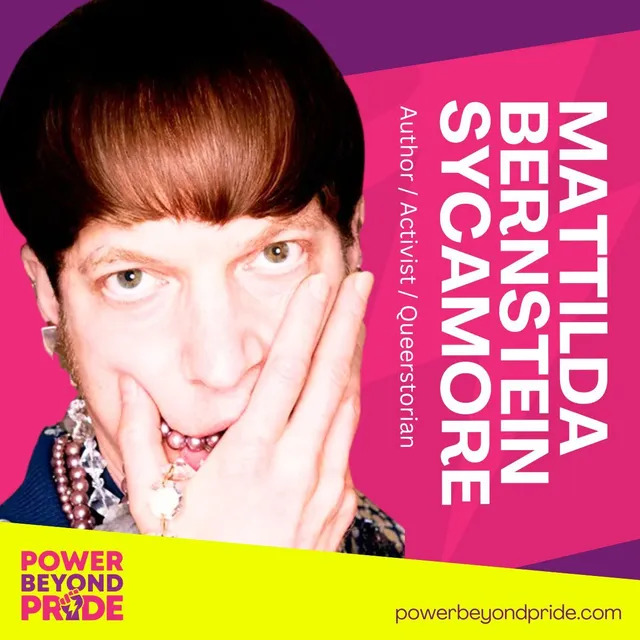
Storytelling, Provocation, and Radical Resistance with Mattilda Bernstein Sycamore
Listen or watch
In this episode
In this episode, co-host team members Mattie Bynum and Shane Lukas talk with The New York Times-lauded author Mattilda Bernstein Sycamore about the "urgency" of queer storytelling and the importance of refusing the terms of dominant culture. Mattilda describes their process of meshing fiction with historical reality to capture the "spectacular intimacy" of queer life in the 1980s and 90s.They share how their early experiences with sex work and the AIDS crisis shaped their commitment to "experimental" writing and vulnerability plus shares insights into their most recent critically-celebrated book 'Terry Dactyl'.
TranscriptRead the conversationAbout 52 minutes to read · 7,749 words · Mattilda Bernstein Sycamore, Shane Lukas, Mattie BynumOpen
- Mattilda Bernstein Sycamore
- The mainstreaming of, um, the so called lgbt. And sometimes they put the Q on, they might put on some other letters, but it's still very centered in this very normative idea of assimilation into straight privilege at any cost. And the cost always is that the people who are most marginalized in everyday experience, those experiences always get pushed to the side unless it's for a fundraising. And so I think that mainstream streaming has really marginalized the people who are most marginalized rather than bringing them in or creating access.
- Shane Lukas
- Hello and welcome to Power Beyond Pride, a weekly queer change making podcast bringing you voices and ideas from across our fierce and fabulous spectrum to transform our world. I'm Shane Lukas. I'm a lifelong harm reductionist, owner of a great idea, and a very proud Leo. Yes, I am. I'm bringing all the girl with me today, along with my amazing co host.
- Mattie Bynum
- Well, if that's the case. And I'm also a Leo as well. So in all, um, my kingdom that I sit on my throne, I am Mattie Bynum, the other co host, the loudest one in the room at all times. Uh, whether I am laughing, singing, or just standing still, I am always a conversational piece. I love it. And we want to thank you for joining us on Queer Cast Journey today. On today's episode, our guest is a New York Times Editor's Choice author, one of Oprah Magazine's best LGBTQ authors of 2020. Mattilda Bernstein Sycamore has penned numerous publications. They are the creator of Lost Missing and has been actively on the forefront as a powerful activist for the LGBTQ community for many, many years. And they are celebrating the launch of their latest work. Terry Bactel, welcome and we thank you for being here with us today. Ms. Mattilda, how are you doing?
- Mattilda Bernstein Sycamore
- Thank you so much. It's great to be here.
- Shane Lukas
- Wonderful, wonderful, wonderful to have you here, Mattilda. And, uh, again, it means a lot for you to join us here on Power Beyond Pride because confession. I was lucky enough to design one of your earliest book covers for Pulling Taffy. So I've known for years how your intense imagery, your honest storytelling about club culture and nightlife and uh, you done with such heartbreaking authenticity. Right, but this is your hundredth book, right? Am I right? What number of book is this?
- Mattilda Bernstein Sycamore
- Well, I have, this will be. I have seven books and then I also have six anthologies. So if you count them together, it'd be like 13. But, uh, it's also my fourth novel because then I have three nonfiction titles and then all the anthologies are nonfiction.
- Mattie Bynum
- That was so much writing.
- Shane Lukas
- Like, how are you constantly uncovering unique and new ways to talk about queer culture? Like, how do you do that?
- Mattilda Bernstein Sycamore
- Well, I think for me, writing is the way that I stay alive. It's how I process the world around me. It's how I articulate things in as nuanced and vulnerable and intimate a way as possible. And it's also how there's something I feel like I need to say, but I can't say it because I might die. You know that you. When you have that panic, that's when I have to write it down, and then I can say it and I don't die. So for me, writing is always the way that I've been able to survive. And so because of that, I am always thinking about or attempting different methods and different strategies for, uh, bringing things out. And it is intimate and explosive and hopefully transcendent way as possible.
- Mattie Bynum
- Well, that's beautiful. I think that writing. Well, art itself is a lifeline, so definitely. And I agree with you on that one. Now, your particular art is interesting because the life that you live has clearly informed your art with joy, the grit, the lessons that you have been through in life. So could you give us a few moments and just tell us how has your journey throughout life itself helped to shape the stories that you tell? And how have you become the person that you are today?
- Mattilda Bernstein Sycamore
- Absolutely, yeah. When I was a teenager, I was a poet, and then I discovered language poetry. And language poetry is when you basically condense everything that's ever happened into 12 words on the page. So that's how I became a really good editor, by cutting, cutting, cutting, cutting. And then when I was 19, I started turning tricks for a living. And my friend. I tell my friends these stories, and they're like, matilda, you have to write those stories down. And I was like, well, I don't ever want to write those stories because I'm trying to change language. I felt like this, uh, because language poetry is very pure. It has a puritanism to it. And. But I was like, wait a second. I believe in experimentation. I'm an experimental writer. Let me just try it out. So I started. I wrote one of those stories. I think it was about my fifth trick. And. And then I was like, wait a second. This is really interesting. And so then, uh, that was when I, like, brought voice back in and voice became the central thing. So it really did start there with sex work, which. Because also, sex work was how I was supporting myself so that I could be. So that I could have my creative life. Right. And Live as close to my own terms as possible. Now, of course, it wasn't on my own terms when I was training tricks, unfortunately. But, you know, in general, I didn't have to have a job that was wearing me out so much that I couldn't do activism or couldn't write or couldn't create kind of wild alternatives to the status quo in my own relationship. And so. So I think it really started there. And I think also with my anthologies. Each one is kind of an intervention in, uh, this sort of political moment to kind of bring the conversations that I've been engaging with other people, whether it's about sex work or about surviving sexual abuse or about assimilationist trends in queer politics or about conformist gender norms or about the AIDS crisis. So then my anthology sort of became a way to bring my sort of skills as an activist and an organizer into a writing realm. And then in my writing itself, I think before, I was talking about vulnerability, and I think that's something I'm really drawn to because as a child and a teenager and a young adult, invulnerability is what saved me, right? Because I'm walking down the street and people are telling me they want to kill me. I might get thrown against a wall. I might. These things are just everyday experiences, and I had to be project invulnerability. But for me now, several decades later, it's not that those things don't happen still on the street, but I do feel like vulnerability is what will save me and what will connect me with other queers, with other people who share similar experiences and also what people can connect with on the page so that it feels like a full experience of the world and not something that's being explicated or toned down in order to find some narrow, different definition of accessibility.
- Shane Lukas
- Uh, it's beautiful that you talk about, especially vulnerability, I think, is so powerful because, again, it's in that authenticity. And you've written for years around your experience of sex work. And obviously it's one of the places you and I have known each other over the years. You were one of the first interviews at Hook, which was a program I ran for men in the industry many years ago. You've also written an incredible anthology around sex work. And one thing that I think about with your writing is it's so provocative, right? It's provocative around sex work. It's provocative around substance use, provocative around experience. Do you feel like in your activism and the way that you think about your writing as activism, that provocation is one of the things missing from the current queer movement.
- Mattilda Bernstein Sycamore
- Oh, yeah, that's a great question. Yes. I mean, definitely the sort of mainstreaming of the so called lgbt. And sometimes they put the Q on, they might put on some other letters, but it's still very centered in this very normative idea of assimilation into straight privilege at any cost. And the cost always is that the people who are most marginalized in everyday experience, whether that be trans people, whether that be youth, whether that be seniors, people living on the streets, migrants, people are in prison, those experiences always get pushed to the side unless it's for a fundraising letter. And so I think that mainstreaming has really marginalized the people who are most marginalized, rather than bringing them in or creating access. And so, so I think, for me, I think activism is both separate from and connected to my writing and my editing. Right. So there is the activism. Yeah. Uh, because direct action activism is really where, say at the same time as I started writing these stories when I was like 19, I was part of ACT up in San Francisco and then a bunch of other different direct action experiments like Fed Up Queers in New York or Gay Shame later. But all of my activism has been outside of, uh, the centers of power and also outside of a nonprofit industrial complex. So. So it really comes from. And I feel like that's where, that's where, like you mentioned sex work and drug use. These are things that come back into my work over and over again, even though right now I'm not turning tricks and not doing drugs. But like Pterodactyl, for example, it opens on the dance floor at the limelight in 1991. And you're just in this world, right? You're just enmeshed in this, like, transgressive and over the top and desperate and also flamboyant and full of pageantry. And. And so for me, that enmeshment or that layering that experience of everything happening at once, that's what I'm always trying to get in my writing.
- Mattie Bynum
- I love that, Anir, I love that you're able to mesh and layer those things, because a good book brings fiction to reality and makes reality seem to be fiction from time to time. So I love that about your writing style, and I definitely want to continue on that same topic in asking you, how do you so seamlessly mesh together fictional, uh, creativity of worlds that we can envision, but you can always intersect and bring in the real stories of history of HIV crisis and the AIDS activism work and sex work. So how is that a hard thing? One or. And also, how do you create that?
- Mattilda Bernstein Sycamore
- Oh, that's a great question. Thank you so much. Well, I think I. In a way, I'm doing both at the same time, but I also do them separately. So, for example, to take Terry Doctal is a trans girl who grows up in Seattle. She's raised by lesbian mothers. They're party girls. Their, uh, house is always filled with all these queens. So when she's a little child, these are kind of like her role models. And then when she's 10, 11, 12, all of those queens start dying of AIDS. And so that's her for her formation. And in a way that came in some ways from my experience. Although I grew up in a world with no queers around, zero, There was no possibility to be queer, you know, but I have the same generational experience. So I wanted to imagine, well, what happens if you did grow up in that world? There are not that many 10, 11, 12 year olds who did grow up in that world in the 80s, but here is someone who did, and then you lose it all. And so how does that trauma impact you now? In one of my anthologies, Between Certain Death and a Possible Future, which is 32 different contributors addressing that same question. So it's not the generation that we're usually. We usually see, like, that's the generation that grew up with sexual liberation and experienced it and then watched as all their friends died of a mysterious disease as the government did nothing to intervene. Now, this is the next generation. We grew up with that death as part of our desire.
- Mattie Bynum
- Right?
- Mattilda Bernstein Sycamore
- We were like 10, 11, 12 when we finally first knew about AIDS. Right. It was part of becoming queer. And so that generational experience, I think, has. Is always informing my work and in the writing itself. So it's interesting. So in nonfiction, for me, it's not necessarily about. So I guess all my work is hybrid, right? So it has aspects of fiction, nonfiction, everything, Right. So when Terry Dax was on the dance floor at the limelight in 1991, that's not me, but I was on the dance floor at the limelight in 191 a few times. But. But so. So each thing kind of interweaves. And I think when I'm writing a book, I don't know necessarily when I start whether it's fiction or nonfiction. I just know I have to write something down, and I just start with it, and then I go where the vulnerability is. So it's that key again. And where. And also I want it to be on the terms of the characters. So in terms. In case of Pterodactyl, which is a novel. It is on her terms and in m. Her world. And then the reader just has to, like, decide what to do. The reader, and hopefully continues reading. Right. Hopefully is enthralled by. By this kind of spectacular intimacy and engaged in a way that kind of opens up the possibility for a more embodied experience.
- Mattie Bynum
- Um, I was going to say you said the key thing just now, and I love this is what makes your stories so touching and so poignant with everybody, is you don't start out writing a nonfiction or a fiction. You start the story and then let the story itself develop. And I think that's beautiful because when we start reading, I don't start reading a nonfiction because it's nonfiction. I find the similarities in the nonfiction of my life. So I can relate to the character. So I appreciate that. Thank you.
- Mattilda Bernstein Sycamore
- Thank you.
- Shane Lukas
- I love that. No, I love this. And we're going to take a quick break, but when we come back, Mattilda, I have, uh, a couple of questions. I want to dig a little bit more into what you shared, especially around urgency. And so everyone stick, stick with us for this episode of Power Beyond Pride. We are in a, uh, conversation with the phenomenal author, activist, just someone I'm grateful, um, to have across our communities doing incredible work. Mattilda Bernstein Sycamore. Welcome back. This is Power Beyond Pride, a queer change making podcast. And I'm Shane Lukas here with my phenomenal, gorgeous belle of the ball, if you will, Mattie Bynum as my co host. And we are, we have our. As a guest, Mattilda Bernstein Sycamore, author of Terry Dactyl, which just hit the shelves and really just, uh, an incredible career of books that are just, uh. I come back to the word urgent. And I think something that you said earlier, Mattilda, that was really powerful to me in the first segment is you really talked about what it meant to have this intensity, to have to write this down. I have to write this down. This is the thing that is fueling my existence. And if I don't put it on the page, I'm curious, as somebody else who similarly grew up and also came to activism at a pretty young age, whether or not that's something that's also influenced by your own story of both coming out in an era that was in the midst of the crisis as. And of the HIV crisis, as well as just something of that time that was pre will and grace. Right? There's just a sense of urgency, uh, a sense that we may not have as long of lives as we thought we were going to have. And I'm curious if you could speak to that a little bit, if some of that urgency comes from this sense of, hey, uh. Because I just turned 50 last year. And it was something that really, in conversations with people, they'd be like, happy birthday. And I'm like, I really didn't think I'd be here. I didn't really think this was going to happen for me. Not for any particular specific reason. There were different people I'd lost over the years. But this idea of urgency just really felt very poignant in what you shared, because it was something I thought of in my early years of activism.
- Mattilda Bernstein Sycamore
- Yeah, absolutely. Yeah. I mean, I think as a kid, like, I was the first time I ever heard of a gay person in the world. It was Rock Hudson dying on the front cover of the Inquiry. So gay and AIDS were intertwined. When I first started thinking about sex, I was, like, afraid that I might get AIDS from my own comp. And while I had sexual education and I knew that wasn't technically possible, I still was afraid, right? So that fear and that fear of an. Almost like a certainty of early death. Because when I moved to San Francisco when I was 19, that was in 1991, 1992, everywhere, people were dying of, uh, AIDS, of drug addiction, of suicide. And that death was part of what it meant to become queer in that moment. And so I think you're right. That. And also there were a lot of artists, artists, performers who were dying of AIDS or had just died of aids. And those were the people who in some ways became where I found role models of a certain kind, but they were role models who were all dying or had just died. And so, like, when I found David Wojnarowicz's work, um, at that same time period, and I literally read about him in a piece that was right after he died. And so that sense of loss and that sense of communal possibility were intertwined and. And being a part of Act UP when I was 19 and finding a kind of culture of politicizing sexuality and refusing the violence of the status quo, of government inaction, of structural, familial, societal homophobia, and. And deciding to exist in our own as much as possible, creating our alternative to that violence that we grew up with, right. So I grew up in an upper middle class, Jewish assimilated family, but it was like, deeply homophobic. And there was like, no. And also I was sexually abused by my father. And. And so for me, becoming queer, part of becoming queer has always meant refusing everything about how I was raised. And I think that is a generational. A particular generational perspective that does come from the AIDS crisis and also from that intense moment of, um, you know, societal homophobia and. Brutality, really, where dominant culture was more than happy to see, like, all these faggots and drug addicts and trans people like Divade, so, like, get rid of them right now. And people literally say that this was, like politics. Now, we still have aspects of that, but that particular moment, I think, um, in terms of the AIDS crisis, is a generational experience that I think. I think it has been. I think, in a way, once we developed drugs that actually extended people's lives. Starting around 1996, HIV and AIDS were kind of pushed under the rug. There are still people dying of AIDS in this country, even in the wealthiest gay neighborhood. So you go to the West Village, and you still see people on the street literally dying of aids. And those are the people who have been pushed to the margin. Right? So that, again, is, like queer youth is trans people, is people who might technically have access to medication, but if they don't have housing, if they don't have a way to make a living, if they don't have food on the table, like, does that really enable them to have a way to survive? And so I think it's a continuing legacy that is ongoing in our current moment as well.
- Mattie Bynum
- I like that. I like how you drew that conclusion. I, uh, mean that narration together now, also, too, currently in our political system. I will say that free speech is under attack. I'm trying to think of the best way to try to say this, the best way, because I think the voice that you have and the narrative that you bring to the table is very important, because a lot of young people, and I'll say this to make my point, a lot of younger LGBTQ may not understand the understanding and the meaning of life that, uh, older gay members of the community have because they grew up during the 90s. They grew up during the HIV and the AIDS crisis. Not saying it's not a tax on community now, but that narrative is so beautiful and so important for generations to come to have. How do you feel about right now with books being banned and being burned, rice being rolled back, voices are being silenced because they may make a comment that somebody else may not like, but at the same time, there's this powerful wave of resistance and creation coming from our queer community. So when you look at all of that, what would you like to see this administration to do differently or do better for the LGBTQ people and to keep that voice alive.
- Mattilda Bernstein Sycamore
- Yeah. Thank you. Well, unfortunately, this administration, the only thing they could do, uh, to do better is to resign. All of them, all of them must go. There's nothing they're going to do to support queer trans lives on the margin ever. Uh, now, unfortunately, there are some very scary gays who are in that administration, right? And that is the nightmare of assimilation right there. You have someone like Peter Thiel, I just realized, is gay, right? You have a gay Secretary of the Treasury. You have these, these scary gays that.
- Shane Lukas
- Are like, Barry Weiss just got announced to take over. I think it was ABC or one, at least one of the networks. And Barry Weiss. Oh, yeah, we have.
- Mattilda Bernstein Sycamore
- What's her name? Yeah, the, the person who started the Free Press is now the cbs, the director or the head of cbs. So we have these. That's the absolute nightmare. Those are people who have developed access by, um, pushing everyone else to the side. And that's saying it lightly. Right? And so, so I think we are in a very scary political moment, and I think the only way to resist is to refuse their term. Right? So. So I actually find, for example, when we see protests in Portland outside of ICE facilities and people are in these inflatable unicorn outfits and frogs and polar bears, like, that's one way to refuse their terms, right? Like, they are still, like firing tear gas at people every night. They're still arresting and deporting people. But I think there's a way to take a kind of pageantry and refuse those terms. And also I think the ways that people are creating mutual aid networks and ways to support one another. But I think the unfortunately dominant institutions of power, that it's never been clearer that they have no interest in supporting really anyone. I mean, that's how bad it is right now. So. So I think that there's no real hope in getting Trump to change his tune unless we can somehow just get rid of him entirely.
- Shane Lukas
- Well, that kind of pushes me to another question then, Mattilda, because again, with your experience, both as an, as a grassroots organizer as well as a creator right in this current moment, as. And as well as somebody who obviously with a career that has gotten enormous notoriety, a lot of respect. Like, when you think about other people who are leading in the movement, and I'm thinking about people who are taking positions of power. So you have your Peter Thiels and Barry Weiss's who are obviously, they're people in those industries doing that work and, and sometimes oftentimes counter productive to the advancements of rights, but you also have organizations Right. Within the nonprofit sector and queer sector that are being led by people of lived experience. But in some ways, even hearing you talk about coming out in San Francisco at a time where we lost enormous numbers of leaders and creative people and innovators and ideators and people who had the courage to step into the movements early on, right. Who had the courage to be in these spaces, were also a lot of the people that we lost in those eras. Do you feel like we're. We have a, uh, we have an absence of leadership in some cases at these higher levels, because all those individuals who were there early on, with some exceptions, obviously, people like Peter Staley and other people who are. Again, we've continued to try to carry on a lot of that work in different ways, but, you know, they're a rarity in many of these conversations. And so we don't have many of those individuals left from that early, courageous days. Do you feel like the absence of that is also one of the things we're contending with within our own movements?
- Mattilda Bernstein Sycamore
- I think, for me, the problem is more that people have believed too much in these systems of power. M. They. So they have internalized the mindset, right. That the only way to change something is, let's say, within a, uh, very normative. Let's say, like, married, gay, serving in the military. I mean, what could be worse than serving in the military? Right? That's where the movement has failed us. I think if they were saying nothing could be worse, going abroad and killing people and getting away with it, like, nothing could be worse. So a, uh, queer movement at its initiation, at the very least, has to be anti military, right? If we got rid of the military in the country, this country, we would have access to the resources to fund everything we've ever dreamed of. Like, everything just immediately, like, universal healthcare would be like, okay, boom, done. You know what I mean? Like, safe houses for queer kids to escape abusive, um, homes. One second. Universal access to every kind of health care or food or sex life that matters. All of it. It all just becomes. And I think so. I think that, for me, is the real problem that this mainstream LGBT movement is so centered around. And in some ways, it gets worse. Like, we had gays in the military in the early 90s. Now, that was very formative, because for me, because in 1993, there was the March on Washington. For then it was just, I think, lesbian, gay, and bisexual rights, because they hadn't on the acronym yet. And I went with ACT up, and we were doing, uh, civil disobedience. For universal health care. We thought we were going to get, like, hundreds, if not thousands of people to join us because there were a million people this march right now. I think we had something like 43 people or something, Right? So it was a small civil disobedience. It didn't get very much attention. Meanwhile, the whole march was around repealing the ban on openly gay members of the military. Right. And so data. And this is in a moment where so many people have lost so entire circles of friends to the AIDS crisis, and universal health care was almost a mainstream issue. There were people like Hillary Clinton were talking, like, that's how mainstream it was. She was like, I'm going to create a plan. Now, obviously, she never did that. But I think if in that moment, universal health care had become the central issue of the LGBT movement, or in that moment, the LGB movement, then we would be so much further along. But as long as the movement is in thrall of, uh, dominant institutions of power, the military being the most obvious, but also things like hate crimes legislation. Let's give the cops more money, like, to fight hate crimes. Okay? But that's not what the cops do.
- Mattie Bynum
- Hello.
- Mattilda Bernstein Sycamore
- And so I think access to benefits through marriage, but not access to benefits if you're not married. So these that, to me, that hypocrisy and that abandonment, you know, it just goes on and on. You know, when they were like, oh, we got that gaze in the military thing, and then suddenly they're like, oh, wait, now, what about trans people in the military? It's like a satire, you know what I mean? Like, there are so many trans people, people who cannot. They can't live in the, uh, their families of origin in the cities where they grew up. They are still, like, brutalized on the street, martyred in broad daylight. And people are like, well, what do trans people need? It's not joining the military. You know what I mean? It's like ending the military so we can actually access the things that will change people's lives when.
- Shane Lukas
- I love you sharing that, too, because you're not just obviously. Uh, I think it's an incredible perspective to say, hey, look, were these the fights that we needed to have? And as activists, as queer people, obviously we live intersectionally. So there are queer people who work in climate movements, housing movements, employment movements, all kinds of movements, but really thinking about what is the most efficient use of our efforts and are we reinforcing existing systems? And I want to call out, too, that you're working on an ACT UP anthology now, right? You're working on, you're starting work on a piece really chronicling the power of ACT up, is that correct?
- Mattilda Bernstein Sycamore
- Yes, yeah. So I'm working on a new anthology. It's called ACT up, uh, Beyond New York Stories and Strategies from a Movement to End the AIDS Crisis. So basically what I want to do with the anthology is because the more I think, I think ACT UP New York, which was the first chapter, it started in 1987 in New York. ACT of New York in many ways has become Canada. And there are books and movies about it. Um, but ACT up actually there were almost 150 chapters. So there was Act Up Shreveport, Act Up Milwaukee, there was Act Up Natchitoches, Louisiana, there was Act Up Miami, ACT Up Memphis, and ACT Up Paris. And so all of the, uh, paradoxically, the more attention there is on ACT of New York, it doesn't filter down and people don't realize, oh, wait a second, so let's say someone is growing up in a Natchitoches, Louisiana, they, and they hear about ACT UP New York, does that inspire them to be able to do something in Natchitoches, I don't know, or Shreveport? And also this sort of, the struggles that people faced in these different environments were very different. So in Shreveport people were fighting David Duke and the kkk. In Milwaukee, they were organizing in the shadow of Jeffrey Dahmer's murders of gay black men and, and also of radical, uh, anti abortion organizing. And so, so for me, what I want to do with this anthology is to bring this really wide range of experiences, whether it's ACT Up Los Angeles or ACT Up Atlanta or ACT Up Evansville, Indiana. And uh, because there were, it was actually a national and international movement and it was decentralized and there were, each chapter was entirely autonomous. And one of the things, once I started circulating the call for submissions, and by the way, if anyone's listening, the call for submissions is open right now for anyone who was involved in any chapter. You can just look on my website, it's there. And but one of the things that happened soon after I came up with the proposal and started circulating the call for submissions in this second Trump term, there are new ACT UP chapters, um, that have just emerged. So there's a new chapter in Pittsburgh, there's a new chapter in Cleveland, there's a new chapter in Boston. And so, so that's really interesting. Right. And so that's, those are people who are seeing the first wave of ACT up, uh, and how people were responding to another right wing administration in Fact, the one that coined Make America Great Again, that was a slogan from Reagan and are thinking, oh, maybe these tactics can help us now in how we fight for resources for the AIDS crisis and beyond. Because some of these chapters are also engaged in these new chapters in fights over trans healthcare. And so it's a, and in earlier wave of ACT up, uh, that wasn't ne, that wasn't something that was public in such a sense. And so no, that's a really exciting thing that I did not expect when I started circulating this call for submission. So I'm really excited to bring about, uh, because for me, an anthology is a conversation. It's like creating a conversation that might be happening but isn't necessarily public and bringing it into the public sphere to hopefully, in this case, one thing is it's a historical corrective, but also it's a way to look at past and present activist strategies in different locales and the very specificity of whether it's in a small town or a larger city, whether it's in the Deep south or the east coast or the Midwest or the west coast, or whether it's in Paris, in another country or in the uk. So putting that all together to see what conversations emerge.
- Mattie Bynum
- Most definitely. Most definitely. I think that is a very good way of bringing it all together so that we can have one particular conversation. At this moment. I do caution people, please stay, do not leave. We do have to take a quick break real quick so we can sit down and have a private conversation with. No, I'm just joking now. Anything we talk about will be discussed on the show. But yeah, we'll be back with Power Beyond Pride in just a few moments.
- Shane Lukas
- Welcome back to Power Beyond Pride. And I am Shane Lukas. I'm here with my amazing co host, Mattie Bynum. Um, and we are interviewing and spending time with author, creator, activist. You know, I, I, I run out of words when I think about all the different impacts that Mattilda Bernstein Sycamore has.
- Mattie Bynum
- I have a great powerful Oz in a way, because I mean, what to use to describe this beautiful being of, uh, creativity and love and knowledge and.
- Shane Lukas
- Figurativeness like. Language guide, storyteller. I guess we could go with all of those as all being true again, story sharer, I think in many ways, both in their fiction and non fiction work. But now we want to get to know Mattilda a little bit more. So we're gonna engage in our speed round. And Mattilda, are you ready for a speed round where we ask you questions and you can't think about the answers you're ready. Ready to go at all?
- Mattilda Bernstein Sycamore
- Not at all.
- Mattie Bynum
- Everybody won't think about it. And then they do the same thing. They stop and look up. All right, so the first question Mattilda's going to be, what's a guilty pleasure? You're not so guilty about.
- Mattilda Bernstein Sycamore
- Oh, taking naps in the sun in the park.
- Mattie Bynum
- Yes.
- Mattilda Bernstein Sycamore
- Oh. Or maybe it's a guilty pleasure having sex in the park. There we go.
- Mattie Bynum
- Not guilty about that.
- Mattilda Bernstein Sycamore
- Uh, not guilty about that. We'll go with both.
- Shane Lukas
- And I think it absolutely works. Speaking of, do you prefer giving gifts or receiving them?
- Mattilda Bernstein Sycamore
- Oh, let's say I'll take both. I'll take both. Okay.
- Shane Lukas
- We appreciate versatility.
- Mattie Bynum
- Here it is. It takes a good art form to be able to give and receive equally. Just as great. So that is a good art form to have. What's one thing you need to start your day? Coffee chaos or quietness?
- Mattilda Bernstein Sycamore
- Oh, I think quietness because I get up and I have to take a bath and pass out in the bath just to recover from that supposed sleep that I had.
- Shane Lukas
- Oh, uh, that is. That sounds like a very. Okay, so now I have to ask. Do you remember any of your dreams?
- Mattilda Bernstein Sycamore
- I do sometimes remember my dreams, but often I think I'm going to remember them, and then they're gone. As soon as I try to access.
- Shane Lukas
- Them again, I feel like. I feel like her dreams would be really vivid.
- Mattilda Bernstein Sycamore
- Oh, vivid. I have vivid dreams, but it doesn't mean that they don't disappear fast because I'm like, oh, that one was so vivid. There's no way I'll forget that. And then, like, 20 minutes later. What was that dream?
- Mattie Bynum
- No clue. Yes.
- Shane Lukas
- Well, all I know is if your life had a soundtrack, and I feel like your life should have a soundtrack. What do you think your entrance song would be?
- Mattilda Bernstein Sycamore
- Oh. Brighter Days by Kashmir.
- Shane Lukas
- Ooh, nice.
- Mattie Bynum
- Good one. Good one. What's the specific challenge you've overcome in your advocacy work?
- Mattilda Bernstein Sycamore
- I don't know if I've overcome my challenges. Let me think. Overcome in my advocacy work. Oh, that's such a good question. I have to think about. Well, I guess overcome the world that I grew up in. Right. That told me that I should either die or disappear. And I think figured out a way to. To refuse those terms, because I think that's what I'm always trying to do when I talk to other people, too, is we don't have to think on the terms of the dominant culture that doesn't believe that we even deserve to live. Right. So. So I think rejecting love, that love.
- Shane Lukas
- That who's one person, living or gone, you'd love to sit down with?
- Mattilda Bernstein Sycamore
- Well, the first two people I thought of are gone. So. David Woic, Ms. Major. That would be a fun conversation, the two of them together. So, yeah, yeah, we do want to.
- Shane Lukas
- Take a woman on her. Ms. Major, we just, uh, she just recently passed, so we certainly appreciate her or her guidance. Was there any moment in Ms. Major's, like, her story that really speaks to you?
- Mattilda Bernstein Sycamore
- Oh, I just love how she was constantly. I mean, she's an example of someone who was constantly, like, reinventing herself and thinking about trans existence in a way that was totally refusing dominant culture norms, totally refusing them, and inspiring, like generations of trans girls to live their lives on their own terms. And also she's always focused on the most marginalized, like trans women in prison, you know, and how to help other girls to, to live a full life on their own.
- Mattie Bynum
- Before I move on to the next one, I, ah, saw a video quote of her this past week that she had did interview. And it was like she said, I never considered myself an activist. I just knew I always dared to be different and I want other people to feel be different. And I think that's a beautiful quote to live as an activist period in this movement because sometimes activism, uh, can get us down. But I love how she was just like, I was just being different, just being herself. So, uh, love that. Love that. So I would say finish this sentence for me writing. Terry Dactyl taught me blank how to live. Oh, okay.
- Shane Lukas
- If you could teleport anywhere in the world for dinner tonight, where would you go and with whom? We'll set a table for you if it happens to be here.
- Mattilda Bernstein Sycamore
- We're gonna go for dinner. I'm not sure. Well, I don't actually. I mean, this is gonna sound really boring, but I love. There's some really good vegan restaurants in la, so I think I would teleport myself to one of those. Outdoor seating, please. During this ongoing pandemic. Good place for outdoor seating. And I think I would have a table with 20 or 30 of my friends.
- Shane Lukas
- Okay, sounds like a great.
- Mattie Bynum
- What's the quote, uh, or mantra you live by?
- Mattilda Bernstein Sycamore
- Oh, do feelings lose their feeling if they speak to a lack of feeling? Claudia Rankin.
- Shane Lukas
- Uh-huh. Can you repeat that one more time? And we will. I want to soak that.
- Mattilda Bernstein Sycamore
- Do feelings lose their feeling if they speak to a lack of feeling?
- Shane Lukas
- I'm gonna have to sit with that one. I'm gonna have to sit with that one. I love it. I have to Sit with it.
- Mattie Bynum
- Yeah, that's a good one.
- Shane Lukas
- That's a really, that's a really great one. Well, now I want to know, here's my last question for you is what does power beyond pride mean to you?
- Mattilda Bernstein Sycamore
- I think power beyond pride means refusing the terms of the dominant culture and invoking the original, uh, power which was fighting against police and state control over queer bodies and lives and building ways of living with, taking care of, lusting for and nourishing one another that are not predicated on any dominant institutions of oppression so that we can create gender, sexual, social and political self determination for everyone.
- Shane Lukas
- Beautiful. I'm going to put that, I'm going to cross stitch that and I'm going to cross stitch somewhere. I think that's brilliant and it's other. Where can people find out more about your work?
- Mattilda Bernstein Sycamore
- Um, so I have a website, it's just my full name dot com, so Mattilda Bernstein sycamore.com that has. I'm going to be on a book tour for Terry Doctyl. So if you're in Seattle, Portland, New York, D.C. or Baltimore, I'll be there. And there's more information about my books and different things there too.
- Shane Lukas
- Well, because you have more books to come, so if you don't, there's a pterodactyl tour. But I have no doubt we have so much more to hear from you, which again, we could not be luckier as a movement, as a community, just as simply a human being alive at this time to be able to again have access to your novels, your anthologies and your work. So again, thank you so much for being here today, spending time on this podcast and we hope you'll join us again.
- Mattilda Bernstein Sycamore
- Thank you so much. It's been such a pleasure to be here and thank you for your amazing questions and also just your warm sense of, uh, care and camaraderie. I really appreciate it, always.
- Mattie Bynum
- Always. And so I just, I would guess I would. My last words to you today would be to just continue being the beautiful essence of a person that you are. I love it. I, uh, love it. I thank you for imprinting on my life today, Mattilda. Uh, so I am Mattie Bynum, comedian, actress, and always the loudest person in the room, regardless if I'm speaking or not, because I just am that girl. And you can follow me on maddystavone737 and Instagram Mattie Bynum at Facebook. And like I always say at the end of these shows now I do have a TikTok, but I only have five videos, so if you want to go watch the five videos? It's maddysimone737 I think as well.
- Shane Lukas
- And I am your other co host Shane Lukas. He him is and I'm a uh, lifelong harm reductionist, owner of a great idea and uh, and also the person who's been watching Mattie's videos at least 50 or so many times. So I can try to get those numbers up on TikTok. Remember to subscribe and actually oh and also you can find me at shaneLukas.com, a great idea.com, any place any of those are around as well as through the Power Beyond Pride channels. Remember to subscribe and get your friends to subscribe to Power Beyond Pride on Spotify, Apple Podcasts or wherever you get your podcasts and and check out our site@powerbeyondpride.com and how beyond Pride is a.
- Mattie Bynum
- Project from A Great Idea, a queer owned design and content agency. Learn more about them at a great idea. Com.
- Shane Lukas
- This episode is produced by Shane Lukas. That'd uh, be me. And Mattie Bynum is the project developer. That'd be her. And our editor is Jarrett Redding.
- Mattilda Bernstein Sycamore
- Hi Jarrett.
- Shane Lukas
- And support from Ian Wilson. Hi Ian.
- Mattie Bynum
- We are both part of uh, the podcast awesome hosting here. We will invite you to always please send in your questions and to Power Beyond Pride it is. We have not renamed it so if you happen to have caught our reply off we are still taking submissions for how we will call it either the Mailbag, the mail slot or if it's just going to be the place where your comments come.
- Shane Lukas
- But yes, I'm voting on mail slot. Check out new episodes each week where we have guests visit us like today with a wonderful Mattilda Bernstein sycamore. And every month we also do a play all episode where we tackle some of the top headlines and as well as other issues impacting activists. We look forward to queer change making with you this time, next time and in the future. Thank you from all of us at Power Beyond Pride.
Transcribed automatically and lightly checked. If something is wrong — a name especially — tell us and we will fix it.
Episode #33
Storytelling, Provocation, and Radical Resistance with Mattilda Bernstein Sycamore