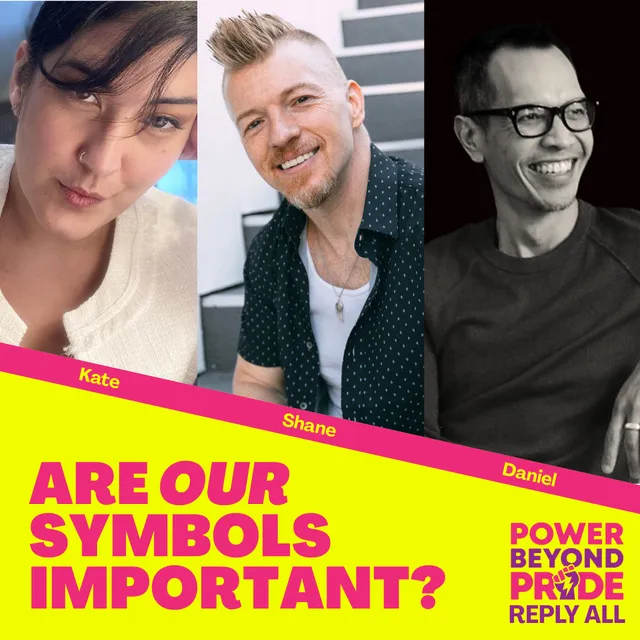
This monthly Reply All episode features hosts Kate d’Adamo, Daniel Lee, and Shane Lukas discussing the balance between symbolic activism (such as rainbow crosswalks and murals) and material policy change, prompted by the attempted removal of the Montrose (Houston) crosswalks. They explore whether a focus on symbols can overshadow more consequential political work. The hosts also critique tokenized LGBTQ+ leaders, specifically addressing figures like Bari Weiss, arguing that representation only matters if it is grounded in shared values and not just identity politics. Finally, they take audience questions and offer advice on how to vet potential sponsors and prioritize making a sustained, local impact in activist work.
There’s a lot of ways that we create culture. One of the consistent pillars, though, is symbols. Being able to see the symbols of what a culture values, considers safe, considers welcome. When we talk about things like rainbow crosswalks, they sound small and they’re absolutely not. They’re really just a visual way to demonstrate that people are welcome. We’re talking about symbols that seem really visual and seem outside of the realm of policy change and the kind of weightiness of that. But what we’re really talking about is, are you a community that is actually demonstrating who you want to feel safe and welcome? Or are you a community that wants people to know that they are not welcome in your space and you’re showing them without words exactly how true that is? Hello and welcome to Power Beyond Pride, a weekly queer changemaking podcast bringing you voices and ideas from across our fierce and fabulous spectrum to transform our world. And Kate, organizer, advocate, and aspiring vinyl girl.
Shane (00:00:57 –> 00:01:07):
I would definitely, you know what? I would stick around you if somebody were hunting me down. I am Shane Lukas, lifelong harm reductionist activist, owner of a great idea, and keeper of your lost socks.
Daniel (00:01:08 –> 00:01:36):
And I’m Daniel W. K. Lee, a poet, author, and a lizard that Katya burnt. Once a month, some of us Power Beyond Pride hosts gather in what we call a Reply All, where we focus on issues or questions impacting activists, share insights from our own work across communities, and take questions from the Power Beyond Pride mailbox. Or is it mail slot.
Shane (00:01:37 –> 00:02:05):
We haven’t decided yet. Okay, so listeners, this is a big conundrum for us. And so, Kate, if you haven’t, if you haven’t joined us in this conversation, we haven’t quite figured out if it’s a mailbag, mail slot, mail, like we haven’t figured out the language that feels right. But I was told that mailbag might not be the correct language. So we, we are still uncertain about what were our, we want to hear from our listeners, so we want to hear from all of you. And we just don’t know what to call it. Kate, do you have any ideas?
Kate (00:02:06 –> 00:02:07):
I’m always pro-sloth.
Shane (00:02:07 –> 00:02:09):
I’m feeling sloth-y today, so I think we’re all there.
Daniel (00:02:10 –> 00:02:26):
I think sloth’s really funny. I don’t– I didn’t– I’ve never heard of mailbag to be a euphemism for scrotum, which is where this all kind of started from Melody. I mean, of course I’ve heard tea bag, tea bag, but not mailbag.
Shane (00:02:26 –> 00:02:39):
Yeah, I’ve never heard of mailbag as that. I mean, I guess as an elder, I think of– maybe I’m thinking like 1940s, you had a postal worker, like running around with a bag of stuff. And I guess what I’m thinking of.
Daniel (00:02:39 –> 00:02:40):
Is a mail bag.
Shane (00:02:40 –> 00:02:42):
But yeah, I mean, I’m for mail slot.
Daniel (00:02:42 –> 00:02:46):
I mean, inbox or box?
Kate (00:02:46 –> 00:02:48):
I vote box. That’ll be your answer.
Shane (00:02:49 –> 00:02:51):
Is it just mail box or just box? Put it in our box.
Kate (00:02:52 –> 00:02:53):
Put it in a box.
Shane (00:02:53 –> 00:03:02):
Put it in our box. All right. All right. I think we’re workshopping this live. Okay, so here we go. We are on the mailbox. That’s a great way for us to kick off our reply all.
Kate (00:03:03 –> 00:03:05):
So, Daniel. What’s in your box?
Daniel (00:03:06 –> 00:03:08):
Many things. That’s a Pandora’s box, in fact.
Shane (00:03:10 –> 00:03:14):
Pandora’s box. When you open it, what falls out, Daniel?
Daniel (00:03:14 –> 00:03:26):
It’s kind of like the, oh, this is going to be a kind of a deep cut. Was it the Dungeons and Dragons cartoon back in the 80s where the little wizard kept on pulling things out of his hat? Yeah. And nothing was ever right. Oh, right.
Shane (00:03:27 –> 00:03:30):
Yeah, it was the funny sort of the comic relief of the group, right?
Daniel (00:03:30 –> 00:03:32):
Yeah. He was kind of the– so is.
Shane (00:03:32 –> 00:03:33):
That what’s coming out of your box?
Daniel (00:03:34 –> 00:03:35):
Yeah. You don’t know. It’s, yeah.
Shane (00:03:35 –> 00:03:37):
It’s a mystery box.
Daniel (00:03:37 –> 00:03:40):
It’s kind of, yeah. Kind of like Orko.
Shane (00:03:41 –> 00:03:41):
Yeah.
Daniel (00:03:41 –> 00:03:43):
Um, okay. Okay.
Shane (00:03:44 –> 00:03:48):
We’re going deep cuts into the 1980s and 90s now. I, I appreciate this.
Daniel (00:03:48 –> 00:03:49):
So, yes.
Shane (00:03:49 –> 00:03:53):
Those of you youngins listening to this, we do encourage you to Google fiercely.
Daniel (00:03:53 –> 00:04:11):
Yeah. Sorry if you were born in the fucking 80s. Actually not sorry that when you were born in the 80s, we got to enjoy the 80s because we were born just in like our late 70s or whatever. Well, I You just missed that on the best toys and maybe swallowable parts, but whoop-de-doo.
Shane (00:04:12 –> 00:04:14):
Yeah, I loved living on the edge when I was seven.
Daniel (00:04:15 –> 00:04:18):
Exactly. Latchkey kids and whatever.
Shane (00:04:19 –> 00:04:25):
Transformers were both more than meets the eye and also potentially my death now. So it’s really hard to know.
Daniel (00:04:25 –> 00:04:28):
Easy bake ovens that were also easy killer ovens.
Shane (00:04:28 –> 00:04:32):
I never thought about that. Those probably were really dangerous.
Daniel (00:04:32 –> 00:04:33):
They were.
Shane (00:04:33 –> 00:04:34):
Or I guess the pen.
Kate (00:04:34 –> 00:04:35):
-They only had a light bulb inside.
Daniel (00:04:36 –> 00:04:42):
-Yes. It’s very incandescent light bulb that actually got so hot that it could bake things.
Shane (00:04:42 –> 00:04:50):
-Yeah. -Now that I think about it, you’re right. -How did we survive those eras, I guess, in these… That’s crazy. I just realized that.
Daniel (00:04:51 –> 00:04:51):
Yeah.
Shane (00:04:51 –> 00:04:54):
Nope, you’re right. Fair enough. We were living dangerously at age seven.
Daniel (00:04:55 –> 00:05:00):
It was the last coughs of evolution. Because evolution is basically dead.
Shane (00:05:00 –> 00:05:02):
Evolution’s dead. That seems like 100 years ago.
Daniel (00:05:02 –> 00:05:47):
Yes. Oh, God. Okay. Let’s take a look at that. Moment here. Everyone should watch humans. It’s a documentary on PBS Nova and it’s a paleo, a paleo anthropology. And it talks about the kind of beginnings of humans and actually the host that she was on a, on a podcast and she basically argues that, and she, it’s not only her, but like that, that that evolutionary evolution is basically done. Because in, because technology and stuff have become interventions that take out the kind of niches and the survival of the fittest. So, you know, like people, we’ll run at this.
Shane (00:05:47 –> 00:05:50):
It’s hard not to make a little bit of a political run at this challenge.
Daniel (00:05:51 –> 00:06:12):
I mean, it’s a, that’s a different thing. This is architect, those are like a artificial architect or human culture, but if we were just out in the wild and I wear glasses and I’ve lost my glasses. My hunting skills to survive would not be so great. Like we’re out of that, like the pressures of like evolutionary biology. That’s basically is kind of the situation.
Shane (00:06:12 –> 00:06:19):
I disagree. I think we just find what’s in your mystery box, Daniel. We just pull out whatever’s in there. And whatever you trapped in there, whatever you trapped in there, we can hang in there.
Daniel (00:06:20 –> 00:06:28):
I wish there was a fucking winning lottery ticket. Dang, you know what I’m saying? Everyone would be coasting because I’m very generous. Well, I like it.
Shane (00:06:29 –> 00:06:36):
Speaking of the, slow or lack of evolution of things. Why don’t we talk about this first conversation topic?
Daniel (00:06:36 –> 00:06:37):
Oh, God. Yeah. Let’s talk about it.
Shane (00:06:37 –> 00:06:42):
Let’s dig into how American culture can possibly get more complicated. Daniel.
Daniel (00:06:43 –> 00:07:42):
Yeah. Let’s talk about devolution, right? God, I have to utter this person’s name, which makes me want to vomit in my own mouth. But Barry Weiss, Weiss technically reporting and art, art directorial positions have included skepticism about or critique of gender affirming care and her platform has sometimes featured voices opposing trans youth treatment. This creates tension within the LGBTQ community about solidarity, prioritization, rights, and what progress means, which kind of begs the question, what or how much does representation of LGPTQ classlu people and in leadership and leadership matter that leadership does not consistently support the full range of L G VTQ bus rights. Like for those who don’t know who Barry Weitweiss is, she is a youre.
Shane (00:07:42 –> 00:07:47):
Really we up German. You really just want to you want to ad to, like, a little bit of a it’s a little bit of.
Daniel (00:07:47 –> 00:07:47):
A mean what is it?
Shane (00:07:47 –> 00:07:49):
If you want to makes two and.
Daniel (00:07:49 –> 00:08:00):
Leave a mean and a She is a, a queer woman who is conservative headed the free things called the free press.
Shane (00:08:00 –> 00:08:29):
She considers herself independent, which I guess, I don’t know, what do you, like, you kind of got in there under the banner of independence when she did the free press. She was like, well, I’m going to start this thing. She was looking at the political climate and said, well, it’s not fair. And so she created this alternative avenue, like this alternative avenue is problematic. It’s, I guess, the best way to sort of suggest it. So I don’t know, like, I feel like counterculture has a space, but she kind of co-opted counterculture a little bit.
Daniel (00:08:29 –> 00:08:29):
Yeah.
Kate (00:08:29 –> 00:09:54):
I mean, I think this comes down to a question of, do you want meaningful leadership that’s grounded in values, or do you want a token who’s going to say the dumb shit and sign off for everyone else? Like, I don’t think there’s any confusion about why she’s popular. She’s popular because she comes in, she says, I hate pussy. Therefore, I get to be your tokenized person to make you feel better about your fear of progress, about your hatred towards trans people. And so I think this is a conversation about tokenization. And I think it’s a conversation about how shallow our politics are. If we say, cool, you think women are hot too. Therefore, you represent an entire ideology when she does it. And We’ve seen this before. Candace Owens exists. Clarence Thomas is still on the Supreme Court. And so there’s a phrase for this. There’s a phrase for what happens when people show up where they might have shared experience, but they definitely don’t have shared values. And so I think that’s a question of what is leadership? Is leadership just looking at someone and being like, cool, you also felt weird and uncomfortable growing up? That must mean something. Or is it about saying leadership is When you have a value structure that I want to be led by, and she doesn’t, because we’re also not talking about the fact she’s fucking racist.
Shane (00:09:55 –> 00:10:05):
Yeah, I mean, well, so, so many other players and I think, well, first of all, what phrase are you talking about? There’s a phrase, is there a phrase like a name for what you’re talking about? I have, I have a name for it, but I don’t know if you, do you have a name for it?
Kate (00:10:05 –> 00:10:08):
Yeah, it’s, you know, skinfolk and kinfolk.
Shane (00:10:08 –> 00:12:09):
Oh, okay. I call it ladder pulling, but like, I think that’s, yeah, I can see that too, because I think about ladder pulling is that they kind of benefit from this identity politic, they sort of get up, they get, they make the certain people feel better. And I think like in the question around interrogating what values are at the center of it, I think it’s also important to think about who they make feel better. Like at the end of the day, when this person is elevated into a leadership role, who feels better? Because to your point, this is not just limited to LGBT plus people, right? This is about women and the feminist movement. And we saw the rise of Phyllis Schlafly and we saw that, we saw the critique of her sort of trying to take down a lot of conversations around equity. And then we saw on the Reconstruction period, we saw a rise. It was the largest people, particularly black community members elected to office, but some of them actually were there because white people wanted somebody in there who would approve things like Jim Crow. And so there’s a real reason to be cautious about who gets elevated into power and particularly Barry Weiss. Daniel started to hint it and talked a little bit about their background. They have zero experience as a journalist. Like they’re a commentator. Like they’re not a facts person, they’re a feels person. And so that should scare us about them moving into this role. So they’re moving into ABC or CBS. I can’t remember which one it is. CBS. They’re moving in as the kind of editorial, and I don’t mean editorial meaning like opinion pieces, I mean editorial meaning like news, the person who oversees facts. And I’m like, well, that’s scary, right? That’s really very daunting because it takes any of the even critique critiquing objectivity, whatever subjectivity you can reduce in the newsroom. I mean, that’s just thrown out the window. And Fox certainly shows that. So it just, yeah, it’s scary. I just don’t like, I think at some level also that they’re a queer person and that this somehow is supposed to make us feel better. But I don’t feel, I mean, I.
Daniel (00:12:09 –> 00:14:26):
Mean, kind of back to the, this original question of does it matter? Does representation of LGBTQ people matter in positions of power? Like not in and of itself, right? It’s the most reductive and like lazy idea. Oh, we just need to install LGBTQ person and then they’re represented and their interests are represented, which of course is not the case. She does not represent a large swath of LGBTQ plus people’s interests. And like, I feel like we, in our best of our abilities, should marginalize her power. I mean, she obviously is the plat, she’s a platform. She controls a very large platform and stuff like that. But is she a leader? No, not to me. I don’t think to most of us. And so, I mean, I don’t want to continue talking about her as if she were consequential, even if she is. I don’t need to mention her. I don’t need to utter her name in any way to kind of talk about the things that I need to talk about. Meanwhile, she does the corporate media thing and platforms who she needs to platform. But for the most part, corporate media has failed us in so many ways. I don’t really know if they’re that germane to conversations that we need to have that are really kind of outside of the discussions that corporate media seems to want to have about us, right? Except for, I guess, inciting fear and violence, but of doing in terms of places and spaces that where people need to do the work, it’s not going to be at CBS, NBC, any of these places anyways. So yeah, I mean, she has got power, but We don’t need to think of the Barry Weisses of the world as leadership. Just as I don’t think of any other, what’s his name, in New York, Richie Torres, I don’t need these hacks, these opportunists, people just who are completely enamored by proximity to power to be leaders. God, I got to stop saying that, but I don’t need them to be leaders or pretend that they are leaders.
Shane (00:14:27 –> 00:15:49):
So I have a question around that though, right? Because you have somebody like Peter Thiel who funded the movement. You have, I mean, you know, again, you have these sort of wealthy folks. And it makes me think about, there’s a comment this week that Amy Comey, Cody Barrett, who’s on the Supreme Court, has said that she’s not interested in overturning gay marriage, which I think is interesting to me, right? Because they’ve overturned everything else. Now that doesn’t mean she’s not going to, and certainly vote to not turn. But I am interested in people, when we talk about teal and we talk about Weiss and we talk about these, and the person who’s in the Trump administration who’s gay, who’s a, I can’t remember his name, the finance guy. Are they also though at the same time kind of a wall to protect, and again, I say protect in a very limited context here, but to suggest that like they won’t go that final yard to essentially throw all queerness under. In this time because they have the money and the resources to hold it, because it would impact that. Barry Weiss probably doesn’t want to see her marriage dissolve. Peter Thiel, I don’t even know if he’s married or not, but people like that, the guy who’s in the Trump administration, he’s married. Are those the people who are holding that wall? Not that that’s the wall I want to live and die on, but is that possibly the benefit of them being in power?
Kate (00:15:49 –> 00:16:45):
No, I don’t think so. I mean, Look at any social issue. How many Republican congressmen really don’t mind abortion? How many actually don’t mind drug user health because they’re all using themselves. How many of them at the end of the day know in their heart of hearts, in the deepest part of their souls, that their whiteness, their class, their documentation are going to save them from whatever they want to put us through. And so I Absolutely would never trust any of these people from not being exactly the people who hired them, exactly the people who support them, and exactly to the people whose opinions and money they actually care about. They will never deprioritize those folks. And they know that there is nothing that their whiteness and their money is not going to get them that they can take away from the rest of us.
Daniel (00:16:45 –> 00:17:24):
And the mental gymnastics in which they indulge in is I mean, galling, but so apparent, like Caitlyn Jenner, like, none of us is, none of this has stopped her, right? I mean, I guess she’s stopped talking so much. So I guess there’s a win there. But like these folks don’t see, they see themselves as impervious to, to, to these attacks. And it says quite something and all the more reason why I did not look towards them for opinion or thought on anything because they just don’t hold our interests. And, and so, yeah, I’m that exceptionalism, right?
Shane (00:17:25 –> 00:18:10):
Like it’s this idea that, again, we saw Latina people, we saw Latina community members vote for Trump, right? And then turn around and be like, well, wait a minute. I’m one of the good ones was one of the phrases that came through because they perceived among their community, again, a wide spectrum, but I think queer people have the same problem sometimes where there’s this idea of exceptionalism. There’s this idea that they can’t possibly be talking about me. Like I’m whatever quote unquote morality. You think Peter Thiel’s got, I don’t know what you think that is, but that they think that they’re absolved. And part of it, of course, to your point, Kate, Daniel’s class and race. So at this point, we’re going to take a quick break. We’re going to come back with a deeper dive, some more headlines on the other side of the break. I’m so grateful to be here with my amazing co-hosts, Kate and Daniel. I’m Shane, and we’ll see you right after the break. So stay tuned, informed, and connected.
Daniel (00:18:17 –> 00:18:53):
Welcome back. This is Power Beyond Pride, the queer change making podcast, and I am Daniel W K Lee here with my co hosts, Shane Lukas and Kate Diadamo. So in Montrose Houston, the iconic rainbow crosswalks are under threat of removal, sparking local protests. Which brings the question, why do symbols, flags, crosswalks, crosswalks, crossword puzzles, murals matter so much to activism and identity. How do local visibility battles connect with broader political struggles? What are your thoughts on the whole?
Shane (00:18:54 –> 00:19:30):
I mean, I love the story about the crosswalks. If you’re, again, just to expand a little bit on crosswalks, because I think with the, after the Pulse Massacre, in honor of that, the, in Orlando, there were, there’s a crosswalk that is there to honor. The individuals who were killed and that’s essentially mass homicide. It’s terrible. And so every year they make sure that this crosswalk is there as a way to recognize the community’s loss and how important it is to create a community that does welcome all people who are part of it. And Florida being Florida in the current moment had decided to get rid of it. And then that night a bunch of local people went by and chocked it back into place.
Daniel (00:19:31 –> 00:19:31):
So.
Shane (00:19:32 –> 00:19:52):
I mean, Kate, you know a lot about these social justice movements. I mean, these symbolic gestures are powerful sometimes, especially for people who don’t have the courage to, in the moment, say, to stand there, to be physically corporeally in the moment at risk. So I’d love to hear your thoughts about this.
Kate (00:19:53 –> 00:21:24):
Oh, I absolutely think they matter. There’s a lot of ways that we create culture. Depending on what you Google and what you read, there’s three pillars, there’s five pillars, there’s seven pillars. One of the consistent pillars, though, is symbols. It is actually being able to see the symbols of what a culture values, considers safe, considers welcome. And so these really, they seem simple. And when we talk about things like rainbow crosswalks, they sound small and they’re absolutely not. They’re really just the visual way to demonstrate. That people are welcome. And we do it, we do it everywhere. If you are a doctor, if you are a therapist, if you are a teacher, and you wanted to let people know that you are welcoming, if you were a teacher in high school and you wanted to let queer kids know that they could come to you, you would put up a rainbow, you would put up something in your classroom. And this is the same thing. At some point, Montrose Houston decided that they wanted to be a place where queer people felt welcome. And now, and if they weren’t important, other people wouldn’t care and they would leave the damn crosswalks. But they clearly do, and they clearly wanna communicate that queer people are not welcome. And so I think we’re talking about symbols that seem really visual and seem outside of the realm of policy change and the kind of weightiness of that. But what we’re really talking about is are you a community that is actually demonstrating who you want to feel safe and welcome? Or are you a community that wants people to know that they are not welcome in your space and you’re showing them without words exactly how true that is.
Shane (00:21:24 –> 00:23:23):
It’s also, I always want to build on that a little bit because it’s so, we are thinking about the taking down the Confederate monuments, right? Like it’s, sometimes you get people who push back against these things. They’re like, well, why should we have to call this stuff out? But if you look at the monuments we have, to your point, Kate, like it’s the story we tell, like the whole point of those Confederate monuments, like that by and large 90% of them were not there to honor people who fought in the Civil War. They were there to reinforce essentially racial injustice in the 1940s, fifties and sixties, like they had a specific symbolism of purpose in that practice. So symbolism goes multiple ways. And so this idea that a rainbow crosswalk, people are like, why do you have to stand out and stick out? Because that’s, we live in a world that’s constantly doing that. And I just want to take a moment too, to honor we lost Miss Major just this last week, who was an incredible voice and incredible activist. And having Miss Major on a mural is powerful because it’s a way for us to honor a legacy of community members and especially When some cities have really gone out of their way to put Black trans women into spaces where oftentimes Black trans women are excluded from conversation. So being able to elevate and make sure that we’re able to see individuals. And here in North Carolina, we have somebody named Paulie Murray. If you’re not familiar with Paulie Murray’s legacy, it’s pretty powerful. Their work was incredible. But a lot of people don’t know who Paulie Murray is. A lot of people may not know who some of these individuals are. And so it is a great way to recognize them. Because when you think about it in the back of your mind, a lot of different statues and same things you’ve walked by that you’ve just incorporated, oh, it’s just another George Washington thing, or it’s just another whatever. But these are names. These are names every kid should know. They should all know Harvey Milk. They should know, they should know people like Sylvia Rivera and Marshall B. Johnson. Like these are people every kid should know. Gay straight doesn’t matter. But they need to be part of our language, of our story. And to do that, you have to make sure that they have, they’re in public spaces, that they’re affirmed in these public spaces. And so, yeah, I mean, again, I think for anybody to critique it is hypocritical.
Daniel (00:23:24 –> 00:25:37):
Well, I’m going to critique it. Well, not the symbols and of themselves and or the usefulness of those things either. What I am going to say is that though I think that defending any kind of symbol at the kind of expense though of like putting in that kind of similar energy towards highly consequential and material efforts is a kind of shortsightedness that I don’t think we, we should like indulge in. I’m not saying this is the case, but if a community was putting in 110% energy to defend just the crosswalks, but don’t have that energy to, or an ordinance that makes it illegal to discriminating against trans people for, or for existing or mobilizing against a bathroom bill, a trans bathroom bill. I don’t want these, I wouldn’t want like the defense of symbols to become a kind of like abetting the least of our political aspirations. Oh, I fought for the, I fought for the crosswalk. That’s all I got. Like what? Like these symbols are important. They are consequential. They do signal things to other people. But like within even our own group, like our own community, we have to be fighting for more. And if this thing, a battle for this takes so much energy, sucks out the air and like of doing other consequential work that like the more marginalized and vulnerable are kind of left, okay, well, you got $100,000 to restore cross crosswalks, but Not a hundred thousand dollars to, to like fund, I don’t know, a trans homelessness like house, like that kind of disproportionate attention, because we are fighting for attention to a degree. I think that’s whack, you know? So I’m not saying like these, like I said, I’m not saying symbols are bad or anything like that, but I wouldn’t want them to be again, the what they’re saying, embedding kind of the least of our political engagements.
Shane (00:25:37 –> 00:26:45):
I mean, this is, first of all, that, that you say this on the heels of the no Kings protest, I think, is also a meaningful part of this conversation. Because again, it comes back in some ways to what I said right before break was, who feels better at the end of this performance? Who feels better? Sometimes you need a performance, and that performance does make a community feel better. When a community does a vigil, for example, if somebody has been assaulted and murdered, and that is part of the way a community comes together to acknowledge the assault or the harm, Right. That can be more than performative if it then translates to a longer form conversation about what prompted it, what it means, whether that’s creating more opportunities to access safety or whatever the case may be, right? It has some outcome. And that’s what I’m hearing you say, Daniel, is like there has to be some outcome. So, Kate, with that comment being kind of in tow, what do you think about the no, I mean, it feels like it ties right into the no Kings conversation a little bit because the whole nation came out 7 million people. Came out, which is amazing. We thank you. We see you all. Thank you for being out there. But to what end?
Kate (00:26:45 –> 00:29:45):
No, I think I was absolutely thinking about the no Kings protest when Daniel and you were speaking. Because, yeah, I think I agree or I agree with what you said. And I don’t think we’re in opposition. I think it’s just a question of what it always is, which is priority of capacity and, and what is your vision of incremental change? And that is a question that it slows things down. And also is that a lot of times the places where our big tents fall apart. And also those are the real conversations that has to happen. You have 24 hours in a day, you have so much money, and how are we going to prioritize that? And I think with queer activism, we’ve seen, you know, marriage be more important than criminalization and poverty. We just had a conversation about what happens when you prioritize, I want to hire a token to say hateful things. I want to hire a lesbian. I don’t want to support actual meaningful change for queer people. And I think that’s what we’re talking about, and that’s what we always should be talking about. I just try to find kind of that right balance. And so I went to the no Kings protests on, on Saturday and had a lot of conversations actually with my partner about this and. You know, the conversation was, what are we getting out of this protest? And how are we guaranteeing that this is not our version of activism? This is our version of community building with other people so that we don’t forget that we’re alone. But what are we going to do with these things? And so I think that becomes the question. I think they are mutually supportive and they should be. And as someone who has been a policy and organizing and logistics focused activist, one of my biggest regrets is that I really did not honor or understand the importance of art. And I didn’t reflect on actually the importance of storytelling. And that was for a thousand different reasons, including like storytelling is really painful. Doing it in trauma informed ways, not retriggering yourself and everyone around you, super tough. Doing that kind of stuff is really important and we have to be able to better integrate our visual arts and the way that we actually create culture with these policy changes. Cause at the end of the day, let’s look at every single struggle where we have a policy change and nothing has happened on the ground. I love the rights. If they don’t come with accessibility and meaningful change in the day to day lives of people, then that is a super pretty piece of paper that I bet has a really good acronym for a name of something that we’re all supposed to celebrate. And at the end of the day, didn’t fucking change anything. And maybe if we thought about these big weighty things versus these like soft, and I will point out, I think a lot of it does also come down to misogyny and the way that we understand the serious things and the unserious things, unless we actually put them together and recognize that this is about culture change, not just about policy change, I think our impacts are going to be limited at best.
Shane (00:29:46 –> 00:31:47):
So I have a question then on that, because I, and then, well, I’m sure we’ll have to go to break. Is sacrifice part of what makes the movement salient? And I say this in the sense of looking at the civil rights movement. And I’ve been kind of, and again, I am not a historian. So if anybody’s historian who wants to sort of counter this, please bring this on. Marches during the civil rights era, I think were actually incredibly important, incredibly represented. There was a lot, there’s an importance about visibility. Obviously we saw the There was a lot of public sympathy that came out of the treatment of people who were marching and what that meant. But I think, and this is how I feel about it, I feel like the biggest dents came at the material changes. Like it was the bus boycotts, it was the threats to financial wellbeing, it was the independent institutions, like again, black only colleges and other institutions that began to essentially see greater investment and structures. That started to threaten white institutions, that started the actual sort of movement’s harsher work. That once you could impact the businesses and the bottom lines, like that did it. And as an activist, there’s always been boots on the ground, tell the stories, the stories are going to, obviously, if people have a heart, they’re going to care. And then I’m like, is this what moved the dial? Is this really, at the end of the day, what moved the dial? So that doesn’t march. Be more for as a more of a form of catharsis and community building, but will it move the dial? Because now it just says, hey, these snowflakes are out there running and running around and doing the marches on their side, right? That’s their critique. And that validates kind of their own kind of sense of opposition versus if we all stayed home, or not stayed home, but if we all allowed all Latina community members, all immigrant refugees to stay home for a month, And we paid that, like that 7 million people all got together and paid that cost. Like it basically took a system down for a month. Would that move the dial?
Kate (00:31:47 –> 00:31:52):
Can I rephrase how you described it and see if it lands differently?
Shane (00:31:52 –> 00:31:53):
Absolutely.
Kate (00:31:53 –> 00:32:00):
Were they hitting their bottom line or were they divesting from a system that did not care about them and building a separate system that did?
Shane (00:32:01 –> 00:32:16):
Both. And I say that only because the buses, like the bus systems, there wasn’t an alternative bus system. So community members had to, for example, core coordinate how people who would lose employment or couldn’t get their children to school. There were different systems there to address that because they couldn’t establish another bus system.
Kate (00:32:16 –> 00:32:22):
However, education in that way, weren’t they building a system that actually centered them in their needs?
Shane (00:32:23 –> 00:32:59):
Yeah, but not to an access form of employment though. I mean, I hear what you’re saying and I think there were other systems like there were other education systems that were sort of, again, I think ways, like you said, to reconfigure existing systems. But I think there was an issue around perpetuity. And again, I’m not a historian, so I really would want a historian to validate that sentiment. But I think to your point, there were new industries and other stuff probably created out of that because it forced people to break from an existing system. And I think that would be, again, are we thinking outside the box enough or are we just perpetuating that box? And to your point, maybe there’s a need to think outside the box and really find those alternative systems. Is that kind of what you’re saying?
Kate (00:32:59 –> 00:34:00):
Possibly. I mean, I think that these are, I totally agree. The ways that people worked around. The bus boycotts and the ways that they supported each other. Like that was never meant to be, at least in my understanding, and I absolutely could be wrong, that was not intended to be a sustainable, scalable system. It was meant to be a workaround. But I think there’s one way to view it where we’re saying this is about causing your bottom line to be impacted. And what I’m saying is maybe the greater change is not about focusing all your energy on forcing others to sacrifice. Maybe it is about divesting and taking your resources and instead building a safe space outside of that and refocusing all of your material interests, wants, needs, and directives on who is at the epicenter of this conversation and saying it’s not about someone else. As my primary target, it’s actually just about you.
Daniel (00:34:01 –> 00:36:37):
Which I think in a way then, I mean, it’s not in direct opposition, but really kind of undercuts the point of things no Kings, right? What is, what are the, what do you get out of an investment of your time for no Kings, right? Like how are you recentering your needs when you go to this kind of large demonstration with no perceived or no articulated desires. Oh, what are we trying to do? Or what are the action points? So I didn’t go this time. I went to the first one we had here in New Orleans. And I, what I found, what was just really interesting in telling was that no Kings wasn’t really supported by our local Palestinian youth movement organization. And, and I, that clicked to me from the last time that there were obviously anti-genocide activists and stuff like that, but none of them were Palestinians. And so I, it started like cooking that, that it was, it’s a, it’s become a little bit of a question of outcomes for some movement folks that aren’t trying to like invest so much of their energy on being out in our heat and say what, right? I asked my friend who went to, who went and I asked, so what are the speakers saying? Are they articulating demands? Right. And not really, apparently, you know, like they were saying, like, oh, we want the government to abide by the Constitution. I guess that’s what someone said. I’m like, great. So how are they saying that should be done? How is that going to be accomplished? Like, I, I fear that, like, I do think there is a point of doing these kinds of things, especially when the, the, the re energizing effects of having or being in, and being with people of common cause, like that helps you. I went to, I did go to another, another march, another rally for Palestinian liberation here in New Orleans. It doesn’t have lots of like policy, like possibilities and stuff like that, but did, I mean for, especially for this kind of work. Like re energizing is so important. But like when, again, if this is like the extent of going, if going to no Kings is the extent of your political engagement for that and maybe voting, but that’s it. Voting is important. So let’s say voting is born, but it is actually the least we can do, right? It is literally the least we can do.
Shane (00:36:37 –> 00:36:41):
And I think the people here too, right? Like very similar to that idea.
Daniel (00:36:42 –> 00:37:51):
Right. So I just, I just, I guess I want to calm that out to kind of like. We kind of recalibrate, right? To kind of, to think of these things as like large brush strokes that are needed to make the painting and that canvas really mean something to kind of construct an image of the world that we want. Like you were saying, Kate, like the art needs to kind of be there too, right? Kind of also make an effect to how audiences and people are not in movements to kind of perceive the image, this, or this vision of the world. But also like the smaller gestures of the people who are doing like in who are in specific work or specific movements, like who need outcomes, you know, that people who are fighting ice, attention, like who need outcomes, like that has to be what we invest our energies in, right? Like more so than a no Kings kind of thing. Which is, you could argue is more of a PR gesture than it is a tactical conference of people.
Shane (00:37:51 –> 00:38:07):
Well, I know we should probably go to break. Why don’t we take a short break here? Again, this has been such a great conversation. And you want to stay with us because we’re having such a great conversation. We’ll be back in just a minute. We’ll be checking our mail. No, we’re checking our box. We’re checking our box.
Daniel (00:38:07 –> 00:38:08):
Peeking in our box.
Shane (00:38:08 –> 00:38:14):
We’re peeking in our box for your questions right after this.
Kate (00:38:21 –> 00:38:32):
Welcome back to Power Beyond Pride. I’m Kate and I’m here with my co-hosts Daniel and Shane and we are queer changemakers ourselves. It is time to check what’s in the box for your questions. So up first.
Daniel (00:38:34 –> 00:38:45):
Our first question comes from Tim and Tim asks, How do we know that sponsors are actual allies for I’m super curious.
Kate (00:38:45 –> 00:38:47):
I’m curious about your answer on this.
Daniel (00:38:48 –> 00:38:55):
I’m curious about everyone else’s answer. You’re very involved in pride’s change in North Carolina. So I would, yeah, why don’t you start?
Shane (00:38:55 –> 00:42:07):
So here in North Carolina, I think it, the challenge is like there’s no litmus test to be able to determine like what’s in the corporations or the businesses long term interests. So I think it is a worthwhile conversation, one that I’ve certainly encouraged among pride organizers, to come to the table with a list that has a bit of substance to it. So you can’t just take the check. And I think that’s, we had a great interview. People go back to listen to the one with Daniel Velez. It’s a really great interview who certainly was one of the leaders in Charlotte pride. It is a challenge because as an organizer, you are trying to build an event that really does welcome all, which means you’re thinking security, size, representation, all these different pieces, and that has a cost. And communities need to understand that this has a cost. I don’t 100% believe that the mega prides are a good idea either, because I do think there is something about a community grown organization of an event. Once it crosses that threshold, I think it becomes something a little bit different, but I’m fine being on the off sides on that. I, it’s, I have to look to community leaders and people want what they want, and if that’s what they want to do. But when people do come in as an investment, I think there has to be some conversation, some deeper well. Of discussion about where that organization is incorporating policies and practices that elevate and affirm community members. And I don’t think they’ve done that. I think they come in and they’re like, Hey, we like gay people. We’re gonna give you $50,000 again. Who’s gonna turn away $50,000? But I do appreciate that Prides are starting to do that. So we saw that happen here in Greensboro, North Carolina. I thought it was really impressive that one of the medical institutions stopped doing gender affirming care. And their money was returned. And so that they originally sponsored pride and that money was returned, which is the correct thing to do. It’s not an easy thing to do. It forces conversations for organizers, people who are volunteers, structures to have to think about their own models. If they’re gonna, they’re gonna pay staff, pay security, pay this different stuff. Nonprofits are nonprofits, but that doesn’t mean that they’re not no business, they’re nonprofit businesses. They’re not there for profit, they’re there for purpose. And that is really important because they still need funding. So communities then are going to have to make up that gap somehow. If you’re not going to be as reliant on corporations, you’re going to have to really make sure that the community is coming to the table. Part of those conversations and looking at what it means to make that investment. That’s just the reality of it. But I do think in terms of signing, how do you know if sponsors are actual allies? I think that takes the definition of sitting down at a table with your team and your community members and saying, well, what does an ally, how do we define that? What does that look like? Because if you don’t have a checklist or some kind of a way to negotiate it, then yeah, somebody can just go, Hey, I know, I know Maria, she works at this great program and she likes gay people, but Maria doesn’t represent the corporation. She might be awesome. But as we found out with all the DEIB firings and all that stuff, one leadership change can change an entire tenor of an organization. And that doesn’t make any reflection of the people day to day who work for those businesses. And so I think there is a reason to again, do that. And be curious with y’all.
Daniel (00:42:08 –> 00:42:09):
Go ahead, Kate.
Kate (00:42:10 –> 00:42:26):
So, I mean, I’ve never worked with sponsors. And so part of this for me, as someone who has not had to deal with sponsors, my question is, would you give the money if your name wasn’t on the program? I mean, some kind of, yeah, that’s an ally.
Shane (00:42:26 –> 00:43:10):
I mean, you want it, I mean, you know, again, as a business, so I’m, I’m a business owner and you know that I think you want recognition for some of the things that are there. Only because you want to make sure that community members know that you are a safe space or space that’s in alignment with those values. And so there is a desire to get some kind of, you know, you know, recognition. I do think it can be out of scale for some organizations. I do think that there, again, there’s a reason to look at that. But I think at the same time, we’ve given money for projects that has no recognition. If there’s a, if there’s somebody comes up with this grassroots idea, we have paid for zine programs and other initiatives that didn’t get any recognition that were just good programs they just wanted support for. But I think that takes a commitment from the organization.
Daniel (00:43:10 –> 00:43:10):
Yeah.
Kate (00:43:11 –> 00:43:41):
And I think there’s absolutely, I fully understand. And I work for a consulting firm and we talk, we want to donate and we also recognize that putting our name on something and offering support to something is sometimes a reciprocal relationship. I just know that as someone who has never had to work with sponsors and who doesn’t ever have to raise money in this specific way, My only answer is just going back to what is your mama and what does your auntie say? People who are who they are when no one’s looking.
Daniel (00:43:42 –> 00:45:41):
Yeah. I think a pithy way of like encapsulating what Shane is saying and actually the kind of is very on brand for us is that we know that our sponsors are actually allies when they are allies beyond pride, right? Without beyond this opportunity when they’re beyond just having the spotlight on your allyship that, and obviously even with a slate of questions for the potential sponsors is one way of kind of vetting, of course, one of the things that makes like DEI so we’ll say, I’m not sure with the right word, but we feel very undone or like unconvinced about DEI is because often like the change that really needs to happen within organization is quite extensive and it can’t be done in a conversation, especially when they’re institutional or structural, like empowering minoritized individuals within an organization to become decision makers, like those kinds of consequential things that actually transform an organization can’t be simply like talked about in a conversation about sponsorship, right? But kind of to kind of hit upon something that you said, Shane, which I think, and actually just wrote, I think this today or yesterday on a paper we’re writing, for a great idea is that we need to let the commitment, like do the messaging, not the kind of like constantly, oh, look at what we did, blah, blah, blah. No, that’s not it. That’s just kind of the virtue signal. We have to let the commitment do the messaging. Like we keep on showing up, we keep on doing things that aren’t like getting spotlight. That’s, I think you have to kind of, it’s a long game. Clearly and sure, but that’s how I think you’re really only going to be able to discern who your allies are when they keep on showing up and they’re not expecting the cameras to be on them while they’re doing it.
Shane (00:45:42 –> 00:45:42):
And.
Daniel (00:45:44 –> 00:45:58):
It’S part of an ongoing, consistent allyship that is discernible one way or the other, but not necessarily A show or a loud signal.
Shane (00:45:58 –> 00:47:08):
A performance, yeah. Again, it’s getting beyond that performativity and it’s recognizing that anytime you’re stepping into a space and you are embracing a conversation that has a great deal of conflict or discomfort as a brand, right? You are stepping into a space to both build advocates, which is what I, which is certainly something that I always encourage is because I think people want you to have an opinion. They want you to commit to a particular direction of seeing things. But I also think it’s recognizing what the risk of that commitment is and knowing that your organization is willing to recognize and honor what that risk means. And to me, the benefits far outweigh the risk. And when you’re talking about inclusive and creating spaces of multiplicity, there’s just statistical reasons for that, as well as just being a good human being. And what that is, but that’s a scarier space to be. And so again, I think it’s finding people to go beyond a performative to those commitments. And our next question comes from, thank you. That’s great answers. Our next question comes from Beth Newton. And Beth is asking us this, how do you balance change making at the local, state and national level? How do you balance all those out and how do you prioritize where to start?
Daniel (00:47:08 –> 00:48:36):
Well, my thought on this is really a kind of kind of talking or speaking to what Kate was saying earlier, kind of seeing what needs where you need to kind of invest, prioritize your energy and divest in other places. My personal thought is understanding your own sphere of influence and where you think you can make a bigger impact. I’m don’t imagine the things I can do to necessarily have a national impact. I don’t want to be in that space if there are knockoff effects from my writing, great. But I think my, my, where I can impact my sphere of influence extends to a more localized level and I’m okay with that. If your aspirations and your resources are greater, then go for that. But I think that also adjust and modify your expectations because obviously when the pond is bigger, you’re a smaller fish generally, unless you’re, I don’t know. Your last name is Bezos or something? I don’t know. But, but yeah, I just, I, I think that you have to kind of weigh your capacities, how much energy you can invest, how many resources you can invest and, and see what is actually nourishing, fulfilling, because the work still has to do that part too. Otherwise you’re going to burn out. I love this.
Kate (00:48:37 –> 00:50:33):
And I actually last week just gave a workshop to help some folks try to figure out this question. And no, I, Daniel, I think you nailed it. I think it’s a question of what I told folks was think about and figure out your capacity and not just you, but the people you’re in it with. I’m a big emergency strategies fan, and there’s a really beautiful quote I’m going to butcher in there, Adrienne Marie Brown’s book, that every conversation is perfectly poised to do something unique that no other conversation can do. And I think that way about policy coalitions, honestly. And a group of people come together wanting to make a change who are really devoted to it. You guys are whoever’s in that room is perfectly poised to do something unique and special and amazing that no one else can do. And so my baseline, my recommendation, my thing, my thought, my approach is always look at the space that you’re in, know your context so well at the local level, the state level, the national level. And then look at the amazing resources and people that you have and ask yourself with these resources sitting in this context with the change that I want to make, what is possible to make sustained impactful change? And sustained has to come first because change is iterative. And so we can make probably change from here till the day the government collapses, hopefully not in our lifetime. And that is always going to happen. That’s always going to be true. And so we can always keep evaluating and iterating and experimenting, getting closer and closer to liberation. And that’s going to look different for everyone. And so who do you have with you? Who are your comrades? What is the space that you’re sitting in? What do you want to do? And where do you do that? And I feel like that’s the question, that question. Answers itself.
Shane (00:50:34 –> 00:50:54):
I love that. And what I’m hearing you both say, and it’s, or it’s the old adage, right? That all politics is local. And I think, you know, what I’ll say, and I think where this question stems from maybe is this miasmic dread that many of us endure in the media cycles and things that we have in our existence.
Daniel (00:50:54 –> 00:50:55):
Right.
Shane (00:50:55 –> 00:54:18):
So we are a bit, and I say fixated, but it’s just is, it’s fascinating. I mean, maybe we live in interesting times, both this cursed and whatever, it is It’s hard not to pay attention to the national frameworks. I mean, they have real implications locally. They’re real reasons to understand national policy. But at the end of the day, you can have enormous impact locally. And part of what has helped conservative movements and movements that have embraced hatred and prejudice and looking at disorganized, not disorganizing, but sort of deconstructing many of the advances of civil rights and social justice. Have all started locally. And I think that’s important because I think that in some ways it’s not that the national politic is a distraction. It’s important to be aware of what it is, but it’s so hard. I mean, it’s hard for me. It’s hard for me to sometimes let go of the conversation because the Gulf of Mexico. I just want to marinate a bit in how angry and frustrating and stupid Literally, they destroyed the White House this week to create essentially a Louis XIV style ballroom for all intents and purposes. These kinds of absurdities that are real threats. And again, those are kind of flippant. They’re very real threats in terms of, again, people in trans experience being reduced for military, the government shutdown, all the things that are very real, right? But where you can have the most impact is in that local conversation because you are having conversations with people and that you can test out and model and try different things. That then ideally have more of a statewide response, have more of an international influence because you’ve shown that something works. So to me, the focus is to keep it very local in many ways and that making sure you are at city council meetings, you are paying attention to local politics. I don’t go to city council meetings. I’m saying that, but you don’t have to. But like that you go, but I do pay attention to my city council folks are, right? I do pay attention to who community leaders are. I sit on a, on a county commission myself, right? There are reasons, and these are involved in the local politics. Volunteer roles, right, that I can take locally. But it means that I’m in the room having a voice in a way that impacts my local government and that they have to look me in the face holes and say things or do things that I do or don’t like. And that is very different than a national politic where they don’t see you as a person. You are a number, a stat, a vote about something, right? You are, you’re so disconnected from the human part of the story. By the point it hits to those national levels that I think that all that fury and that rage just sits there. And you have to be able to translate it into something local. You have to be able to do it in things in ways that connect to people on local levels. And then work collaboratively to have a larger impact. So again, how do you balance it out, which is Bess’s question? I think you, in some ways, you have to create some negotiation to disconnect from the national that other than voting, obviously important things to do that you just can’t let all of your energy get staffed into that. And it’s really focusing at the local organizations, that local leadership, that local civic engagement, and really spending your time in those spaces. And then as you get more confident, perhaps you are moving to something like a county or a state level that you’re like, oh, wow, I feel like I’ve got this. I feel like I have this network. But most of us don’t. I don’t.
Daniel (00:54:18 –> 00:54:18):
Right.
Shane (00:54:18 –> 00:54:52):
Like, I’m more interested in just building relationships with people. And so I really focus at local levels. That’s where I feel like I can make my peace and do my work. I still have opinions nationally, obviously, but I think it would eat at my soul. And I’m in this as a marathon, not a sprint. And I have to make sure that I do that self-care to make sure that I’m not, I don’t get lost in that. What feels like beating my head against the wall at a national level. I feel like I can make a difference locally. And my hope is it does translate that if enough of us do this, If they see that, then it does have that national impact. And that’s, that, that’s kind of how.
Daniel (00:54:52 –> 00:54:53):
I balance it out. So great.
Shane (00:54:54 –> 00:55:01):
I mean, absolutely wonderful. Wonderful to get these questions. Thank you so much, Kate. Daniel, do you have anything you want to add before we cycle out here?
Daniel (00:55:01 –> 00:55:01):
I think we hit it.
Kate (00:55:02 –> 00:55:11):
I think I, next time we sit down, I’m going to make you an evangelist on administrative regulations at the federal level. This is, I apologize, but it’s going to happen.
Daniel (00:55:12 –> 00:55:12):
I love it.
Shane (00:55:12 –> 00:55:36):
I’m here for that. I’m here for that. Thank you both so much. And, you know, it’s wonderful to get these questions from activists and icons from across the country. We appreciate it very much. If you have questions about your activist experience or how career change making can impact your communities, send it to mailbox@powerbeyondbright.com that will be the, or box, we’ll just do a box@powerbeyondbright.com or visit the site@powerbeyondbright.com to submit your questions.
Kate (00:55:36 –> 00:55:43):
Or even better, send us a video on any of our social channels. We want to see you, we want to hear you, and we want to be in community with you.
Shane (00:55:43 –> 00:56:17):
That’s all the time we have for us in Reply All. We do these episodes once a month and there’s such an exciting opportunity to connect with you. Other hosts, Daniel Cate, I’m so glad to be with you today to have this time. Every month we really look at some of the headlines and some of the conversations that are impacting activists across the country. So really glad to be here. I’m your co-host, Shane Lukas, and I’m a lifelong harm reductionist, activist, owner of a great idea. And now I guess I’m going to assume you’re going to be a big fan of bureaucratic something or something that Kate said that sounds really complicated.
Daniel (00:56:18 –> 00:56:20):
Administrative excellence, apparently.
Shane (00:56:20 –> 00:56:22):
Administrative excellence.
Daniel (00:56:22 –> 00:56:23):
I love it.
Kate (00:56:23 –> 00:56:46):
I love my time with y’all. I’m your co-host, Kate, organizer, advocate, absolute nerd, and aspiring final girl. And you can follow me@reframehealthandjustice.com or on Instagram@harmreductionfams. Remember to subscribe and get your friends to subscribe to Power Beyond Pride on Spotify, Apple Podcasts, or wherever you get your podcasts. And check out our site@powerbeyonpride.com and I’m.
Daniel (00:56:46 –> 00:57:04):
Your co-host, Daniel W. K. Lee, poet and author of Anatomy of Want. And you can follow me at @strongplum on Instagram and upscrolled. This episode is produced by Shane Lukas. Maddie Bynum is the project developer. Our editor is Jarrett Redding with support from Ian Wilson.
Shane (00:57:04 –> 00:57:22):
And Power Beyond Pride is a project from A Great Idea, a queer-owned design and content agency. You can learn more about them at agreatidea.com and as I said before, we’re all part of this podcast’s awesome host team. There are many of us and really such an exciting group to be part of. Remember to send in your questions and comments, as I said before, at powerbeyondpride.com.
Kate (00:57:23 –> 00:57:30):
Check out our new episodes each week and we look forward to queer change making with you next time. Thank you from all of us at Power Beyond Pride.