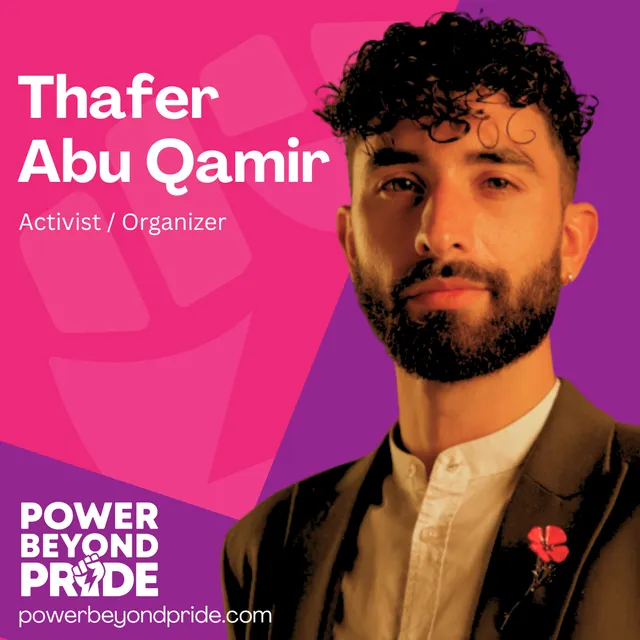
Palestinian American writer and organizer Thafer Abu Qamir chats with Daniel W.K. Lee and Shane Lukas about co-founding NOLA Freedom Forum and the Palestinian Youth Movement in New Orleans to educate people on the interconnectedness of liberation struggles and to create a space for queer Palestinians, his views on how to create a more inclusive and just world that recognizes the significance of Palestinian storytelling, and how writing plays an important role in his own life practice.
Something that I’ve seen is that there are many queer Palestinians here in the city, and many of them don’t feel comfortable being both of those things publicly at the same time. And for me, it became important to show them that in this work that we’re doing, there is a space for them and that we wouldn’t be expecting them to bend their expression in any way. We’re going to be not only welcoming to queer Palestinians, but supportive of them and showing up for them in whatever ways we need to. I think Being able to see someone in your community embrace all parts of themselves at one time, maybe gives you the push that you need to do that as well.
Daniel (00:00:35 –> 00:00:53):
Hello and welcome to Power Beyond Pride, a weekly queer changemaking podcast bringing to you voices and ideas from across our fierce and fabulous spectrum to transform our world. I’m Daniel W. K. Lee, poet and author who recently realized that I’m not into feather boas.
Shane (00:00:54 –> 00:00:55):
You’re not into feather boas?
Daniel (00:00:56 –> 00:01:03):
I don’t think so. They just get hot and sticky here New Orleans, and I’m like, eh. I think I’m trying to get rid.
Thafer (00:01:03 –> 00:01:04):
Of my small collection.
Shane (00:01:04 –> 00:01:48):
I find it difficult to be averse to hot and sticky at times, but admittedly, it is the summer season. So, Daniel, it is wonderful to join you. I am your co-host, Shane Lukas, and person still traumatized by that one time I tried to make an Italian Pendoro dessert from scratch, and it died on me. And I’m also a harm reductionist and a lifelong activist. And we are your co-hosts, Daniel and I, on today’s Queer Cast journey. In this episode, we are talking to the brilliant Palestinian American writer and organizer, Thafer Abu Qamir, the co-founder of NOLA Freedom Forum, the Palestinian Youth Movement in New Orleans, and the Palestine Film Day. That is a lot. Welcome, Thafer. We are really excited to have you join us from New Orleans today. Speaking of hot and sticky.
Thafer (00:01:49 –> 00:01:58):
Very hot and sticky. I’m very excited to be here, but it is my first podcast, so by the end, I to will be hot and sticky, I’m sure.
Shane (00:01:58 –> 00:02:00):
If we’re doing it right, that’s what I say.
Daniel (00:02:01 –> 00:02:03):
Are we taking your podcast cherry?
Thafer (00:02:03 –> 00:02:04):
Oh my God.
Daniel (00:02:04 –> 00:02:07):
You are. I feel so honored.
Shane (00:02:07 –> 00:02:08):
Oh my God.
Thafer (00:02:08 –> 00:02:12):
Oh, thank you. I should have prepped. Oh wow.
Shane (00:02:13 –> 00:02:15):
I feel like we should have a cake or a candle for you to blow out.
Daniel (00:02:18 –> 00:02:34):
Well, thank you so much for joining us for Power Beyond Pride. Before we get into your prolific organizing work, why don’t you tell us a little bit about your origins and then how you’ve come to make New Orleans your home. You can do top line, obviously.
Thafer (00:02:34 –> 00:02:56):
Oh, gosh. Yeah, I’m a Palestinian American, second generation. I grew up a lot of different places, but I spent about 10 years in the Lafayette area, which is about three hours from New Orleans. I moved here for college and just stuck around after. That’s really it.
Daniel (00:02:56 –> 00:02:58):
No Cajun accent picked up.
Shane (00:02:58 –> 00:03:03):
I think for the beads, right? You just stuck around for the beads. Somebody just gave you beads and that was the end of it.
Thafer (00:03:03 –> 00:03:15):
The beads are actually the bane of my existence because of the way they get clogged up in the catch basins and then our streets flood. But, but, yeah. But you know it comes with the territory.
Shane (00:03:15 –> 00:03:24):
We need water soluble. beads for Mardi Gras, right? Wouldn’t that be great if that, oh, is there like candy or like salt versions?
Daniel (00:03:25 –> 00:03:37):
Hey, I’m bringing up ideas here to solve. There are paper ones, like one of the crews, they don’t throw plastic beads, a crew of Iris and all their necklaces are, I think they’re paper beads or whatever.
Shane (00:03:37 –> 00:03:52):
So, yeah. So, so, is there a thing about New Orleans that drew you to stay? Like that you, when you were there, like immediately Wow, this is, especially having grown up in Lafayette, was it just sort of like, hey, this is the space for me. I love a good brass band.
Thafer (00:03:54 –> 00:04:02):
To be honest with you, I have no particular attachment to New Orleans. I know.
Daniel (00:04:03 –> 00:04:03):
I’m gassed.
Thafer (00:04:04 –> 00:04:04):
Hold on.
Shane (00:04:05 –> 00:04:06):
Daniel just fainted.
Thafer (00:04:06 –> 00:04:21):
Yeah. This is just where I ended up. It’s a little bit more of a free space than what I was accustomed to. So it felt a little bit more like home, but I won’t say that I’ll be here forever. Who knows?
Shane (00:04:21 –> 00:05:01):
I, well, speaking of that, because the world is your oyster, I love that a lot of your activism is around drawing attention to a lot of different identities from individuals with experiences all over the world. And so you’re a co-founder of NOLA’s Freedom Forum, a lecture series that explores the interconnectedness of global liberation struggles. See, I’m bringing that world in right there. And a founding member and board member of Palestinian Youth Movement in New Orleans. Obviously, when we think of New Orleans, we don’t often think of the Palestinian community there in the city. So can you share a little bit about the impetus to found both organizations and then the impact that you’re looking to attain?
Thafer (00:05:02 –> 00:08:46):
Yeah, so what people might not realize is there is a very large Palestinian diaspora in New Orleans. There are about 20,000 of us here. And so there’s a lot of need in the community. The Palestinian youth movement is a transnational organization with chapters and networks all over the globe. But there was no presence in New Orleans. And as a result, there was no real vessel for organizing that was strictly led by Palestinians for Palestinians. And there are so many great organizations in the city that have adopted Palestine and our liberation as a cause. But there really needed to be a way for Palestinians to plug into organizing with their own people and to be leading the charge in our own liberation movement. And that was really the impetus for bringing PYM to New Orleans. We started our network hopefully soon a chapter in May last year of 2024, we made our sort of public debut at the Nekba Day rally. For those who don’t know, the Nekba is, it means catastrophe in Arabic. It refers to the initial displacement and ethnic cleansing of Palestinians in 1948. And so we commemorate that anniversary every year. And ever since we’ve just been finding opportunities to make our cause visible in the city. to bring in Palestinian and Arab youth into our organization and really make sure that they’re seeing themselves as an extension of the liberation movement and break down those mental barriers that can be constructed when you’re in diaspora as seeing yourself as separate from your own people back home. So that was really the foundation of that. The Freedom Forum was something that became necessary because at the beginning of the genocide in October 2023, we realized that there was just this huge gap in knowledge. And in order for us to effectively mobilize and organize around Palestine, people have to understand what Palestine is and our history. And so we started the forum as a way to, to talk about Palestine. But when you talk to Palestinian organizers, it’s also really important to us that people see that what happens in Palestine is replicated all over the world. And the sources of our suffering and displacement, colonialism, white supremacy, all those factors contribute to every liberation struggle all over the world. And so the Freedom Forum is a way for us to educate about all of these different struggles and to tie them back together. There can be this tendency in liberation movements to really have your blinders on and to not see your liberation as intertwined with other people’s. And that has so many different effects. One of the main ones that has been frustrating for me is that there can be this phenomenon that I’m sure you’ve all witnessed where when one oppressed group is in the public eye, you’ll see other oppressed peoples being like, but what about us? Why is no one paying attention to us? And we don’t want people to think that way because the advancement of any liberation movement is advancing all of them. But for that to actually happen, we all have to be working together and not really see our work as happening in silos. So it’s part education, but it’s also really a challenge for people who are organizing, who are activists, who are in a learning stage to see this as one human struggle rather than something that is exclusive to one group of people or one location.
Shane (00:08:46 –> 00:09:09):
I love that you shared that. Is there a moment in your journey where you came to that conclusion? I’m just curious about, as your journey as an activist, like, I’m thinking little thoffer running around a lot of head, and like, at some point you are, you’re, you’ve grown into this vision of the world where you see the interrelationships and the intersectionality. And could you share a little bit about that journey?
Thafer (00:09:09 –> 00:10:13):
Honestly, I think it was more of a challenge to myself because that that feeling that I just described of frustration, of being invisibilized is something that I felt. And the last thing I want is to start feeling resentment toward any other liberation movement because ours isn’t in pride of place in the public discourse in that moment. And so I really just had to find a way to challenge that discomfort and understand where it came from. And so as much as The Freedom Forum is a vessel for education for our community here. It is also a utility for me. The more people I get to work with and interact with through the forum, the bigger my own understanding of the scope is. And so it’s meant to serve the community, but it also serves me. I hope that doesn’t sound selfish, but I always want to be growing in this work that I’m doing. I don’t think I’m ever gonna get it exactly right. And so it’s a really push and pull for me. Spiring words.
Daniel (00:10:13 –> 00:10:52):
You need anything to propel you and inspire you, and sometimes even a little bit of that can be a self serving. And I don’t think there’s any need for a little bit of a guilt in that for sure. Talk to us about some of the challenges of collaborating with dis, disparate, we’ll say, organizations that have, they are interested in something else. Climate action or something, climate resilience or something like that. And, or this is a predominantly black city here in New Orleans, like that, that, that cross racial conversation that may or may not be happening.
Thafer (00:10:52 –> 00:10:52):
Yeah.
Daniel (00:10:53 –> 00:11:03):
Talk to us about what have been your experiences that and what, and like through those experiences. what might you have learned and can share with our listeners? Like things to avoid, perhaps.
Thafer (00:11:05 –> 00:12:37):
Honestly, I don’t want to sound flippant, but I don’t think there have been real challenges in doing it. I think what is mostly the case is that when we sit down with organizers who are leading other liberation movements, they already understand how interconnected everything is and Everyone’s just excited to be in the room together at the table together, putting a name to it and being able to broadcast that to the community in a new way. As far as I know, there hasn’t really been anything like the forum that is explicitly aimed at bringing these movements together. Of course, through PYM, solidarity work is really important to us as well. So we’re regularly meeting with and collaborating with other organizations. But I think the forum has been the main way that we bring people in. And sometimes these are organizations I know nothing about, and I’ll find out they’re in the city, I’ll reach out to them, have a conversation with them, they’ll come and do a forum. And by the end of it, I even have a deeper understanding of how intertwined our work is and our struggles are. And then that just becomes a gateway into future collaborations. We’ve been able to do repeat events with people who started out as forum guests. And so I think the, there’s not necessarily a challenge in the work. I think the challenge is to yourself as an activist, as an organizer, to make sure that you’re prioritizing those connections outside of your own community. Absolutely.
Shane (00:12:37 –> 00:13:48):
Well, I would love to know. I know we’re talking about intersectionality and, and hearing you say that it’s hard for me to not want to bring in a conversation around the role your queer identity plays within these conversations about liberation. and just in queer liberation, always having seen early leaders like Sylvia Rivera who drove home the idea of intersectionality and that the struggles of our trans plus communities and our many other communities was tied to the elevation of gender expression, sexual orientation, and all of these components in there. How in the conversation to increase the voice of Palestinians in New Orleans, Palestinian Americans in New Orleans, have you experienced your own queer coming out, if I can say that? I guess we don’t think of, again, a queer Palestinian voice is a very common voice. And I don’t know if that’s just simply, as you said, in many ways we have not elevated enough individuals to be able to hear those voices across different media. Or does it feel very isolating to be in that space?
Thafer (00:13:48 –> 00:16:59):
I would say maybe it’s a little bit of both, but I think sometimes the feeling of isolation is not even necessarily from the community that I’m working with or the work that I’m doing. That is just something that I grapple with. When I was first starting to organize, I was not sure how much I was going to bring my queer identity into it, if at all. And pretty early on, I had a conversation with a friend of mine who is also a queer Palestinian organizer. And this was at the very beginning of us bringing PYM to New Orleans. And something that I’ve seen is that there are many queer Palestinians here in the city, and many of them don’t feel comfortable being both of those things publicly at the same time. And for me that it became important to, I hate to say be a figurehead, but like a representative of that identity in my organizing, just to show them that in this work that we’re doing, there is a space for them and that we wouldn’t be expecting them to bend their expression in any way. And so I sat down with my friend and I said, look, we’re building this organization here. I want to make sure that with our founding members, we’re all on the same page that we’re going to be not only welcoming to queer Palestinians, but supportive of them and showing up for them in whatever ways we need to. And I’m planning to bring this to our founding meeting tonight. And will you back me up on it? And she did. And fortunately, I didn’t even need backup because everyone was on the same page about that. And it’s been fantastic. I’m really glad. She and I both made that decision together because we have been able to bring in so many Palestinians of varying gender identities and sexual identities, sometimes into the organization, sometimes just as volunteers. But I think being able to see someone in your community embrace all parts of themselves at one time maybe gives you the push that you need to do that as well. So there are challenges with it, but I will say that they’re all extremely rewarding. And one of the first freedom forums we did was called Queering the Frontlines, and we brought in a trans Palestinian poet named Yafa who is just an incredible organizer and thought leader in every way. And they came and talked to us about how everywhere you look in the world, any liberation movement you see, you are pretty certain to find a queer person leading that work. And it’s especially true in the Palestinian movement, even if it’s not always talked about. And yeah, so it’s really important for me to be bringing those conversations together. I won’t say that it’s always the easiest to navigate, but I think I have a privilege in being able to do that. And I have a very supportive community and family, and I’m gonna Keep amplifying the voices of queer Palestinians as much as I can, because you really never know who’s listening and who needs to hear that and who it’s helping.
Shane (00:16:59 –> 00:17:18):
Take that stage offer. I say, take it. Take it. We’re going to give you a spotlight. I love it. Thank you for that courage. The courage to step into that space. It’s wonderful to hear how it models for other people who just may not feel that same level of courage. And so it is not easy. And So what you’ve done is just powerful and thank you for sharing that.
Daniel (00:17:19 –> 00:18:04):
And it’s great that you’ve also been recognized for this work as a Southern Partners Fund to 2025 young leaders social change fellow, which is amazing. What does this kind of recognition mean to you? I mean, I’m being recognized as a leader in this regard, especially we’ll think about it maybe in the context of like how a number of like current and alleged progressive political and social leaders have been absolutely silent or relatively silent about like us and genocide. What does it mean to you to be uplifted in this regard when, or we could say an older guard has looked away towards the primary kind of thing that you are working on?
Thafer (00:18:05 –> 00:19:51):
That’s an interesting question because I think it’s the fact that so many of our leaders are absent and dropping the ball in this conversation that makes me do this work in the first place. I won’t say that I’m very comfortable being in the public or anything of that sort. I never, I would have never chosen to be recognized in any way or to even be in this position in the first place. I think organizing and activism are things that I’m compelled to do as a responsibility to my people in my community, but I don’t think anyone from the time they’re a kid is, I want to spend all my time organizing. Like, there are other things that I’m passionate about that I want to be spending time pouring into, but for now there’s just this greater need that has pushed me into this position. So even doing things like this and having my name attached to the word activist is new to me and not necessarily a place of comfort for me. So it’s, I’m honored to be recognized in any way, and particularly with the YLSC Fellowship. It’s not just a title. It’s a year long collaborative workshop where representatives, activists from each of the southern states meet every month to discuss our work, to study critical theory together, and to learn from each other because We don’t want to always be starting at ground zero in this work. There’s so much institutional knowledge from people who are doing this work and learning how to learn their community’s needs and then turn those needs into a strategy and then actually carry that strategy out. And so it’s really an opportunity for me to do better work.
Shane (00:19:52 –> 00:20:29):
And we’re going to continue that. I want to hear more about your community organizing for really just a An amazing story. I understand about reluctantly stepping into a space, but it also, like you said, it can be really motivating to see our communities come together and it amplifies that space by you stepping into it. So thank you for that. And I want to hear more about it. But right now we’re going to take a quick break. And so we ask everybody to stay tuned with us as we get to know Thaoffer more on this episode of Power Beyond Pride. and we’ll see you right after the break.
Daniel (00:20:37 –> 00:21:36):
Welcome back. This is Power Beyond Pride, a queer change making podcast, and I am Daniel W. K. Lee with my co-host Shane Lukas talking to Thafer Abu Qamir from New Orleans. I love to just chat with you about the Palestinian resistance organizing with respect to LGBTQ, queer, the community here in New Orleans. Before we came back, I mentioned we had chatted a little bit about Pride being a little bit of a contentious space. A group of LGBTQ people here in New Orleans had made them demands of divesting that Pride should divest the organizing group behind our Pride, divest from Shell, who complicit to the genocide. So what’s been your experience with trying to organize across into LGBTQ spaces? I imagine, or I’m, yeah, I’m curious, like how that’s been for you.
Thafer (00:21:37 –> 00:25:09):
It’s been an interesting experience because I think, if I’m being honest, that I’ve cultivated this deep resentment toward the dominant queer culture in New Orleans. which tends to be very depoliticized. If you asked me, I would say no one anywhere should be celebrating Pride at all, especially if it’s a glorified street party. There are so many things that our community enables and overlooks. We’re in a city built and shaped by Black revolutionaries, and those aren’t the faces that you see. in these celebrations, and it’s not really those stories being amplified. And so for me, this sort of whitewashing of the queer experience is a problem and has for most of my time in the city kept me out of queer spaces because I don’t want to be the person in the room talking about colonialism when everyone just wants to go dancing at Oz, you know? So it’s been great to connect with other queer organizers in the city who are really pushing for the political origins of pride to be restored in everything that we do and say. And as you mentioned, there have been contingencies of people who like disrupt the pride parades with Palestinian flags and signs and messages. I think that’s extremely important, but I also have seen the wider response from the community being like, who are these people who are interrupting our celebration? And then they’re just like, why are you celebrating? We haven’t liberated everyone. If a white cis gay person is liberated, that doesn’t mean the work is done. But I think a lot of people have adopted this mindset of liberation starting and stopping at the borders of their own identities, and they’re not really pushing themselves to see who else they’re leaving behind. And that’s just a flawed definition of liberation in the first place. So I’ve had some hope restored by connecting with queer organizers in the city from other organizations who really see things this way and who are consistently turning out to Palestinian mobilizations and protests and coming to the Freedom Forum and making sure that their challenging their own potential complicity in any other liberation struggle. So I’ll say it’s a work in progress. I don’t think we’re really there yet. I think when I bring up my Palestinian identity in queer spaces, I’m often met with, well, I have Israeli friends, and then they go on that tangent, and then they want to talk about their time at Tel Aviv Pride. And I don’t even know how to respond to those things. Because all the times that I’ve been detained by the IOF just for attempting to visit my family, never once have they asked me, are you queer? No. The fact that I’m Palestinian is enough for them to detain and deport me. And my queer identity never plays a role in it. So this whole mythology that Israel is a safe haven for queer people in the Middle East is just another rhetorical tactic that is used to dehumanize Palestinians. A few weeks ago, we had a queer Palestinian cinema event through the Palestine Film Day event series that I also helped to organize.
Daniel (00:25:09 –> 00:25:11):
It was great, by the way.
Thafer (00:25:11 –> 00:26:34):
Yes. Thank you. I appreciate you coming. And hopefully you found that informative, but because so much of Israeli propaganda is narrative driven and rhetorical, it’s important for us to combat that with the same mechanisms. And so, We are Palestinian storytelling is so important. Palestinian storytelling in general is so important, which is why we started Palestine Film Day in the first place. Like some people are going to come to Freedom Forum and enjoy this sort of academic perspective on liberation. Some people are maybe more motivated by protests. But then there is also a group of people who really need to see our lived experiences played out. And Palestinian film is such a great way for them to see what we actually go through. both in Palestine and in diaspora. So I really was happy to do that event. I was able to host a panel with several other queer Palestinians in the city. And what’s so interesting is that they all told me when I approached them, I’m not sure I’m going to have anything to say. And Daniel, as you saw, everyone had so much to say. And I think it’s really a testament to the fact that we don’t know how repressed we’ve been in our own expression until we’re given the space to say these things out loud. And that’s something that I’m really passionate about continuing to do.
Shane (00:26:34 –> 00:27:03):
Well, that actually brings me to pivoting a little bit to build on what you just shared. Because in your work in advancing Palestinian cinema, in elevating community storytelling, your own writing, is a way to frame your experience, to bring people into conversation. Can you share a bit about your, what got you to start writing and what inspires you to begin to share your own words and language and your own story?
Thafer (00:27:04 –> 00:28:53):
Yeah. So this might not be the answer that you expect, but I’ve been writing since I was a kid, moved around a lot, and so there was a lot of inconsistency in the spaces I found myself in and the people that were around me. And for me, stories were just a really consistent thing. I could pick up a book and take it with me everywhere I went, and it was always the same characters inside those covers, you know? So it’s always just been a real refuge for me. And so I always knew that I wanted to contribute to that, but because I was coming to this realization as a kid, most of what I write is for children. So I love this. Yeah. I’m inshallah this year finishing a novel for children. Yeah. So I, I wouldn’t say that my writing is overtly political or overtly about my experience as a Palestinian, but it’s certainly in there. I think it was a roll doll that said, you can’t go into any writing project expecting to teach a child a lesson. You have to tell them a good story. And if there’s a good lesson in it, that’s so much the better. But they’ll see right through it if you are going in there with intentions to teach them. And so that’s what I want to do. That’s, that’s really where I feel most comfortable. It’s an escape for me. I also think that when you’re, you know, when you read as an adult, you’re reading to challenge your worldview. When you’re a kid, you’re reading to form your worldview. And so I think there’s a great opportunity there to expose children to themes of loss, displacement, grief in ways that are sometimes exciting and thrilling, but then also very human at the same time.
Shane (00:28:53 –> 00:29:29):
Well, and practice for those feelings, right? Like that if there’s anything that adults don’t do well and the current moment sort of illustrates is the process of handling conflict or grief or shame or all of these different feelings that are human. And yet not having the practice through literature to work through those feelings, that was the whole point behind the fairy tales and so much storytelling was to give young people a chance to work it through in their imagination. and practice those skills.
Daniel (00:29:29 –> 00:29:44):
Well, do you have any, like, models and, like, specific Inspirations, people that you’ve read their work and be like, that’s the kind of writing that those are the, that’s the kind of Storytelling even for children that is really profound.
Thafer (00:29:45 –> 00:30:01):
I’m not sure that I have exact models in terms of content. There are so many writers who Inspire the tone and the style that I use to write. My favorite book is the Never Ending Story. And if and when my book comes out, you’re going to see that I’ve stolen so much from it.
Shane (00:30:02 –> 00:30:05):
Are we going to sing part of it now? Can we sing part of it now?
Thafer (00:30:05 –> 00:30:07):
No? Oh, of the film?
Shane (00:30:07 –> 00:30:10):
Yeah, can we get Never Ending Story? Come on, all together now.
Thafer (00:30:10 –> 00:30:11):
Come on!
Shane (00:30:11 –> 00:30:23):
All together. Yes. How can you not, we have to, we mentioned it, we just have to have a little bit of theme music going right now. Well, now we’re not licensing that, by the way, whoever’s listening, that’s not happening.
Thafer (00:30:23 –> 00:33:10):
Yeah, forget it. that movie is the first five chapters of a 26 chapter book. I highly recommend you pick it up and get the full scope of it. But yeah, so there are people that I model my prose after, but I think the people who have more so influenced the themes that I write or are more critical theory and like adult writers. So it’s like me trying to pull so many different influences together in a way. that still feels true and responsible, but also is exciting enough for a child to read. And enough to say that everything I’ve written is for children. I’ve written short stories and most of those are for adults. And those are really where I process some of the more complex feelings that come with being in diaspora. I wrote a short story called the Museum of Modern Maladies, which is probably my favorite piece of work. It took me four years to finish, which is crazy for a 20 page story. But in 2015, I was 22. I was diagnosed with Hodgkin’s lymphoma and underwent treatments for that, and then had to crowdfund the cost of my treatment. And that was a very humbling experience, but also quite humiliating because it requires you to tell all these intimate details of your life to complete strangers to get their sympathy enough for them to save your life. And that’s what that story is about. It’s like, if you imagine that GoFundMe is a building you can walk into, and all these people with so many different stories are in there trying to appeal to the same people with limited resources. to support them. And in that situation, how do you make sure that your story is compelling enough and what do you have to sacrifice in order to get that support? What parts of yourself do you have to hide to get that support? What parts of your story do you leave out? And so that was an exploration of that. And of course, in the past few years, I’ve written a lot of speeches that are a little bit more personal and more directly mine my personal experiences to humanize the Palestinian cause. I think there’s this tendency for people to think of Palestine in this abstraction and to forget that it’s a place that does still exist and that there are still people there with real stories. And so if I’m speaking at a protest or at some Palestine focused event, that’s usually where I feel a little bit more comfortable just talking about my family’s history of displacement, of what they’ve been through since 1948 and beyond.
Daniel (00:33:10 –> 00:33:10):
So.
Thafer (00:33:12 –> 00:33:17):
Depending on what I’m writing and who my intended audience is, everything might change.
Shane (00:33:18 –> 00:33:41):
Do you write across languages? As somebody who’s multilingual, sometimes I like reading Italian and sometimes Russian in the original, simply because the language is they’re just words that don’t translate. Are you, do you write across languages because sometimes it, it captures more of the moment or the feeling you want to get, or have you explored that?
Thafer (00:33:42 –> 00:34:19):
I wish I could, I wish I could say my Arabic was good enough to do that. I feel so much more comfortable writing in English, but the Arabic that I speak with my family and with my community is a dialect and it’s not what you would use to write. and the written language is it escapes me a lot more. So hopefully one day I’m at a point of comfort where I’m able to do that. Cause I do think some of the stories that I have to tell and some of the perspectives that I want to share should be accessible to Arabic speakers. Not quite there yet, but it’s a goal for sure.
Shane (00:34:19 –> 00:34:21):
You got time. You’re like, what, 20?
Thafer (00:34:21 –> 00:34:23):
So. I’m 32.
Shane (00:34:24 –> 00:34:25):
I don’t believe.
Daniel (00:34:25 –> 00:34:34):
Don’t see it. I think all of us are really cheating at it because I’m 80. So it’s great.
Shane (00:34:34 –> 00:34:35):
The pain is not live.
Daniel (00:34:35 –> 00:34:50):
Masha’Allah, you look great. I think we need to take a break here and stay with us, please, because we’ll be right back for our speed round of questions where we’ll get to know each other. a little better.
Shane (00:34:57 –> 00:35:34):
Welcome back to Power Beyond Pride. I’m Shane Lukas, and I’m here with my fabulous poet co-host, the great Daniel Lee. And we are talking with the New Orleans-based changemaker Thafer Abu-Kamal. Queer theorist José Esteban Muñoz stressed Pope’s role in realizing The Queer Utopia and Futurity. Daniel wrote, that said, what is your hope? Daniel wrote that he had to throw in something really wonderful and complex, and I love it. But you know what? In thinking about it, though, Thofer, it does prompt the idea, what is your hope for the future of Palestine?
Thafer (00:35:34 –> 00:36:53):
Complete and total liberation, first and foremost. I will say I have visions of what my life in Palestine will be like, which is being near my family who are still in Palestine. My mother immigrated to America on her own. So I’ve been separated from my family all of my life, except for the times that I’m able to go home. But in a more broad and general sense, I hope that the future Palestinian state is completely and entirely shaped by Palestinians who are at this moment in Palestine. As someone who has the privilege of being in diaspora and who has in so many ways been influenced by Western culture, I don’t ever want to project my visions or ideologies or opinions onto Palestine because although I’m Palestinian, I don’t have the lived experience of living under apartheid every day of my life. and I really hope the people there are the ones to shape what Palestine becomes. I don’t want to become Palestine’s next colonizer. I want to create the conditions where Palestinians are able to choose what their future is.
Daniel (00:36:53 –> 00:37:50):
I’m going to add the reason why I added that, because I think what’s so powerful about what Munoz was saying was that we can’t lose hope and this idea of a utopic vision of our world. If we’re going to really be able to aspire towards it, like that motivates us, that animates us to this kind of utopic vision or this futurity that is queer in his way was the political queer, not the inclusive queer, but the political queer of a revolutionary and liberatory that we have to remember, we have to have this utopic vision in order to keep ourselves in a direction towards it. And so that’s why I wanted to bring that in, because I think that it’s like, in a way when we’re in a muck of it, we have to, or we should allow ourselves to be like, that’s the thing, that’s the vision that we need to keep on marching towards.
Shane (00:37:50 –> 00:39:06):
Well, and I would add to that, that one of the things that inhibits a lot of movements is they become either complacent or they get this sense that it was this way, it will always be this way. And when we talk about Israel and Palestine, when we talk about these regions, you lose sight of the legacies, of the histories, of the loss, of essentially the complexity of how we got here. And that it wasn’t always like this. And that we don’t have to be like this. And part of that transformational change has to be a vision of what we move toward. and what we learn in that process as we move toward and do the accountability in that work. Because sometimes, as you said, Thelma, people with great intentions will want to step up and they’ll be like, this is how I know I want it to be. And they may not have that lived experience, or they may be talking about communities with a different lived experience or at adjacent or similar. But being able to make space for that to change as we listen, elevate voices that may not have been in the room prior, Just different opportunities like that as part of changemaking movement. The reality is we just don’t want it to be like it is now and we know it can be better. And I, so I love the work you’re doing, which I feel is so powerful. What will your work look like in the foreseeable future? Are you thinking about what your next steps are going to look like, Dafna?
Thafer (00:39:07 –> 00:40:51):
Well, I’m really taking it day by day. I know that I’m going to continue trying to advance these organizations that I’ve to create. I’m just so passionate about the Freedom Forum. I think that is one of the most critical spaces for our community. I’m not sure when this is going to air, but next on July 8th, we’re bringing in Desmond Tutu’s daughter to talk about hope beyond apartheid to tie a South African apartheid to Palestine and to hopefully talk about some of the strategies that were effective in their liberation. In August, we’re going to be discussing the criminalization of HIV, which you might hear and think has no relationship to Palestine, but there are so many intersections in these conversations. Palestine is a public health crisis, and think about HIV prevention under apartheid and how that exacerbates hopelessness and the spread of HIV. So all of these things are connected. So I think the more that I’m able to bring in these seemingly disparate conversations and really make them into one, that’s what I want to keep doing. It’s all a form of storytelling when you look at it that way. And that’s what I’m going to keep doing. And then whatever I write is always going to touch on these themes of displacement, of what it means to to belong somewhere to belong where you are or of a place maybe you’ve lost. Those are things that I’m going to keep talking about forever. I’m not entirely sure what form that’s going to take, but I think those are the things that are the most important to me. Thank you.
Daniel (00:40:51 –> 00:41:02):
Absolutely. Well, we’re going to pivot to something a little more light, a little more fun. It’s time for our speed questions round. So we can get to know you.
Thafer (00:41:02 –> 00:41:03):
A little bit better.
Daniel (00:41:03 –> 00:41:10):
And you’re going to try not to overthink it. Try to let your reptilian brain take over.
Thafer (00:41:11 –> 00:41:17):
Okay? It’s been here this whole time, don’t worry. Okay, absolutely. All right, are you ready? Yeah.
Daniel (00:41:18 –> 00:41:22):
Okay, so first question. When it comes to first drafts, pen or keyboard?
Thafer (00:41:23 –> 00:41:23):
Pen.
Shane (00:41:24 –> 00:41:25):
Oxford comma or no?
Thafer (00:41:26 –> 00:41:27):
Oxford comma.
Shane (00:41:27 –> 00:41:29):
Head on. Heat, band the shoots and leave.
Daniel (00:41:30 –> 00:41:31):
Correct answer too.
Thafer (00:41:35 –> 00:41:47):
Ooh, okay. You’re trying to, and you’re trying to start a fight here. Because whatever I say, someone’s gonna come to me and say, why would you say that? It’s hummus. All right.
Shane (00:41:47 –> 00:41:49):
A little more in tea or coffee.
Thafer (00:41:50 –> 00:41:50):
Coffee.
Daniel (00:41:51 –> 00:42:00):
What’s the best part of living in New Orleans? Oh my God, my heart is breaking.
Shane (00:42:00 –> 00:42:02):
There’s gotta be, we put, really?
Thafer (00:42:02 –> 00:42:04):
Can we put a cricket sound effect?
Shane (00:42:04 –> 00:42:22):
Okay, here’s the deal, Poffer. I’m gonna be in New Orleans, and Daniel and I are gonna be there, and we are going to do something fun. That’s what we’re gonna, okay. We’re gonna, we’re gonna, there, I have favorite things in New Orleans. We’re gonna find some, we’re gonna do it. Okay, in that case, do you have a favorite Palestinian food?
Thafer (00:42:22 –> 00:42:46):
I have so many favorites, but I’m sure, well, maybe you haven’t heard of it. Maqluba is like the quintessential celebration dish for Palestinians. It’s meant to be served to a big group of people, but when my mom comes in for a visit, she will make this giant dish just for us two, and I will eat it for weeks to come. What’s in it? It’s so good. Describe it.
Shane (00:42:46 –> 00:42:46):
Like what’s in it?
Thafer (00:42:47 –> 00:43:06):
Yeah. So you fry vegetables. like eggplant, and you line it at the bottom of your pan, then you put chicken, rice, stock, you cook it, and then you flip it over at the end and you lift the pan. And if you’ve done it correctly, it holds its shape.
Shane (00:43:06 –> 00:43:14):
I have had this and your, yes, I’m all in. So is there a good place you recommend in New Orleans to get this?
Thafer (00:43:14 –> 00:43:17):
My mom’s kitchen.
Daniel (00:43:18 –> 00:43:20):
We won’t be sharing that recipe.
Shane (00:43:20 –> 00:43:28):
That’s the correct answer. In case she wants company, just if she wants, if she wants a queer North Carolinian, I will happily volunteer.
Thafer (00:43:29 –> 00:43:34):
I was born in North Carolina, so she would be happy to do that for you.
Daniel (00:43:36 –> 00:43:48):
See, we are learning so many things. Didn’t even know that. All right, next question. Would you share five favorite Arabic words and why are they there, why are they your favorite?
Thafer (00:43:48 –> 00:43:52):
Ooh, okay. Hopefully they’re all appropriate to say.
Shane (00:43:53 –> 00:43:55):
I mean, it could still be your favorite.
Daniel (00:43:55 –> 00:43:56):
I mean, yeah. Okay.
Thafer (00:43:59 –> 00:44:41):
I’d be is when I use the most, it means like normal, regular. So if something bad happens, I’ll just be like, ah, I’d be. It happens. This is something that my aunt does that I’ve been told other Palestinians do not do. But if something is not up to par, like if she sees trash on the street, she’ll like point at it and say, Muzra, which means farm. But so I say that all the time and everyone’s, what are you talking about? I think hub is has to be said. It’s love. Zahiri is liberation. Also my aunt’s name.
Shane (00:44:42 –> 00:44:43):
Oh, I love that.
Thafer (00:44:46 –> 00:44:51):
Another word. I don’t know. I don’t go around picking favorites. Habibi.
Daniel (00:44:51 –> 00:44:53):
You gave us four that were really great.
Thafer (00:44:53 –> 00:45:01):
Okay, let’s look. Habibi is great. But some, when, sometimes when people call me Habibi, I’m like, not you. Nice.
Daniel (00:45:01 –> 00:45:05):
You don’t get to say it’s like poppy. When people call you poppy, you’re like.
Shane (00:45:05 –> 00:45:06):
Let her know about that.
Thafer (00:45:06 –> 00:45:07):
Oh, yeah.
Daniel (00:45:07 –> 00:45:07):
There was a really.
Shane (00:45:08 –> 00:45:30):
And I, again, I, my, my ignorance here, I, there was a show I think it was on Netflix that did a really great job chronicling a Palestinian-American experience. I think it was Netflix. It was Amazon or Netflix. It was one of the streaming channels. And I can’t remember it, but it was really good. But they used it a lot in there, and then it suddenly became around the household we ended up Just as a general, just a term of endearment. And so?
Thafer (00:45:30 –> 00:45:50):
Well, just so you know, Habibi is a gendered and it is possessive. So Habibi is like lover, but it’s masculine and the e at the end means mine. So you’re saying like my lover. If you wanna, if you’re saying it to a woman, it’s Habibi, you add the t. So don’t call a woman Habibi.
Shane (00:45:50 –> 00:45:54):
Oh, that’s good. Oh, okay. That’s good. Okay. Thank you for sharing that.
Thafer (00:45:54 –> 00:45:57):
I have learned things.
Shane (00:45:57 –> 00:46:24):
I love, thank you, I appreciate it. I love learning languages. I love it. I think again, it’s, to me, there’s just a magic because there are, like we talked about a little bit before, earlier, there are words, there are expressions and feelings and emotions and moments that languages capture at times that just don’t translate well. And so sometimes those words Open up a new way of seeing things. And I really appreciate that. So thank you.
Thafer (00:46:24 –> 00:46:26):
Thank you for sharing. Yeah.
Shane (00:46:26 –> 00:46:34):
So do you have a favorite film? So since you did the Palestine film night, a film date, what’s a favorite film from the past five years?
Thafer (00:46:34 –> 00:46:38):
What’s a film that you would recommend people see? Oh, does it have to be from.
Shane (00:46:38 –> 00:46:40):
The past five years? Can I go back?
Thafer (00:46:40 –> 00:46:47):
That’s what it says in the script. But you know what? Honestly, you do you. Okay. My favorite film is Pan’s Labyrinth. Have you seen it?
Shane (00:46:47 –> 00:46:47):
Yes.
Daniel (00:46:48 –> 00:46:48):
Yes.
Shane (00:46:49 –> 00:46:50):
Gorgeous.
Thafer (00:46:51 –> 00:47:05):
Yeah. I mean, we talked about fairy tales earlier, so I’m sure you see why that is, but it’s a story set in the middle of a colonial struggle about a little girl who, whose imagination is her refuge. So it’s always been very special to me. Yeah.
Shane (00:47:05 –> 00:47:24):
And it’s, and the, it’s, there’s a cadre of directors at the time too. I’m trying to remember that it’s a Mexican director. It’s, it’s not Quaron, nor inerito. I can’t remember which director it is, but yeah, just amazing storytelling and really just the metaphor of everything of that film is so powerful. So thank you. Thank you for bringing that back in.
Thafer (00:47:24 –> 00:47:24):
Yeah.
Shane (00:47:24 –> 00:47:25):
Now I have to go watch.
Thafer (00:47:25 –> 00:47:28):
You will. It’s Guillermo del Toro.
Shane (00:47:28 –> 00:47:29):
Total.
Thafer (00:47:29 –> 00:47:30):
Total.
Shane (00:47:31 –> 00:47:31):
Thank you.
Daniel (00:47:32 –> 00:47:36):
Our next question, Savor the small talk or strip down and get to business?
Thafer (00:47:37 –> 00:47:38):
I don’t do small talk.
Daniel (00:47:42 –> 00:47:46):
I’m out after Shane’s heart because he doesn’t do small talk either.
Thafer (00:47:48 –> 00:47:50):
I am into radical vulnerability.
Shane (00:47:51 –> 00:47:54):
Love it. Who are you reading right now?
Thafer (00:47:54 –> 00:48:09):
Right now I am reading a book called Yellow Face by RF Kuang. I just finished her other novel called Babel, which is one of my favorite books ever now. And so I just had to read her other titles because it was, I was just blown away.
Daniel (00:48:10 –> 00:48:23):
Awesome. Well, I know you through social media and, and real life to make really fun start and strong sartorial choices. So what is a piece of clothing that you think men should wear more often?
Thafer (00:48:24 –> 00:48:29):
Oh, good question. Why did you ask me this? What did you see on my social media?
Daniel (00:48:30 –> 00:48:44):
I just think you, you, I just think you always have some really great style that you’re giving. So I’m thinking that you have, you might have strong opinions of men should wear or I could wear something like, like great hats or that kind of thing.
Thafer (00:48:44 –> 00:48:59):
I have a collection of the lasers that cinch at the waist. I love to serve like Miss Trunchbull realness in everyday life. And I think more men should get into the thick belt around your waist.
Daniel (00:49:00 –> 00:49:04):
We need a little bit of safari kind of flavors too, right?
Thafer (00:49:04 –> 00:49:05):
Yeah, yeah.
Shane (00:49:06 –> 00:49:07):
It feels like a hat.
Thafer (00:49:07 –> 00:49:08):
With a hat.
Shane (00:49:08 –> 00:49:10):
My nose is too big for hats.
Thafer (00:49:10 –> 00:49:13):
But if you can pull it off, you do that. I don’t know if I want to.
Shane (00:49:13 –> 00:49:19):
Cover my Mohawk, but I, I’ll have to, I’ll have to think about that. That’s, it’s a good Mohawk.
Thafer (00:49:20 –> 00:49:22):
You don’t want to smash that down. Thank you.
Shane (00:49:22 –> 00:49:23):
You really don’t.
Thafer (00:49:23 –> 00:49:24):
Well, thank you.
Shane (00:49:24 –> 00:49:37):
I, I, you know what? But I’m willing to try the Blazer with the big belt. Count me in. I think we’ll try it. We’ll give it, we’ll give it a go. Okay. When we go out in New Orleans, that is where that is going to be our attire. That’s what we’ve been talking about.
Thafer (00:49:38 –> 00:49:38):
You got it.
Shane (00:49:40 –> 00:49:45):
So what does Power Beyond Pride, which is the name of the podcast, what does it mean to you?
Thafer (00:49:46 –> 00:50:31):
First of all, I really like the title because I think it ties into what I was talking about earlier, which is that pride is a feeling that you earn through work. And it’s not just something you get to show up for once a year. And so power beyond pride is to me examining what pride is, what conditions can result in pride, and then doing the work to create those conditions instead of just living in this idealized version in which you can feel pride, but you haven’t actually pushed your community towards that feeling. It, I think pride is labour. It’s not just something that you can claim.
Daniel (00:50:32 –> 00:50:32):
That’s a great answer.
Shane (00:50:33 –> 00:50:33):
Speed round.
Daniel (00:50:34 –> 00:50:41):
Yes, absolutely. And this is not part of the quick speed round, whatever we’re calling it, speed round.
Thafer (00:50:41 –> 00:50:41):
Yeah.
Daniel (00:50:41 –> 00:50:44):
But where can people find you or follow your work?
Thafer (00:50:45 –> 00:51:22):
If for some reason you want to follow me on Instagram, you can. My username is the offer Dan. That’s T-H-A-F-E-R-D-A-N. But most of the time you will see me on the NOLA Freedom Forum Instagram account. The handle is NOLA Freedom Forum. NOLA4Palestine, it’s the number four. That’s where we push out our PYM work. And also it’s a collaborative hub for other organizations in the city to boost their work as well. So if you follow NOLA4Palestine, you’ll see every Palestine related thing happening in the city, whether or not it’s something I’m involved in.
Shane (00:51:22 –> 00:51:29):
That’s awesome. And eventually we get to read more of your work. I hope that’s also the case. We’re going to see more of your writings in process.
Thafer (00:51:30 –> 00:51:56):
I really hope so. I’ve kind of made a commitment to myself to do that more this year. It’s really been put on hold for the past couple of years because I was pretty much spending all my time organizing, which I’m going to continue to do, but I think I’m at that stage where I have to find a healthy balance with it and pour into myself a little bit so that I am well enough to keep organizing 100%.
Shane (00:51:56 –> 00:52:57):
Absolutely replenishment. Well, Thuffer, thank you so much for being here. You’re, from sharing about the importance of intersectionality to your writing to just your energy is just a joy to be able to spend time with today for our listeners to spend time with today. And we really do hope you’ll come back and join us again in the future and keep us up to date on what’s going on, both in New Orleans and wherever in the world you decide to, which is also your invitation to come to North Carolina, as well as visit all across the country and all across the world. So we are excited about all the journeys you get to have. We are out of time for this podcast, but again, everyone, please follow Thoffer@Nolah4Palestine. That’s the number four Palestine on Instagram. I’m your co-host, Shane Lukas. I am a lifelong harm reductionist. Owner of a great idea and just a big pile of ginger trouble. And you can follow me on socials. Well, sometimes. We are AGI. You can follow great ideas, socials you can find there, shaneLukas.com, you can also find me there and here at Power Beyond Pride.
Daniel (00:52:58 –> 00:53:20):
And I’m your co-host, Danielle W. K. Lee, poet and author of Anatomy of Want. And you can follow me @daniellewklee on Blue Sky or strongplum on Instagram. Remember to subscribe and get your friends to subscribe to Power Beyond Pride on Spotify, Apple Podcasts, and wherever you get your podcast, and check out our site.
Shane (00:53:20 –> 00:53:28):
At powerbeyondpride.com Power Beyond Pride is a project from A Great Idea, a queer-owned design and content agency.
Daniel (00:53:29 –> 00:53:36):
Learn more about them at agreatidea.com this episode was produced by Shane Lukas. Sumita Sarkar is the project developer.
Shane (00:53:36 –> 00:53:51):
Our editor is Jarrett Redding with support from Ian Wilson. And Daniel and I, the sartorial Daniel and I, are both part of this podcast’s awesome host team, and we invite you to send in your questions and comments@powerbeyondpride.com Check out our new episodes each.
Daniel (00:53:51 –> 00:53:57):
Week, and we look forward to queer change making with you next time. Thank you from all of us at Power Beyond Pride.