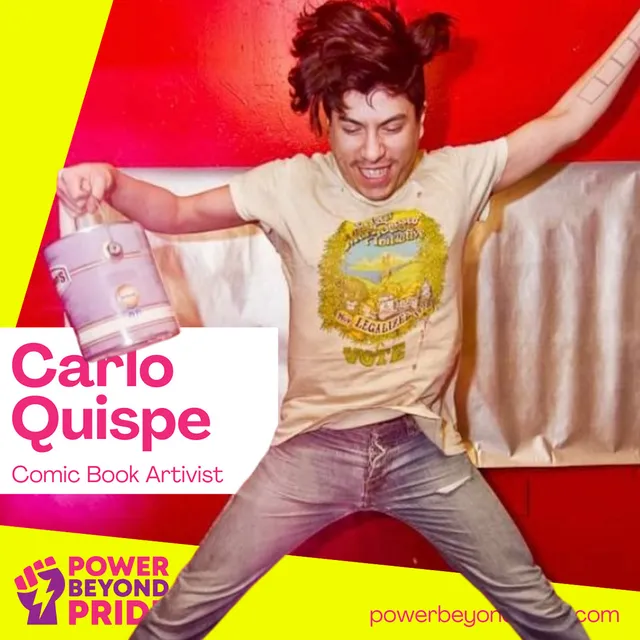
Artist and activist Carlo Quispe discusses his journey in using comics to explore queer and Latinx identity, challenge censorship, and advocate for social change with co-hosts Mattie Bynum and Kenyon Farrow.
I’ve wanted to always make comics about other people, make comics about activists, people that I admired. I never wanted to make it about myself. But when Trump came in and started talking all this trash about Latin people, I started thinking that maybe this is a time for us to speak up for ourselves and tell our story. And I thought maybe this is a way for me to talk about larger issues of immigration. I disarming. kind of narrative. It gets to the deeper point that nobody is illegal. Immigrants are what make this country what it is.
Kenyon (00:00:35 –> 00:01:01):
Hello and welcome to Power Beyond Pride, a weekly queer change making podcast bringing you voices and ideas from across our fierce and fabulous spectrum to transform our world. I’m Kenyon Farrow and I’m a writer and activist and have sometimes been referred to as your favorite butch queen’s favorite butch queen, but we’ll talk about that another day. So very I’m so glad to be here.
Mattie (00:01:01 –> 00:01:18):
And I’m Maddy Bynum. I am your hostess with the mostess. I am a true Southern belle with the education of a Yankee all day, every day. And I’m loud mouth, and I love to be happy and right at all times, can you? So, you know, long as you know that I’m right and you’re wrong, we’re good to go.
Carlo (00:01:19 –> 00:01:20):
How we doin’?
Mattie (00:01:20 –> 00:01:54):
OK. And in this episode, we are talking to the Peruvian-born artist, Carlo Quispe. He studied cartooning and illustrating at the School of Visual His Arts comics in New include York. Uranus Comics, Carlito and Queer Superhero Super Manual. At the time of this recording, he is a part of an exhibit walking through Latinx comics and alternative histories at the Clemente Center in New York City. But anytime you listen to this episode, you can always see his exhibit on YouTube. Welcome, Carla.
Carlo (00:01:54 –> 00:02:00):
Thank you so much. Thank you for being so nice to me and saying such kind words. I appreciate that.
Kenyon (00:02:01 –> 00:02:57):
You’Re more than welcome. So just to get us started, again, thank you for taking the time to talk to us today. So you started reading comics to learn English, right? Which I think is really interesting. When you were moving to the U.S. from Peru, and now you’ve made, obviously, this remarkable journey and left a strong mark on commercial art before you moved into doing more social political activism during the 9/11 era through the medium of comics and art. so for those who are not as familiar with your work or your journey, talk a little bit about that story. So how did you first kind of come to learn your skill for drawing and illustration, and then how you moved from not just having that talent and using it for kind of commercial settings to using that work to really help kind of drive and shape a narrative around the changing political landscape for immigrants, particularly queer and trans immigrants in the United States?
Carlo (00:02:57 –> 00:05:42):
So when I talk about comics, I kind of have to talk about them in general terms because not everybody reads comic books or is familiar with comics. And if people are familiar with them, it’s mostly because of the superhero movies or with the ways that comics make it onto other mediums. So when I talk about comics, I get a little bit like obsessed with the comics and the comics industry. Just help me bring it back. because I can sometimes go off a little bit because I’m also an educator about comics. And when I talk about comics in America, I really like to talk about how they were censored for a long time. The comics in the US had to be published with a stamp in the front of the comics called the Comics Code Authority. And this happened because in the 50s they were blaming comics for teenage delinquency. And they would have religious people and conservative people would have comic book burnings where they would burn comics that had to do with supernatural things or if they were telling stories of crime, like pulp fiction stories, or if they had any kind of sexuality. Okay. And so this Comics Code Authority made comics, they prohibited comics from mentioning any kind of sexuality, which then made like queer characters or queer stories have to go underground. This is why you hear the term also underground comics. These are basically the comics that were sold without the Comics Code Authority stamp, right? And so this is why a lot of comics that included these adult contents had to be called underground comics. And also you might have heard of the magazine Mad Magazine. It’s like a comics humor magazine. Those are the cartoonists that had that you used to be making tales from the crypt or weird science or the comics that that used to get there used to be burning these book burnings. And so they had to make a Mad magazine and call it a magazine so that they would have to get around the censorship, you know? And so right now I feel like we’re in a similar period of time now where people are looking at comics. specifically queer comics or comics that have to do with the trans experience or even comics that have to do with racial progress. And they are banning those books. And so we are kind of in the same, in a similar time period that we were back in the 50s. I feel like this atmosphere has brought us back in time instead of moving us forward.
Mattie (00:05:42 –> 00:05:43):
I agree.
Carlo (00:05:44 –> 00:08:22):
So, so when I make my queer comics, I make them understanding that we are in a comic book industry that is very conservative and it’s very religious and afraid of any kind of controversy like this. And so even though the Comics Code Authority hasn’t been used since 2011, it’s still a very conservative world out there. When I go to local comic book stores, they’re always looking for the one page that is going to offend some imaginary family. And so that sometimes keeps my comic books out of the bookstores. And so I’ve had to be smart about it and have to make comics that can somehow also get around the censorship. that we are, we’re living at. And so I, when I started making comics, I would just make them for myself and would make them as adult as I wanted. And I’m happy with that. That’s why the Uranus comic has got that double entendre, because I always want to confront that kind of homophobia, right? And fear of the, of anything to do with the butt, right? And so that’s why I named it that. But it’s also got this other like outer space, connotation to it, but Uranus is like the god or the goddess of chaos and change, you know? So I’ve always kept that in mind also when I make my comic. But when I started out, I would just make them for myself and for my friends and make them adult, you know? But when I tried to take them to the stores, I would get stuck in the erotic section, right? The adult only section, right? And so when I started to continue the comic, I made it more and more for general audiences, and I still tried to keep the focus on the queer community, but I also was aware that I wanted people to be able to read it and access it. This is also why I did the comic book Carlito, which is more about like myself as a child when I came to the US in the early 90s, and I made that character in a way to make it so that people would think it was like a more innocent or like maybe a humor comic. But in reality, it’s an adult comic that it’s about immigration and about finding out about your sexuality when you’re a kid. And it’s actually inappropriate, right? In some levels to express your sexuality.
Mattie (00:08:22 –> 00:08:31):
So I do have a quick question for you on that same topic. What comic books inspired you growing up? Like what influences from the comic world?
Carlo (00:08:32 –> 00:10:22):
So when I was growing up, my father was in the military in Peru and he was stationed in Madrid for a while. So our family for about five years in the 80s went to Madrid. and so I was exposed to the comic books that they have there. In other parts of the world, the comic book industry is for everybody. So there’s comics for kids, comics for adults, comics for any kind of community, any, it’s just a much better environment for comics. Also, if you think about Japanese comics, they also have that kind of idea that everybody gets, you know, to read comics. so in Madrid in the 80s, I would read the humor comics that actually my dad would buy for himself. And also the adult magazines, I mean, not sexual magazines, just like grown-up magazines that were about, like, I don’t know, Pulp Fiction or, I don’t know, Cowboy stuff or sci-fi things, magazines like Heavy Metal magazine. that eventually came to the US also. It’s like a more grown up magazine about science fiction. And the comics in Spain, a lot of humor comics come from this publisher called Ediciones B. And they have a lot of humor comics like Mortadelo y Filemón, Cip-Sap, El Botones, and they also have a comic that is by John called Super Lopez, which is a Spanish version of Superman. But it’s actually making fun of everything that has to do with a Spanish culture. And this actually influenced me to make my own Superman character, Super Manuel.
Mattie (00:10:22 –> 00:10:33):
Okay. And before we go to break, I do want to ask. So you currently have a curated project in the Clemente Center in New York, correct? Could you give us a little information about it as we go out?
Carlo (00:10:33 –> 00:12:14):
Sure. So I participate, I make comics like independently and I publish my own stuff too. But I also work with other collectives that make comics like Political Comics Collective called World War 3 Illustrated. And this is a comic that has been going on for over 45 years. And when we would meet to have our editors meeting, we would meet at a, a community center, like a radical community center in New York City called ABC No Rio, which is also celebrating 45 years. And so my exhibit with the Clemente Center is taking inspiration from World War III Illustrated and also ABC No Rio. So the comics that I’m showing are over a hundred pieces of comics. that are from seven different artists and they are all from different Latino backgrounds. It’s a mixed age and mixed gender exhibit and the cartoonists live in, they’re all based in New York, but they’re also from different boroughs. And like I said, they’re, I’m Peruvian, another artist is Puerto Rican, another one is Dominican, there’s a Mexican artist and also indigenous Mexican artists that are all living in New York. And so I thought that it would be an interesting show to have all of these perspectives together in one place, like the Clemente, which is another radical cultural space in New York City. So the show will be going on until May 31st.
Kenyon (00:12:15 –> 00:13:11):
Ah, that’s great. And so as we mentioned in the beginning, so if you’re listening to this podcast after May 31st, there is a YouTube clip where you can walk through the exhibit on YouTube, which is what’s so great about technology now. But before we get into more conversation, you’ve already given us so much red stuff about kind of the history of comic and the popularization of comics and then how you see that in your own work. But before we get into more conversation, go into a short break. So please stay tuned to Power Beyond Pride and our conversation with inspirational Peruvian activist and artist, Carlos Pispé, and we’ll right back. Welcome back. This is Power Beyond Pride, a queer changemaking podcast. And I’m Kenyon Farrow here with my co-host Mattie Bynum, talking with artist and activist Carlo Kaspri.
Carlo (00:13:12 –> 00:13:13):
Hi, Carlo.
Mattie (00:13:13 –> 00:13:17):
I did want to ask you, what influences does your Latino heritage come through in your work?
Carlo (00:13:18 –> 00:17:18):
So when I was discovering my way into comics, I had to really, like, dig and search for other Latino cartoonists that are, like, currently working. I think that the one that I, like, really attached myself to first was an artist named Sergio Aragonés. who is one of the Mad Magazine artists. And also when I was continuing to look at Mad Magazine and look at the publications that they did in the 80s and the 70s, I saw also a lot of other Latino cartoonists and caricaturists. And so I think that they had a big influence on me. Like I was saying before, Mad Magazine came out of this censorship period of comics. And so that’s why Mad Magazine has always had a kind of irreverent humor and anti-establishment feeling. And it’s because they had already been censored by the government. And so I think they, when they hired Sergio Aragonés, who is, I think, has Mexican ancestry, and they had also hired an artist whose name escapes me, but he invented the comic strip Spy versus Spy. I don’t know if you are familiar with that one, but it’s because the comic was invented because the artist came from Cuba and there was always like tension with Cuba because it had support from Russia. And this was during the period of the Cold War when there was a conflict, a 20th century conflict, between Russia and the US, which also we have returned to, right? So if you check out the Spy vs. Spy comics from Mad Magazine, they have also like this attitude that ridicules that kind of conflict, right? The other artist that I was really influenced by is named Ivan VIlis Jr. And Ivan VIlis Jr. He wrote a comic book and also drew a comic book called Tales from the Closet. That was one of the first US comics that was featuring queer characters of color, and they were also figuring out their issues in high school. And so it was really kind of influe, if you can imagine, like a queer Archie where all the characters have some kind of, you know, issue going on that then they work out through the comics, right? So this was done in the 80s and it was supported by the Hetrick-Martin Institute, which is the ones that fund the Harvey Milk School, which is the LGBTQ+ high school here in New York. So when he was going to that school, he was influenced by their mission and then went on to make this comic book And also because he did that comic book work, he went on to work for Marvel and also DC Comics. In the 90s, there was a partnership between DC Comics and another company called Milestone, which was all creators of color. And so this is where the character Static Shock comes from. I’m not sure if you’re familiar with that cartoon, but Ivan made that comic. and also a comic book called, I think it’s called Blood Syndicate. It’s about a gang of queer superheroes of color. Yeah, the Blood Syndicate. That’s it. I remembered. I always, that always escapes me. But look for, look out for work by Ivan Velez Jr. Because he’s the one who created those comics. And also from working with World War III Illustrated, I can say that I’ve also been influenced by the work of Sandy Jimenez. who is a writer and editor for that comic book.
Mattie (00:17:18 –> 00:17:27):
I do want to know, are you working on an autobiography or is there autobiography coming? Because you are a very interesting individual. So I would love to know more about your story.
Carlo (00:17:28 –> 00:19:31):
Thanks. So I’m working on a comic book called Carlito. Right now it’s a 50 page mini comic that’s published by Paper Rocket Comics and that was the first time that I did a comic that was done in, that was published in 2019 during the first Trump administration. And I, I wanted to always make comics about other people, make comics about activists and people that I admired. And I never wanted to make it about myself. But when Trump came in and started talking all this trash about Latin people, I started thinking that maybe this is a time for us to speak up for ourselves and tell our story, right? And so that’s when I started thinking about Carlito in Latin American countries. The comic strip Charlie Brown, the Snoopy cartoon, it’s the most famous comic ever, right? And also very influential. And the name of the comic strip is not Peanuts. in Latin American countries, it’s called Carlitos, right? And so when I thought about doing my own story about when I was coming into the US, that’s when I was like about 11 or 12. And I thought, maybe this is a way for me to talk about larger issues of immigration from a personal perspective where it can be a character that can be cute like Charlie Brown, Right. And those characters, but it could have a deeper meaning where it could actually get people to side with immigrants and make a character that was a disarming kind of narrative that made people feel charmed by the style of the drawing and the humor. But it gets to the deeper point that nobody is illegal, but that ultimately immigrants are what make this country what it is.
Mattie (00:19:32 –> 00:19:34):
So true. So very true.
Kenyon (00:19:34 –> 00:19:56):
So what was the moment that you kind of realized that you could really use art as a political tool and not just art for art’s sake, right? So was there a pivotal moment where you were like, oh, this is not just something for fun or recreation, but something that really can be used as a tool for activism.
Carlo (00:19:56 –> 00:22:59):
So when I go look for comics, I don’t just go to the comic shop. I also go to the used bookstore or even places like, I don’t know, Salvation Army or other places where they sell used books. And I’m always looking for books that are out of print and books that were made, and I guess in the time period between like the sixties and the nineties. I’m looking for these underground comics, like I was mentioning before, these comics that don’t have that seal of the comic book code authority, right? And books that are independent. And you know what? A lot of queer comics that were published in this time period, between the sixties and the nineties, they were published in local queer papers. There was also a gay magazine in the eighties and the nineties called the Advocate. and they would publish a comic strip called Wendell. Wendell was made by a cartoonist named Howard Cruz, who also came from commercial art. And then when he wanted, when he first published his first comic strip that was actually outing himself, it was, it was for the Advocate, for the Wendell comic, which was a semi-autobiographical comic about himself growing up. And so when I was maybe 14 years old, I went into this local used bookstore and went to the back of the bookstore where they have the special interests and went to the bottom of the shelves where all the comics were. And I found the first edition of Howard Cruse’s Wendell comic. And I couldn’t believe it because it was showing the life of a gay man where he was politically active and had a group of friends that was a mixed group of lesbians and drag queens and would have adventures in the bathhouse and would talk about aging as a gay person and even having a character that had been straight and had a kid and then had become gay. all of these characters were in the comic strip Wandle. And so when I first read that, it really blew my mind because I had never seen like a positive, a positive image of a queer person before. And I was like 13 or 14. And this is a comic that had a lot of sexuality and a lot of conversations about politics that made me realize that I could express myself fully in art. I didn’t have to segregate all these different aspects of my life. If I wanted to be a cartoonist, I could make a comic about being queer and about being a Latin person and about being, I don’t know, just different. So I think that is one of the first, I think that was one of the first times that I had that feeling that art could be political.
Kenyon (00:23:00 –> 00:23:23):
You are a very talented illustrator and cartoonist, and I’m sure you’ve gotten the question, have you tried to go work at DC or go try to go work at Marvel or do XYZ? So I’m curious to know why you have made a decision or think a decision to really use your art as an activist and to kind of be attached to real kind of movement work.
Carlo (00:23:23 –> 00:26:39):
I think the key to a lot of the work that I do has to do with the larger comics environment, right? So I was mentioning the Comics Code Authority. And so when I was going to college, I went to college to the School of Visual Arts from ’96 to 2000, right? And back then, I was maybe one of two queer people that were out at SVA. And also at the time, there were very, like a handful of women who are working there. And now when you look at the kids that are going to SVA, they all look queer and there’s maybe more than half are women. And so that also shows how the comic book publishing has changed. Right now, also with the internet, we can do anything we want, right? But when I was going to school, I was seeing a very limited world where everybody who was teaching us was coming from DC or Marvel to just show us how to keep that structure going, right? And I had maybe one or two teachers who were queer, who were in the comics world, but doing their own thing independently, like Thomas Woodruff, who eventually became the head of illustration, and also my other teacher, Keith Myersen. So they kind of like cracked the shell open for me a little bit. But when I got out of school, I immediately went to work for an animation company, which was all like working with like network TV and it was very commercial art. But I wanted to do other work that was more about what I was really going through. and I got, by doing protests and making my own signs and my own posters, I became connected to the group World War III Illustrated. Right? And so they were an underground comic that was doing political comics, and that was in the early 2000s. Right? So it, and so, like I was saying, the code didn’t stop being used until 2011. Right? So that was like a whole decade of work that I was doing for World War III Illustrated that was still considered underground comics, right? In 2010, there was a publisher called Printed Matter Incorporated, and they’re an art book publisher. And they funded my first comic called Uranus Comics. That was the adult comic, the queer comic that I’m talking about. And so I wouldn’t say that it wasn’t all my choice, but I would say that the opportunities that I found were with underground comics and like the fine art world and like the adult comics section, right? So that’s where I put my focus on because that was where I was getting the support, right? And then after I did the Uranus comics, I started to look for more resources, more help from other institutions and nonprofits. And so I started to do work that was more for general audiences But it still had the ideas and messages that I wanted to put through.
Kenyon (00:26:40 –> 00:26:52):
Thank you so much. So stay with us, audience, because we’ll be back in a minute to talk just more about comments and really go through a speed round with Carlo. So we hope you stick with us and hear even more.
Mattie (00:27:00 –> 00:27:30):
Welcome back to Power Beyond Pride, where we are talking to the beautiful and just amazing activists Carlo Kiswana. Like, I have– I’ve fallen in love with you already. It’s just sitting here talking to you, and I’m looking at some of your artwork. But I do want to say when we say power beyond pride, and that’s a statement that we use in our show, and it’s the title of the show, but it’s a question also we want to pose back on our people, our guests. So what does power beyond pride mean to you? What do you think about when you hear that statement?
Carlo (00:27:30 –> 00:28:49):
I’m also an educator. and a lot of times when we are doing our class, we have to think about what we are teaching the young people. And a lot of the things that the messages that we are expressing with our courses and our class has a lot to do with having confidence, right? And when I, for me to prepare to do my class, I have to think about not just performing the confidence, But also, I guess, having that confidence, right? And so I think that is, for me, it’s important to realize that I also have the answers inside me, even though it might not be obvious, like, even for myself at first, but I think that it’s having to, I don’t know, having to do with letting other people know that they have that talent and that they have that power too. You know, I feel like it doesn’t just end with you feeling good about yourself, but it has to do with the environment around you and the people around you. So, yeah, I think that when I hear things, messages like that, I think of, that’s what it makes me think of, being sort of like a teacher or some sort of role model to other people.
Kenyon (00:28:50 –> 00:29:08):
Thank you. So we’re going to move on to our last section, which is the lightning round or rapid fire round. So, this is where we’re going to ask you some questions and you don’t get any time to think about it. You just got to come with whatever comes off. The first response is where we going, right? So are you ready?
Carlo (00:29:09 –> 00:29:09):
Let’s do it.
Kenyon (00:29:09 –> 00:29:17):
All right. So first up, favorite secret place in New York. Although now we’ll all know about it, but, like, your favorite, like, spot.
Carlo (00:29:17 –> 00:30:28):
Okay. I would say it’s called. I have to say a comic book store. for sure. And it’s called Forbidden Planet, which is near Union Square. And Forbidden Planet is my favorite place because they are the only comic book store in New York City that will work with other independent artists to sell their zines and their comics in a deal called consignment. Forbidden Planet has always made deals with artists independently so that We can sell our art there. And they’re amazing because they will buy your comics and they will pay you immediately. They don’t wait for the comics to get bought. They will pay you right away. So they’re like supporting artists. And also, I should say, the manager Matt was one of the young people who grew up in going to ABC No Rio, which is the space I was talking about before, where he would go to see punk shows there. And so I feel like that kind of punk spirit, which is really means community spirit, is something that he takes to his own business. And that’s why Forbidden Planet is the best comic book store in New York City.
Mattie (00:30:28 –> 00:30:45):
Let me tell you, not only did he answer your question, Ken, but he gave a shout out to Matt, the manager, to the punk shows that he goes to. So I need you to understand, Carlo, this is no longer going to be your private secret stash. When you go tomorrow, it’s going to be a line out the door, because everybody heard money up front. I just need you to understand that part, okay?
Carlo (00:30:46 –> 00:30:46):
Oh, yeah.
Mattie (00:30:46 –> 00:30:49):
What’s your favorite Peruvian song and why?
Carlo (00:30:50 –> 00:31:41):
Okay, so my favorite Peruvian song is Mambo by Ema Sumac. If you ever. I mean, I’m sure you’ve heard Ema Sumac before because she’s one of the favorites for. For people to perform when they do a show. It’s. She’s an amazing singer that has an. eight octave range or five octave range, I think. And so she is, Ima Sumac is a Peruvian woman who was famous in the late 20th century. She came to the US claiming to be an Incan princess. And when she said that she grew up in the Andes, which is why her lung capacity is such that she has such a range. So yeah, so Mambo by Ima Sumac. that’s my favorite song. Right?
Kenyon (00:31:41 –> 00:31:56):
So good. Okay, so next question. It’s date night, right? Let me get my date night voice on. It’s date night audience. And so you’re gonna watch a movie. Is it a horror movie or is it comedy?
Carlo (00:31:56 –> 00:32:10):
I mean, I would make it a horror movie, especially. Specifically, I would say Sinners. If you’re gonna go see it, take someone to a date, go see Sinners. It’s very hot movie and they’ll be grabbing you by the arm for sure.
Kenyon (00:32:11 –> 00:32:18):
All right. I’m going to I’m going to see centers, but I don’t like to do horror generally. My take on horror is go on a date.
Carlo (00:32:18 –> 00:32:19):
Go on a date.
Kenyon (00:32:20 –> 00:32:23):
It’ll be like a 12 o’clock noon. My general thing with horror is.
Carlo (00:32:26 –> 00:32:26):
It’Ll.
Kenyon (00:32:26 –> 00:32:32):
Be a matinee date. If I want to be horrified, I just have to go outside or turn on the.
Mattie (00:32:33 –> 00:32:34):
That is true.
Kenyon (00:32:35 –> 00:32:46):
$20 to make me anxious or horrified is like crazy to me. But I get it. And also because I get the significance of sinners and it’s supposed to be fantastic. So I’m actually going to see it.
Mattie (00:32:46 –> 00:33:03):
But I want to go see the movie too. But I’m just loving how Carlo is just name-dropping and he is plugging everybody in his own interview. I love it, Carlo. This is the definition of community. I love it. So, Carlo, what is your dream travel destination? Where is one place you want to go?
Carlo (00:33:03 –> 00:34:00):
Wow, okay. I mean, of course I would like to go back to Peru. My favorite place in Peru is the Amazon. So if you ever get a chance to go there, that is the most beautiful place. And also the Amazon is an area of Peru where the Catholics didn’t really get to, okay? They were just afraid to go there. And so there is less influence of Catholic Catholicism, and you’ll see that in the indigenous people. and how everybody, you know, is kind of just loving to each other. And even when you go visit there, there’s no, I would say, like, gay clubs, but there’s queer people in every club. You know what I mean? So it’s a different atmosphere there. So, yeah, I. I would say if I was gonna go anywhere, I’d go back to the Amazon to a town called Iquitos. or San Juan, those are the best. Great.
Kenyon (00:34:00 –> 00:34:03):
Okay, so I’m kind of back to date night type questions.
Mattie (00:34:03 –> 00:34:03):
So.
Kenyon (00:34:05 –> 00:34:10):
Yeah, you see where this is going. Biggest turn on and biggest turn off.
Carlo (00:34:12 –> 00:34:27):
Well, I will be turned on if their library has comic books. Okay? They don’t read comic books. That’s a deal breaker, right? And then, so turn on his comic books. And then I would say, if they’re a Trumper, period.
Mattie (00:34:28 –> 00:34:29):
Hey, I get you.
Carlo (00:34:29 –> 00:34:31):
I don’t even wanna hear it.
Mattie (00:34:31 –> 00:34:43):
Well, as my aunt always tells me, know your limitations. So I get you. And that is such a limitation, that’s all. So now this is the biggest question of the whole interview, DC or Marvel Comics, which is your favorite?
Carlo (00:34:44 –> 00:36:02):
Okay, so when I was in high school, I would only read X-Men, Fantastic Four, and Spider-Man, okay? But then when I went to college, I started to get more into the indie comics and underground comics. And then around 2011, like I was saying, like when DC dropped the comics code, they changed their whole style of comics. This is why you saw the Superman Man movie or the Wonder Woman movie, and they actually killed somebody. And that’s because of this change in the code. that’s why that change happened. And so there were more like interesting writers working for DC Comics. I’ll say specifically, Grant Morrison. Grant Morrison is a British writer who just came out as non-binary and he’s been, well, they have been influencing comics, I would say, since the late 90s. And so if you check out their work in Doom Patrol, or in Justice League or in the they even created the Invisibles. Yeah, the Invisibles, which is a comic book that supposedly inspired the Matrix. So Grant Morrison is definitely one of my favorite writers. And because they’re working with DC Comics, now I’m into DC Comics.
Kenyon (00:36:03 –> 00:36:12):
Got it. So other than your own work, which everyone should have, what’s the must have illustrated novel that every queer should read her own.
Carlo (00:36:13 –> 00:37:10):
Okay, so right now, the most banned book in the country is called Gender Queer by Maia Kobabe. And it’s an amazing comic. Again, it’s called Gender Queer, and it’s a YA book. It’s for young adults. Okay, this is a book that I wished existed when I was growing up, but it’s very recent. and like I said, it’s because it’s such a good comic and because it’s so well written, it’s connecting with a lot of people. And I think because it’s such, it’s become such a powerful tool to communicate these ideas. And it’s also reaching a lot of young people. This is why this book is being banned. So I would say definitely read that book. I know I said it was in a YA book, so you might read it very fast, but it’s a really powerful book.
Mattie (00:37:10 –> 00:37:14):
I do want to take the time to ask you, where can people follow you at? What’s your social media handles?
Carlo (00:37:15 –> 00:37:42):
So, well, on, on YouTube, which is one of the, I’m discovering how much fun it is. And now that I’m able to put videos there, my walk through the historietas, for example, my family from Peru can see the show, even though they can’t come to New York. So right now, my YouTube channel is called Carlo Quispe Art, and that’s also the same name for Instagram. And my website is simply carloquipespe.com Thank.
Kenyon (00:37:42 –> 00:37:45):
You so much for being here.
Carlo (00:37:45 –> 00:37:46):
You’re great hosts.
Kenyon (00:37:46 –> 00:37:47):
Thank you.
Carlo (00:37:48 –> 00:37:49):
Thank you so much.
Kenyon (00:37:49 –> 00:38:05):
So unfortunately, we’re out of time for this podcast, but hope that you all will join us again. And like I said in the start, this world, this moment needs your wisdom and passion. And obviously, Carla, we would love to have you back some other point.
Carlo (00:38:06 –> 00:38:06):
Anytime.
Kenyon (00:38:06 –> 00:38:09):
Talk about your work moving forward. Thank you.
Mattie (00:38:10 –> 00:38:22):
Like I said before, we thank you again. And I am Mattie Bynum, the co-host of the show. And you can follow me @MattieSymone737 on Instagram. Mattie Bynum on Facebook and Kenyon.
Kenyon (00:38:23 –> 00:38:52):
Yeah, and again, thank you all. I’m Kenyan Farrow, and you can follow me on everything just at my name @KenyanFarrow. So hope to see you there online. And just for our audience, remember to subscribe and get your friends, get your homies, get your lovers, get your dates to subscribe to Power Beyond Pride on Spotify, Apple Podcasts, or wherever you get your podcast. And also check out our website at powerbeyondpride.com Thank you all.
Mattie (00:38:52 –> 00:39:12):
Now, Kenya, you either have recently fallen in love or we got to get you in love because you are all about these lovers and your dates and everything today on this episode. I’m loving it. Okay. But also, I do want to tell everybody Power Beyond Pride is a project from a great idea, a queer owned design and content agency. Learn more about them at a great.
Kenyon (00:39:13 –> 00:39:24):
Idea.Com this episode is produced by Shane Lukas. Samita Sarkar is the Project developer, our editor is Jared Redding with support from Ian Wilson.
Mattie (00:39:25 –> 00:39:35):
We are both part of this podcast Awesome Host Team and we invite you as our listeners and viewers to send in your questions, your comments to powerbeyondpride.com because we’re here to serve you.
Kenyon (00:39:36 –> 00:39:44):
Check out our new episodes each week and we look forward to queer change making with you every single time. Thank you from all of us at Power Beyond Pride.