audiogo-pixel
Power Beyond Pride Podcast

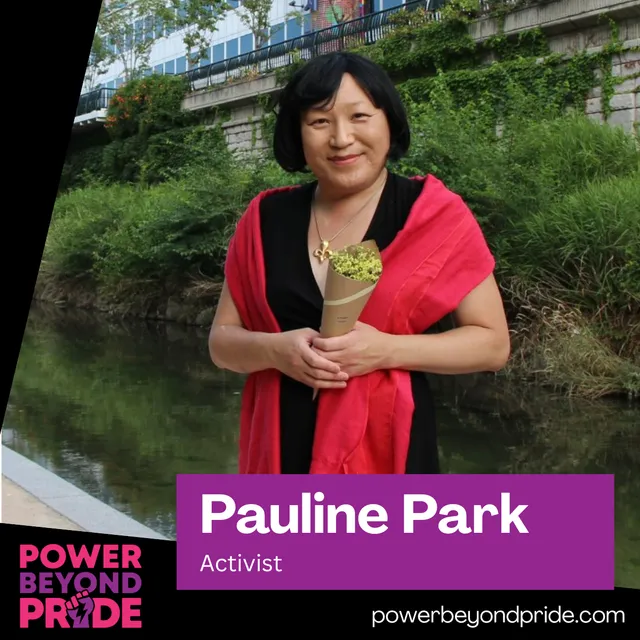
Queer Activism, Electoral Politics, and Pinkwashing with Pauline Park #20

LGBTQ and human rights activist Pauline Park joins co-hosts Daniel WK Lee and Kate d’Adamo as she shares about the critical need to move beyond representational politics and dismantle systemic oppressions, including capitalism and apartheid.
Daniel (00:00:00 –> 00:00:47):
My commitment to human rights is a commitment for rights for all human beings. And that necessarily includes Palestinians living under legal occupation, just as it includes Uyghurs in Xinjiang or Tibetans living under the prc. We have to be consistent. We have to apply the same standard of human rights across, uh, the board, to every country, on every community. Hello and welcome to Power Beyond Pride, a, uh, queer change making podcast, bringing you voices and ideas from across our fierce and fabulous spectrum to transform our world. I’m your co host, Daniel W.K. lee, author, poet and president of the American Spinster Society. Ass. AH for short.

Kate (00:00:48 –> 00:01:26):
And I’m your co host, Katie Adamo, a queer femme organizer and aspiring mountain witch. In this episode, we’re talking to the legendary Pauline Park, a, uh, Korean American LGBTQ activist. For over 30 years based in Queens, New York City, Pauline has dedicated decades of her life to LGBTQ, Asian American, Pacific Islander, sitting in solidarity activism, viewing all human rights struggles as distinct yet interconnected. Her work and life has been the subject of multiple documentaries, including Envisioning justice, the Journey of a Transgender Woman, and Coming Full Circle, the Journey of a Transgender Korean Adoptee, both by Larry Town.

Daniel (00:01:26 –> 00:02:12):
Pauline has co founded many organizations, among them Queen’s Pride House, Transgender Health Initiative of New York, and the New York association for Gender Rights Advocacy. She is also a fervent AAPI activist, excitedly working South Asian activist in her homeboro, Queens, and human rights activist, having participated in January 2012 in the first US LGBTQ delegation to Palestine, a seven day tour of the west bank in Israel that included meetings with LGBT and non lgbt, Palestinians and Israelis. Welcome, Pauline. We are so honored to have you with us today. Thank you so much, Kate and Daniel, for the invitation. I’m really delighted to be able to join you.

Kate (00:02:12 –> 00:02:23):
So you’ve been an LGBTQ activist for over 30 years. From your perspective, how has queer activism changed in the time that you’ve been organizing? And what’s the change that you’re still fighting for?

Daniel (00:02:23 –> 00:17:29):
Wow, those are two great questions. First, there had been a huge number of changes, both, uh, in terms of greater acceptance of LGBTQ people, and also societal changes and technological changes. The fact that we’re recording this right even though we’re in four different states, which is not something that I could have done when I started my activism in 1994. We have seen an enormous shift in terms of acceptance, I think, of lesbian and gay people. We saw that with the fight for marriage equality. Acceptance of trans people has been very much lagging. And of course, now, uh, the transgender community is under Unprecedented attack from the highest levels of the federal government. But I think in some respects, the attack on what the right wing is very falsely calling gender ideology is an indication of the growing strength of the trans community, the growing visibility of trans people, and the increasing acceptance of transgender people, uh, throughout society. Obviously, very differentially, across different demographic groups, different class groups, different age groups, different cities and states. But nonetheless, we see a change even in the terminology lgbt, lgbtq, et cetera, et cetera, which was not the language of 1994 when I started, uh, doing queer activism, um, you were lucky if you got gay and lesbian or lesbian and gay, that was extra if you got lesbian, gay and bi and trans were almost never included. I actually participated in a campaign with a, uh, bisexual activist, the late, great Sheila Lambert, to get all the major LGBT organizations in the city of New York to change from being lesbian or lesbian gay, which they were all known as, to lgbt. And so we got the center in Manhattan, which is called the Lesbian Gay Community Community Services center, to change its name to LGBT Community Center. Uh, we got the Pride Parade run by Heritage Pride, uh, which is called the Lesbian Gay New York City Pride March to New York City lgbt, uh, Pride March. And I was honored when they, a few years later, made me the first opening trans grand marshal of the Parade of March back in 2000. So there’s been a change. There’s been a real shift in terms of nomenclature. Um, even politicians have caught on to LGBT or LGBTQ or whatever lingo they use. But full acceptance, I think, of trans people is still quite far away. And I think, uh, being hindered by a concerted effort to attack the trans community and even transgender identity, uh, non binary identity, the identities of people who do not fit into, uh, the sex gender binary, heteronormative sex gender binary, which I believe is the root of all of our oppressors. I want to ask you kind of a little bit more a broader question. Intersectionality has kind of become one of the most important and prevalent concepts to enter mainstream social justice discourse. What’s your assessment as to how it’s helped LGBTQ politics, and perhaps more importantly, what’s been its shortcomings in terms of how it’s discussed these days? Well, I would make the distinction between real intersectionality and, uh, has become very popular. And there’s a sort of surface intersectional discourse that is fashionable in certain circles. But real intersectionality, I think, involves bringing in not only discussion and analysis, but action to address structural oppressions. Those obviously have to include gender identity, sexual orientation, also Class, as well as race, ethnicity, citizenship status, etc. Um, ability, disability. And it has to involve bringing that analysis into our work as activists. Ah, it has to involve making it real in terms of action to address those structural. I’m going to pull on this just a little bit more because I had a slight agenda when I asked this, which is this, which is to kind of broaden the ideas of intersectionality in action and how it’s seem to fall short in how we talk about decolonization or the limits of the politics of inclusion, even how we frame diversity as some kind of like, uh, some kind of like, solve for racism. So where is mainstream kind of social justice discord getting, really, getting intersectionality wrong, not just in terms of an analytical tool, but as a kind of an idea to organize around. Let me focus on the issue of representation, which I think is key here. So there have been relentless attacks coming from Trump administration on dei, diversity, equity and inclusion. Well, I’m actually critical of DEI because I don’t think it goes far enough. I think there’s a surface inclusion in terms of greater representation of different underrepresented groups. But simply including women, people of color, LGBT people, et cetera, does not in and of itself transform institutions or systems. We’ve had so many examples. And, uh, I know some people idolize Barack Obama, but in all honesty, was his presidency transformational? Really good question. There, obviously there are women and people of color in the Trump administration. Does that make it inclusive? Does that in any way make it transformative in a progressive way? If it’s transformative at all, it’s really arguably in the opposite direction. We’ve had women, people of color, even LGBT people in positions of power in. Think of conjuries of Rice as Secretary of State to George W. Bush or Colin Powell. You can think of Nikki Haley as Trump’s ambassador to the United nations in his first term. I could go on and on. There are so many examples of women, people of color, even LGBT people. Uh, Pete Buttigieg is the first openly gay cabinet secretary as Secretary of Transportation in Joe Biden’s administration. Was that transformative? Ask the people of east, uh, Palestine. Ironic that his biggest failure was around a town called East Palestine. Talk about that. Um, and so what I am focusing on, I’m actually working on, um, writing something about this is what I call the ideology of representations, which is that simply adding people from underrepresented groups, women, people of color, et cetera, not only does nothing transform systems, it can actually reinforce them. So I will date myself by noting that I spent two years living under Margaret Thatcher, the first woman to become British Prime Minister. Uh, did she transform the country? If she did, it wasn’t in a progressive direction. And it’s hard to imagine any actual, uh, feminist arguing that she was a feminist. In fact, she explicitly said she was not feminist. She said she hated feminism. Um, and, uh, we could point to many other, uh, different examples of such leadership. Ireland had its first open gay prime minister. Was there transformational change as a result of that? One could argue not really. So when we think about diversity, when we think about inclusion, when we think about intersectionality, we have to see how existing systems are quite flexible and adaptive in their own way. They can adapt to include underrepresented groups. And so every, uh, Pride season, and I feel a certain ambivalence because every banking corporation in town has a Pride flag and has. I remember going into Union Square and seeing Capital One, which is a major bank, and they have a branch in Union Square, and they had neon, uh, rainbow lights going. And I think, well, isn’t this what people call rainbow capitalism? Um, and, uh, when you have corporate support for such events, what does it actually do in terms of helping to advance a progressive agenda, much less radical agenda? I was honored to be the keynote speaker at the Queer Korea Festival, Seoul Pride parade, uh, in 2015. There, they do the festival first and then the Pride March. And so I spoke to this crowd of over 35,000 people, which is the largest audience I’ve ever addressed. And afterwards, I just marched with everyone else. And what was really thrilling was that there was no corporate sponsorship. Uh, there was no Walmart affinity group. There was no representation from Amazon, much less Tesla, any bank or corporation. No Citibank or Bank of America. And, uh, it was just queer Koreans and their friends and allies marching for their rights. And in some ways, it was kind of a throwback. It actually reminded me of participating in the very first national march on Washington, which is called Lesbian, Gay, uh, March on Washington way back when, which had no corporate sponsorship, because at that point in time, no banker corporation wanted to be associated with us, uh, queers. And so I think what we have to do is think about how corporate sponsorship actually can compromise our accuracy. And having run organizations I was executive director of three years. I understand the need to raise money. I understand the need, uh, to get, uh, different entities, some of them corporate, to support your events. They cost money. So I’m not standing in judgment of executive directors of community centers, uh, Pride parades, etc. We need to raise money. But I think we can think of different models. And so even though I was the first Stephanie Trans Marshall in New York City Pride March in 2005, when reclaimed pride Coalition started the Queer Library as a non corporate alternative, I was delighted to march with them, uh, because they had no corporate sponsorship, we didn’t include the nypd, uh, in the march. And they also were happy to help uh, Palestinians and those involved with Palestine solidarity work, such as myself, uh, with Palestinian flags and signs. And so I think we have to think about what uh, the relationship between the LGBT community and the larger socioeconomic political structure of society is. We can’t simply silo ourselves off and think, oh, we just need juridical rights Now. I supported marriage equality because I don’t think the state should be discriminating on the basis of sex or gender identity or sexual integrity in terms of the issuance of marriage licenses. But I also think that for at least 10 years the movement seemed to be taken over by marriage and it became the all consuming ambition, passion, objective of the uh, movement to the neglect of other issues that I think are equally as important. Think about transactions to healthcare, think about um, trans and queer people in relation to the criminal justice system which all too often delivers criminal injustice, uh, in terms of jails and prisons, the carceral state. Think about our relationship to the military. Once again, I supported uh, repeal of Don’t Ask so Tell signed into law by Bill Clinton. Right, because that was discriminatory. And LGBT people and trans people who are now or once again banned by uh, should have the right to serve in the military if they want to. But at the same time we can um, recognize that legal constitutional rights and question what the US Military is actually doing around the world. It’s not one or the other. And we have to move beyond binary thinking and networking as well. We have to seek juridical rights which are under attack. It’s an attempted rollback of our juridical rights, but also go beyond legal rights to talk about transformation of how society thinks about their gender identity, sex and fragmentation and challenge the dominant discourses, uh, of our society. That’s a, ah, great statement. Before we go on a break, uh, we’ll be back with you dear listeners shortly after this break.

Kate (00:17:35 –> 00:18:10):
Welcome back. We are in conversation with the legendary Pauline Park. And Pauline, you just shared so many beautiful thoughts, especially around really rejecting tokenization, rejecting rainbow capitalism, rejecting, you know, putting a beige or brown or black face on violence and then calling that a win. So with all of that in mind, I would love to know what is your vision for the future, for liberation, for where we are trying to get to beyond these really limited interjections?

Daniel (00:18:11 –> 00:21:14):
Yes, well, I have a really radical vision of a different society. First. I think we need to abolish capitalism, if I may use the C word. Right? Because, uh, regardless of how far, ah, individuals can advance, like all four people, advancing within society however they wish, but regardless of how LGBTQ people, women, people of color advance in the society, we still have, uh, an extremely problematic class, ah, basis for our society, which is intermingled, uh, obviously with race and ethnicity and national origin. And so we have to transform the economic system. We have to think about public policy and foreign policy and how they are in many ways underpinning, uh, a system of radical inequality. We are the only developed economy in the world that doesn’t have universal health care. And so when I think about debates about transgender access to health care, I think they’re too limited because it can’t only be about getting private insurance or public forms of coverage through Medicare, Medicaid, etcetera, For gender affirming care. It has to be about creating a system in which everyone can access any needed form of health care. And much of the debate within the trans community is focused on, uh, trying to safeguard the minimal gains that we have in terms of insurance coverage for various medical interventions. But I think we have to think much more broadly. We have to think about Medicare for all Bernie Sanders legislation that’s pending in Congress. But even beyond that, we have to think about dismantling systems of oppression that are rooted in economic inequality. And as I say, we have to transform the way people think about gender. And so while greater representation of trans people in Congress and state legislatures is great, not everyone who is elected to office is going to be progressive, is going to have a progressive, much less radical vision of transformation. So mirror representation alone, increase of representation alone is not going to get us where we need to go. Speaking of systems, what are we not getting right about our movement’s relationship with electoral politics? Since electoral politics is also a system, isn’t it? Yes, and a very problematic system.

Kate (00:21:16 –> 00:21:18):
That is the kindest way to describe it.

Daniel (00:21:19 –> 00:24:04):
I mean, look at where we are, right? As, uh, one observer noted, we have two right wing parties. We have a right wing party, the Democratic Party, and we have a far right wing party, Republican Party. And of course, the interesting thing is, even though Americans think of a two party system, there’s nothing in the Constitution about political parties. And in fact, if you read the Federalist Papers, considerable writing by John Jay and others about the danger of political parties which they called faction. Right. So, uh, political parties have no constitutional basis. Right. Um, and to that extent, I actually think we should have non partisan elections. New York City has adopted ranked choice voting. So we’re going to have our second mayoral election with ranked choice voting. Um, and that’s a step forward. But we have to think about the power of political parties in the way that LGBT people slip in without even thinking to existing regimes. And so, for example, in Queens, there’s a Democratic Party organization, let’s call it the Queen’s Machine, the all powerful Queens machine. And it can be beaten on rare occasions, most spectacularly with Alexandria Ocasio Cortez, who, uh, beat the party boss who represented the district I live in, the House district that I live in, Joe Crowley. Uh, but that’s a very rare example of someone beating a machine. Uh, and we have to think about how, for example, here in New York, and this is true in many other cities as well, there’s a very cozy relationship between LGBT political clubs and elected officials, which on the face of it, looks like enhanced representation and access. But if LGBT political clubs are really actually just the queer arm of an existing corrupt political machine, is that really progress? And here in New York, I know any number of queer politicos who are all too cozy with existing machines. Uh, mostly Democratic Democratic Party machines, including the Queen’s machine. I think, arguably to the detriment of transformational change, you have a little bit more enhanced representation with a little bit more access. What’s the point of access? You’re not asking for real change 100%.

Kate (00:24:04 –> 00:24:13):
So given that and given your relationship to the system, um, tell us about your involvement with third parties and expanding beyond the two party system.

Daniel (00:24:13 –> 00:42:45):
Well, I think that I am philosophically agreeing, but the Green Party here in New York has not been able to elect anyone because of the monopoly that two parties have at the local level and the state level. Uh, also the other thing is, Green parties around the world have an ambivalent m relationship to progressive politics. When I was living in Berlin, I was such a fan of German Green Party that I actually attended German Green Party conference. It was only later that I discovered that the Greens Party, like every other party in Germany, is a Zionist party. And the first woman to be foreign minister in Germany, Annalena Baerbock, is a huge Zionist supporter of apartheid Israel. And under her leadership, Germany has increased its shipment of arms and, uh, funding for apartheid Israel, its occupation in the Gaza genocide. So I think that while I think that third parties in theory are a good thing. We have to look very carefully at how they actually operate once they get into power and whether their commitment to transformational change actually results in any transformational change. I mean, I think ultimately really I’d like to see nonpartisan elections. When you have partisan elections, you have primary systems and those primary systems create all sorts of problematic incentives. And uh, one of the reasons why Donald Trump is in power is really because of this bifurcated party system. Because most Republican, uh, members of Congress fear a challenge from the right primary challenge, um, for someone who’s even more right, uh, in more uh, rapidly supportive health than they fear a general election contest with the Democrat. And so I think frankly eliminating um, partisan elections would be a major step. I think that one observation that’s been made that’s not original to me, uh, is that the Democratic Party historically has been the graveyard of social movements. Uh, Democrats are better on LGBT issues and reproductive rights and Republicans. But that’s not saying very much. And recently we’ve seen Gavin Newsom join the transphobic, anti, uh, trans participation in school sports crowd. And that is just part of calculation of any number of politicians who are Democrats who see the transphobia that has become really quite virulent, uh, in public discourse and want to find a third way. This is the uh, Clintonesque third way triangulation, uh, strategy which produced Don’t Ask, Don’t Tell and the Defense of Marriage act. Right. Which took years for activists to reverse. So I think that we have to think about how existing party structures largely inhibit social change. It is certainly true that ah, one can work within certain party structures in certain jurisdictions, uh, to try to push for more progressive candidates and legislative agendas. I think ultimately we have to think about how both the two party system, um, and even the larger system of representative democracy can serve as a massive structural impediment to real change. It’s really social movements that have had push the Democratic Party forward not only on LGBT issues, on African American civil rights, uh, reproductive rights, etc. Etc. So it’s really ultimately for me about empowering individuals and movements, individuals working in such movements more than it is necessarily engaging in partisan politics. Although I have done that. I co founded two political clubs. I co founded a little club called the Guillermo Vasquez Independent Democratic Club of Queens. Not because I had any particular investment in the Democratic Party, but in Western Queens all the local elections are decided in the Democratic primary. That’s why I’m registered as a Democrat, because otherwise I’d Be disenfranchised, because by the time you get to the general election, it’s in the House district that I live in, which, uh, AOC represents. No Republican has won for eons. Right. And so we have to think about those structures and how we really need radical change in our existing political structures. And, uh, I think we need to decouple party politics from representative democracy, if there’s any hope. Representative democratic democracy. And who knows, given where we are right now as we slide into fascism. Right. I feel like a character in Cabaret, you know, Feels like the Weimar Republic, 1932. That’s a great point. Uh, we got to take a second break. We’ll be right back. We’re back with the phenomenal Pauline Park. I wanted to ask you a little bit more about your history and your experiences with Palestinian liberation organizing, having been part of that first lgbtq, um, kind of contingent to visit the occupied territories. And I’m also curious about how. What’s been your experience with LGBTQ organizations and organizing, specifically New York, uh, with kind of pink washing and kind of this discourse that kind of places Palestine or liberation and LGBTQ organization as somehow, like, antithetical or at odds with each other. So let me tell you, uh, one or two little stories as context for how I got involved with Palestine solidarity work. Um, it’s really interesting because when I encounter Zionists, they make a few assumptions. First, they seem to assume that I was a red diaper baby, when in fact I was the opposite. My parents were conservative Republicans. They were Christian fundamentalists. So I did not grow up in a household with, you know, a photo of Yasser Arafat hanging on the wall. Secondly, I only got involved with Palestine solidarity work because the LGBT center in Manhattan, which, as I mentioned before, under pressure from me and Cedar Lambert, changed the nation. There’s been a decrement community services center to LGBT community center, decided to ban, uh, group called the Siege, uh, Busters working group under pressure from Michael Lucas, who’s a well known Aporn producer. In 2011, uh, I actually wrote the only full length account this whole saga. But basically what happened was there’s a huge community forum, uh, at a center to discuss the band. And it was sort of like a Passover Seder with Zionists on one side of the table and anti Zionists on the other side of the table. And afterwards, I went out for drinks with a few friends who were actually members of Siege Master Sporting group, which had been banned. And we decided to start a group called New York City Queers Against Israeli Apartheid. Because one of the excuses that the center executive director and board chair made was that C. Foster’s working group was not a queer group. Uh, which is really an absurd pretext because they host a number of 12 step groups which are not explicitly LGBT. They just happen to have LGBTQ members. So we started New York City Quiz against Israeli apartheid, in part to end the ban. It took us two years to end the band on even discussion of Israel, Palestine, let alone, uh, the, uh, legal occupation of, uh, Palestine, uh, let alone organizing. And partly as a result of that work, Sarah Schulman, who had organized the first US Tour for queer Palestinians, invited me to participate in the first US LGBTQ delegation tour of Palestine, which place in January 2012. And we went all over the West Bank. We stayed in the Hessian refugee camp for two nights in Bethlehem, which is the largest Palestinian refugee camp in occupied west bank, met with Israelis, Palestinians, queer, non queer, and it gave me a really good sense of what was going on there. Um, and, uh, if there were any surprises, the two surprises were one, extent, which even back in 2012, the Palestinian Authority had lost all credibility and come to be seen really as an arm of the apartheid regime, of the illegal occupation. And second, to the extent to which no one there talked about two state solution. Here’s the news, folks. The two state solution has been dead for years. And so the real choice is between a one state solution or a permanent apartheid. Gene. Now, one of the biggest, uh, impediments to my work within the LGBT community has been my Palestine solidarity activism. Uh, because there is so much investment by LGBT organizations and institutions in streams of money, both individual donors and, uh, corporate donors, who themselves are invested in the illegal activation. And so one of the things I did was, as executive director of Queen’s Pride House, organize the first ever forum on Israel, Palestine, and on the pink washing of Israeli occupation, the, uh, Israeli occupation of Palestine in June 2013. And you can also read my account, that whole saga on callingthepark.com you would not believe. Pushback that I got most of it within the queer community, including for friends of mine who designed this and were incredibly upset at the fact that I was organizing and hosting with Sarah Schulman this forum. Uh, it is an interesting and rather sad fact to note that was not only the first, it is, as far as I know, the only forum on Israel, Palestine and the Israeli occupation of Palestine ever organized and hosted by an LGBT community center in the United States ever. And that was in 2013. And here we are 12 years later. There hasn’t been another one. I think you can guess what. And if I hadn’t been both executive director and the president of the board of directors, I think it would have been very difficult for me to have organized and hosted that event as an official event, um, sponsored by Queen’s Pride House. And after the event, uh, the Queen’s Chronicle, which is one of the leading weekly papers, the borough, uh, not only reported on it, but the publisher, who was a rapid Zionist, ordered the editor to write an editorial explicitly lasting me by name and Queen’s Pride House. Uh, so I guess I’m officially an enemy of the state of Israel. And it’s interesting to me that every time that I march in the Palestine related march or take part in an action, there’s inevitably some Zionists who shout something silly at me. You know, if you go over there, they’ll hang you. And my response is, well, I did go over there. They came back unhanged. Um, the truth is, pink washing is not only a false discourse because, in fact, the Israeli authorities and military blackmail queer Palestinians to become informants and agents of the Israeli state in the illegally occupied west bank in East Jerusalem. Uh, which, of course endangers their lives, right, to become known as an Israeli informant, an agent of the apartheid regime. And there’s no free, pink or queer past to Tel Aviv for queer Palestinians. Political asylum is vanishingly rare for Palestinians of any kind, let alone lgbtq. The truth is that the BDS movement boycott investment and sanctions on apartheid Israel is a huge asset for advancing LGBT support in illegally occupied Palestine. Because when Palestinians, who, many of whom associate LGBT people with the occupation, uh, because of what I was talking about before in terms of, uh, recruitment, uh, in blackmail queer Palestinians, and also the pink washing of the occupation by organizations such as the Wider Bridge, which was founded explicitly to pinkwash rebase in Chicago. Um, when Palestinians find out that LGBT organizations and queer individuals in the us, Europe, elsewhere, are actually actively participating in the movement for the liberation of Palestine, it helps change their minds. And then they think, oh, okay, so not all queer people support apartheid Israel. In fact, some of them are actual allies. And if you want to help queer Palestinians, of course, uh, there’s homophobia and transphobia in Palestinian society, as there is in every society. But if you want to help queer Palestinians, the best way to do it is actually to support queer Palestinian groups such as Al Khaus, which is based in the occupied East Jerusalem. Palestinians for queer Palestinians for bds, uh, and Palestinians who are queer identified, who are actively working for liberation as well. As allies, both queer and non queer who are supporting Palestine. That is how you empower queer Palestinians. If you’re queer and you’re living under illegal occupation, you don’t have some special pink guard that keeps you from being arrested or detained. If you are living in Gaza, the bombs will fall on you. They don’t have special radar detection to say, oh, well, we’re going to avoid falling on queer people in Gaza. And so the pink washing aspect, which is so obnoxious, the usual refrain as well. So when, when is there going to be the first pride parade in Gaza? Well, what queer people in Gaza want, first of all, is for the bombs to stop falling, secondly, for the legal blockade to end so that they are no longer literally being starved to death, quite deliberately. There are certainly, as I say, issues in terms of homophobia and transphobia been misogyny. But the way to deal with that is by empowering queer Palestinians within Palestinian society, not by trotting out, uh, some false discourse of pink washing that privileges certain identity formations articulated in terms of Zionist discourse. In other words, Israel is a deep paradise, therefore must also support Israel and refrain from criticizing it. It is quite possible that I’ve lost opportunities in terms of speaking engagements, but so be it. Uh, my commitment to human rights is commitment for rights for all human beings. And that necessarily includes Palestinians living under legal occupation, just as it includes Uyghurs in Xinjiang or Tibetan, uh, living under the prc, people of various kinds living under oppression in Russia. Ah, Saudi Arabia. The list of countries that are engaged in massive human rights violations is so long with the powers just going on about it. We have to be consistent. We have to apply the same standard of human rights across the board to every country, uh, every community. And so the discourse of pink washing has to be challenged whenever it rears its ugly. Good. Absolutely.

Kate (00:42:46 –> 00:43:21):
Uh, thank you for sharing all of those amazing ideas and experiences and visions with us. You touched on so many different things that I think are not just about remembering our history and recognizing, um, the movements that we come from, but also what does this moment mean around our structures and how do we move towards the future. And so it’s really been an honor to hear what you’re seeing and what you’ve seen and what you want to see ahead. And we have a few rapid fire questions for the audience to try to get to know you in a little bit of a different way. Are you ready to take the plunge?

Daniel (00:43:21 –> 00:43:22):
Sure.

Kate (00:43:23 –> 00:43:29):
All right, first question. I hear that you love languages. What is your favorite word?

Daniel (00:43:30 –> 00:44:31):
Oh, gosh. What is My favorite word, I’d say Vergunheits Beweltigung. Uh, that’s a very long German word. Germans love these long compound words. Vergangenheit is the past. The Waltergung is accountability for the past. And so there’s no future without accountability. The past. And that can include everything from um, um, the enslavement of Africans and genocide, uh, of Native Americans upon ah, which this republic was based, this country was based, to what we’re talking about in terms of apartheid, Israel, Palestine, etc. Etc. So yeah, see it five times. I don’t think I can say it even once, at least without seeing it written. And um, a pronunciation key of all.

Kate (00:44:31 –> 00:44:36):
The letters and maybe a coach and maybe a few practice sessions and then we can do it.

Daniel (00:44:39 –> 00:45:07):
Uh, the next question. What’s the best piece of advice you’ve ever received from. Oh, it’s funny because it’s Shakespeare’s birthday today. So I’m thinking of uh, the advice of that old fuddy duddy Polonius to uh, Hamlet, to thine own self be true, for then thou canst be false to no man or no trans. Excellent.

Kate (00:45:08 –> 00:45:16):
So this is a question that I’m saying is absolutely selfish for myself. What is your favorite opera moment?

Daniel (00:45:17 –> 00:48:08):
Oh my God. I actually just wrote a blog post on PaulinePark M.com where I list the 20 most transcendental moments in opera. And at the risk of uh, overload here, I’ll just cite two. So one is the presentation of the rose scene and Der Rosenkavlier by Richard Strauss. Now what’s interesting is you have a young man presenting a rose, a silver rose to a young woman. But the young man is always played by a female bodied mezzo. So it’s one of the great lesbian love scenes in opera. And it’s also, you know, Entre V, it’s basically a lesbian cross dressing love theme, right? And it’s also the most glorious music wrote. High point. So the presentation roasting from the Rosen Cavalier, uh, the other moment I would say, and you can read all 20 of them on um, my website callingpark.com but I’d say, uh, finally to Don Giovanni, uh, by Volkan Amadeus Mozart. Because a final scene in which Don Giovanni is dragged off to hell, the five antagonists sing ah, which means such is the end of anyone who does evil. And so when they sing that, I have to say I think about all the people doing evil today and I think about Donald Trump or Benjamin Netanyahu. Go down the list of people who are doing Evil. And I want to say questo el fin. And, uh, so. And then. Okay, at the risk of overload, third favorite is the quintet from the Magic Flute, last and greatest opera. Uh, and there’s this extraordinary moment when the three ladies present a flute to Tamino, and they present little glockenspiel to Aldeno, and then they sing in the most utter simplicity. Uh, you will be met by three boys who will guide you on your path. And it is a moment, divinity, um, that is impossible to, uh, really fully explain. So that’s the one. And I gave you three. But just go to colleenburg.com and see all 20 of them.

Kate (00:48:10 –> 00:48:11):
Absolutely. Will.

Daniel (00:48:11 –> 00:48:44):
Thank you for all three. Yes. With links, uh, videos. Um, next question. What’s a song that always puts you in a good mood? There are so many. Well, I guess I’m going to date myself a little bit and just cite Simon and Garfunkel, who I grew up with. And, um, Bridge Over Troubled Water, the boxer. Sounds of silence. Mrs. Robinson. Sounds great.

Kate (00:48:45 –> 00:48:48):
All right. And what do a raven and a writing desk have in common?

Daniel (00:48:49 –> 00:49:38):
That is a good question. Edgar Allen Poe. Quoth Raven. Nevermore. For sure. Good answer. One of my favorite authors. If you could eat one thing for the rest of your life, what would it be? You know, that is a really tough choice. It would come down to chocolates or berries. Chocolate, because it’s the food of the gods and I can’t live without it. But berries, uh, including raspberries. I’ve gotten into wild blueberries in the last year. Um, so it would come down to either chocolate or berries. Maybe berries and chocolate. Chocolate covered strawberries.

Kate (00:49:40 –> 00:49:44):
And very last question. What are the only two mammals that lay eggs?

Daniel (00:49:45 –> 00:49:47):
Um, is the platypus one of them?

Kate (00:49:48 –> 00:49:51):
Yes, because it’s the only one. So, Daniel, I hope you know the other.

Daniel (00:49:52 –> 00:49:54):
Is it the echidna? That I don’t know.

Kate (00:49:58 –> 00:50:06):
Well, uh, while we ask our producer to Google it, uh, where can people find out more about you and your work and your incredible thoughts?

Daniel (00:50:07 –> 00:50:53):
Well, mostly on PawlingPark.com, and everything I’ve talked about, including write up of the first U.S. lGBTQ delegation toward Palestine. Uh, my write up with the whole history of the LGBT community center in Manhattan, saga around pink washing. You can find it there. Also, uh, at least two, if not three, autobiographical essays you can read about my whole life journey. And at least one of Larry Tung’s documentaries is actually on YouTube. I think the first one. The second one is about my trip, uh, to Korea in 2015. The first one is more my life up until that point.

Kate (00:50:53 –> 00:51:02):
Well, thank you so much and I really wish we had more time to continue this conversation, but unfortunately, that’s all we have for today. Will you please come back and honor us with more of your time?

Daniel (00:51:03 –> 00:51:05):
Sure. I hope it was, uh, interesting and.

Kate (00:51:05 –> 00:51:21):
Useful, more so than we can say. But that, unfortunately, is all we have for today’s show. And you can learn more about Pauline@paulinepark.com I’m Kate D’ Adamo and you can find me at reframehealthinjustice.com and on Instagram at Harm, uh, reduction Femmes.

Daniel (00:51:21 –> 00:51:49):
And I’m Daniel W.K. lee. I just want to thank Pauline park again for joining us in today’s conversation and sharing so, so much. Uh, remember to subscribe and get your friends to subscribe to Pauline. Sorry to yes to Falling park, but to Power Beyond Pride. Wherever you get your podcasts and check out our site, powerbeyondpride.com as well as following all of our socials.

Kate (00:51:50 –> 00:52:14):
Power Beyond Pride is a project from A Great Idea, a, uh, queer owned design and content agent agency. Learn more about them at A Great idea dot com. This episode is produced by Shane Lucas. Smita Sarkar is our project developer. Our editor is Jarrett Redding with support from Ian Wilson, part of this podcast’s, uh, host team. And we invite you to send your questions and comments@powerbeyondpride.com we look forward to queer change making with you at Power Beyond Pride.

Frequently Asked Questions
What is Power Beyond Pride?

Power Beyond Pride is a weekly podcast featuring LGBTQ+ individuals from across the identity and expression spectrum who are leading or participating in meaningful organizing and transformative activism. The show shares their stories, the power of their purpose, and how listeners can engage in their own communities. Two of the host team will lead each conversation. Once a month, all hosts will engage in a group chat about movement trends and the latest news.

To be a guest on Power Beyond Pride, you must identify as a member of the LGBTQ+ community and be engaged in community organizing or movement work. Contact us at guest-@-powerbeyondpride.com with your information and interest.

If you are an ally, we encourage you to subscribe, share your questions, and help elevate and celebrate queer changemakers in your movement work and communities.

The Power Beyond Pride Host Team is created from queer changemakers across the country bringing lived experience and movement expertise to each interview and interaction. Learn more about them here.

Power Beyond Pride has a talented and skilled production team that records and edits each episode. Learn more about them here.

Power Beyond Pride is an initiative of A Great Idea, an award-winning LGBTQ+-owned and operated brand and design agency serving nonprofit, education, and healthcare partners across the country. Learn more about their community engagement initiatives as informed by their values at https://agreatidea.com/values