audiogo-pixel
Power Beyond Pride Podcast

Cannabis, Community Care, and the American Dream with Kassia Graham #8

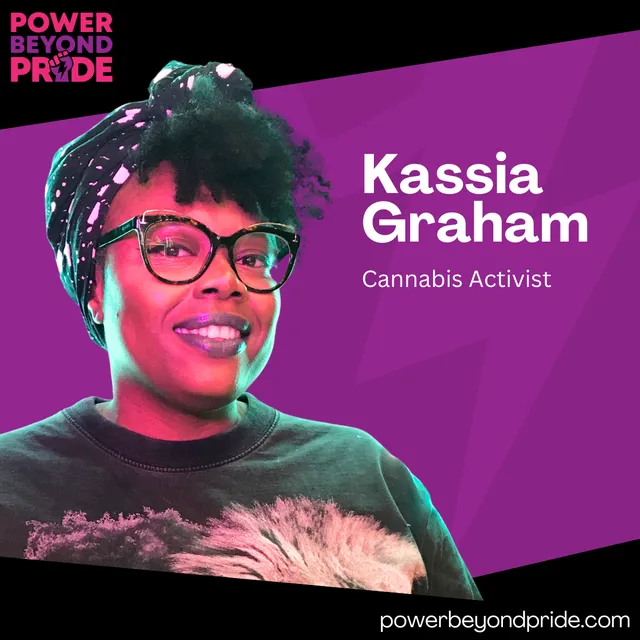
Award-winning advocate Kassia Graham joins Power Beyond Pride co-hosts Melodie KG and Daniel W.K. Lee to share insights on their lifelong connection to cannabis, its healing properties, and the need to dismantle capitalist notions in pursuit of true community support.
Kassia (00:00:00 –> 00:00:25):
There is this notion about cannabis helping to build generational wealth, and I realized that was basically just reinforcing capitalism and reinforcing this individualism. Whereas now I’m just like, okay, like, why aren’t we focusing on building communal wealth? Why aren’t we bringing that wealth into our community? We should be doing our best to repair the harms caused by the war on drugs, especially with the focus on cannabis.

Daniel (00:00:26 –> 00:00:44):
Hello and welcome to Power Beyond Pride, a queer change making podcast bringing you voices and ideas from across our fierce and fabulous spectrum to transform our world. I’m your co host, Daniel, author, poet and tofu Stan.

Melodie (00:00:44 –> 00:01:21):
And I’m your co host, Melodie kg, artivist, sex worker, rights advocate and provocateur. In this episode, we are talking to Kassia Graham, an award winning multi hyphenate advocate, consultant, digital strategist, visual artist and filmmaker, cannabis subject expert, writer and DEI specialist. Casia has more than two decades of experience working with diverse organizations, including Fortune 100 companies, cannabis companies, boutique agencies and nonprofits.

Daniel (00:01:22 –> 00:02:09):
They are frequently sought out for their expertise in the cannabis industry regarding topics including policy, dei, consumption trends and more. They are skilled in digital strategy, integrated marketing, event management and more. Besides Kassia’s professional work, they are devoted to various social causes including anti racism and Palestinian liberation. Kassia is a graduate of New uh, York University’s Tisch School of Arts, where I met them and where they majored in film and television and minor art and culture. To explore their history and story, let’s dive deeper in conversation with our guest in today’s episode, Kassia Graham. Welcome, Kassia. So excited.

Kassia (00:02:10 –> 00:02:22):
Thank you so very much. It’s always very awkward when I read my bio because, yes, all those things are true and I do all those things and I’m. Man, that’s a lot and kind of overwhelming just to hear.

Daniel (00:02:23 –> 00:02:26):
So is that a little bit of imposter syndrome or. No?

Kassia (00:02:27 –> 00:02:43):
Um, a little bit. But I’ve always had my hands and probably my feet and lots of different things. A lot of it just has to do with, uh, not just avoiding boredom, but maybe jail time. Although some of those things could probably result in jail time.

Melodie (00:02:44 –> 00:02:45):
That’s, uh, so real.

Kassia (00:02:46 –> 00:03:21):
Yeah, but yeah, I mean, I’ve lived a fairly full life in that regard in terms of the things that I’ve been involved in and the people that I’ve worked with and folks who I feel I’ve touched and who have touched me. So. Yeah, but yeah, it is a bit of that imposter syndrome because, like, how can one person do all of that. But I started doing all that stuff, like, really young. So it, it definitely builds up. And it’s also the things that I’ve learned in the past, I apply to the present and use that also to think about how I may look at the future.

Melodie (00:03:21 –> 00:03:53):
Yeah, absolutely. That’s super relatable. Just in terms of, like, all the hats you wear, all the projects you lead and things that you do. It’s really exciting to hear about. I’m wondering, especially as a vocal advocate of, uh, cannabis, really wondering how you got into. Into that, that work and how that work has sort of informed all of your other projects. And where did you start with this journey?

Kassia (00:03:53 –> 00:06:03):
I’ve actually had a lifelong experience with cannabis. My grand uncle. So for some context, I am, um, from Jamaica, born there, but not raised there. And my grand uncle was a Rastafarian. And for them, um, cannabis is a sacrament. And so I’ve always, like, grown up with it around me when I was in Jamaica, when I was in the United States, and had to keep it on the hush because cps, the minute they hear that someone has grown any kind of weed in someone’s home, it becomes, whoa, that’s a danger to the children, right? Although in order for you it to actually be a quote unquote danger, it would have to be com. Like, use it through combustion. Like, you can’t just eat a leaf or a, A bud and then get high from that. That’s not the way it works. It, uh, needs a catalyst. But what you can do is you can use it in salt, salves. You can actually eat the fronds. It’s actually delicious. Tastes a little bit like shiso, almost, uh, a little bit spicy. So it’s like a mixture of, like, I’d say rocket, also called arugula. It’s a really nice taste, and you can juice it also. It’s very diverse. And it’s something that has been a part of our diet and a part of our healing for centuries. Given its East Asian roots. It’s also a part of, uh, like, dance history. And then it’s something that has traveled around the world in one way or another. When I was doing some research for a client in Germany and like, finding out about, like, things like hemp, which is still related to cannabis, and how that was like a big part of, like, the dietary staple. And the same way that it was in, like, South Asia, some parts of Africa and the Caribbean, and then even in the United States. But because of reefer madness, a lot of things got really flipped upside down with regards to cannabis, its pros, its cons, and then just in terms of like also taking away certain sacraments from people and taking away their ability to also have a financial resource via, uh, cannabis.

Melodie (00:06:03 –> 00:06:39):
So you’ve sort of been like this lifelong sort of end user and hearing about growing up in close proximity to cannabis. That’s super interesting. I’m wondering if in the course of your activism or in, in the course of your kind of education on this subject, how often you sort of hear kind of the antis argument of like, what do you mean? You were exposed to this as a child? Like what is your, what is. So what is your response to some of that, that pushback?

Kassia (00:06:40 –> 00:10:54):
Yeah, before I respond completely to that question, just adding that it was around 2017 that I officially entered the industry and this was while I was in the process of getting a stem cell transplant. I was a two time cancer survivor prior to that. And so cannabis was a part of my healing. Instead of taking the opioids that I was given that had some really nasty side effects, I was just like, okay, this is something that I’ve used for decades, with the exception of that one time I ate a brownie that was a little too dosed. I have not had any adverse effects with it. And I was like, this is what I’m going to use to aid with the pain, with the inability to eat, with needing to sleep and uh, not being able to get there. So this is what I’m going to use. And so that was more so self guided. I had to like figure out how it would interact with other, other medications I was taking because there was one day when I got way too high and I was like high for like two days. And it was awful because I had to go to the oncologist and I was like, uh, God, do you think they can tell? And also, you know, you, each time you go, you end up being tested for whatever. And I was like, man, I hope they don’t test because. Yeah, but it was never an issue. I never saw like any kind of reports that like seemed to, that they was testing for drugs. But in terms of what I’ve heard, in terms of stigma pretty frequently. And some people would be shocked to find out that a lot of that stigma comes from communities of color and even from the Jamaican community. Like there’s a dichotomy where it almost seems as if there are maybe two Jamaicas to a degree, there’s one that’s a bit more freer, you know, and then there are the folks who are heavily into the church. And so with that leftover from colonization, well, from enslavement and colonization, you get people who, if you are not like what they consider, quote unquote, straight and narrow, sort of like you’re pushed out into other parts of society. And so that’s what happened with like Rastafarians is they’re like often maligned and misunderstood. And uh, it was always, it wasn’t great for them in terms of being an outlier. Hair is different, custom is different, food is different. So there’s like a type of food called Ital food, which basically they make foods and use sort of like the natural flavor, like carrots get a little sweet and you can just leave them alone. We don’t have to like put a bunch of like sauces and whatnot on them. And so like, like really good for you food that’s like whole food and so on. And then again like the hair being different, the religion being somewhat different though having some basis in Christianity. It also combines like animism and some other more traditional African related religions. So we have stigma in our community, stigma in the Latina community. Any, actually any community where Christianity is like heavily influenced and also in Islam. And that’s more like a cultural thing as opposed to necessarily a religious thing. So that’s important to like, well, at least in Islam, more so cultural than religion. To point that out. For some people in Islam, cannabis is haram because it’s an into, it’s intoxicating. So like, and then also you have to differentiate between THC and other cannabinoids. THC is highly intoxicating, whereas the other cannabinoids, they will give you more of like a body high versus a head high. So THC is what makes you feel like you’re blasting up into space or you’re just like sinking into your couch. Whereas like other cannabinoids, like CBD is much more like relaxing, but for your body versus your head, things like CBN that will help you to get to sleep and for me feels better than having melatonin. There are other cannabinoids that will help you with focus, that sort of thing. And what’s awesome is that although there’s all this stigma, we have what’s called an endocannabinoid system. So we have receptors for cannabis. So it’s like essentially it was made for us.

Daniel (00:10:55 –> 00:11:35):
What do you think? Like in general, uh, I mean culturally and then politically, like we’re kind of getting wrong about the discussion. Like if we’re kind of like, obviously Narrative framework is kind of the thing that can kill any kind of work. It’s so intrusive and uh, obstructing with Palestinian liberation. But with cannabis, even in a, uh, national context, what are the narrative through lines that are just flat out wrong and what, how they, how should they be recalibrated?

Kassia (00:11:35 –> 00:13:21):
M I think a lot of people are under the impression that cannabis can solve every and any problem that someone has. Does m it have multiple uses? Yes. Is it right for everyone? I don’t believe so. Um, there are some folks who have certain mental health issues whereby cannabis can exacerbate it. If someone has like issues with their lungs, like cannabis is a bronchodilator, but that doesn’t mean that you should necessarily consume it in such a manner. You may want to try a salve or you may want to have an edible or something like that. You may not necessarily want to smoke it, but also more so on the commerce side of cannabis, there is this notion, and for a while I bought into it too, about cannabis helping to build generational wealth. And I realized that was basically just reinforcing capitalism and reinforcing this individualism. Whereas now I’m just like, okay, like why aren’t we focusing on building communal wealth? Why aren’t we bringing that wealth into our communities? And it’s not just dispensary owners or I can’t even say farmers because farmers get the shit out of the stick with cannabis to a degree. But it’s like we should be doing our best to repair the harms caused by the war on drugs, especially with a focus on cannabis, because that’s how they got a lot of people across the country. But then also in New York State, especially with the Rockefeller drug laws, I could do a whole go down a rabbit hole with that for lots of different reasons, especially because some members of the Rockefeller family are now in the cannabis space. And so that presents like a whole other discussion irony that’s so interesting.

Melodie (00:13:22 –> 00:13:29):
I do want to ask about this idea on building individual wealth.

Kassia (00:13:29 –> 00:13:29):
Mhm.

Melodie (00:13:30 –> 00:15:26):
But first let’s take a short break here and get back to you in a minute. We are in conversation with Kassia Graham and we’ll be speaking about their work around DEI and some fun stuff on the other side of the short break. Welcome back. This is Power Beyond Pride, a queer change making podcast and I’m your co host Melodie and I’m here with the beautiful and creative Kassia Graham. Kassia, before we went to break, you mentioned as sort of a, a narrative thing that happens within cannabis advocacy is there’s a misconception that, that in um, sort of industrializing cannabis use can sort of build individual wealth. And I wanted to bring this up because as we’re seeing new states roll out what we’re calling sort of this recreational or adult use cannabis, we’re seeing progressive states like the one I’m m in Minnesota try to do things like have, have what they’re calling like social equity kind of lotteries for cannabis licensing or programs that really are trying to refocus hyper marginalized communities and folks who are historically affected by particularly the war on drugs. And so these programs are sort of aimed, as you may know, at uh, of trying to like, trying to encourage those folks to do this sort of like building of individual wealth and trying to like reclaim this business identity. So I’m wondering if you could break that down a little bit for us and tell us like what’s sort of wrong with that narrative.

Kassia (00:15:26 –> 00:19:51):
Social equity has been such an uphill battle for advocates as well as owners, whether they are farmers, processors, dispensary owners, and there are also so few farmers of color as well as so few processors of color. There are a decent amount of dispensary owners. But for instance, I know that in Massachusetts there was a program whereby people who were disproportionately impacted by the war on cannabis, especially those who are of color and other marginalizations, were able to get a quote unquote head start, which may even been called a head start. I think that’s also where they went wrong. But those people should have been granted that early access to the space. And there were a couple of larger companies, multi state operators and registered organizations who were basically like, nope, we want to get in there immediately. And they sued. A similar thing happened in New York where we had our conditional adult use dispensary licenses. And these large companies again came in and we’ve had like injunction after injunction because they want to put a hold on these smaller businesses that uh, are largely owned by people who may have been incarcerated or who fall into, they may be people of color, people women, service veterans and other people who fall into like different protected classes. And these companies have all of this money. They know that once they enter into the space, they have the marketing money, they have the money for the rent, they have the money for everything and anything that they could want in this space, that they’ll be fine, that they will thrive. But they feel that they have to stifle progress for other people, which I feel is very typical. And very USian in nature. And so that’s been like, quite the struggle in New York. And now with these ros who are coming into the state, they, they are really impacting the way that our Office of Cannabis Management does things. They have the lobbying money, they have the people, they have the lawyers, all that stuff. And so, to a degree, I almost feel sold out by the state government. But what’s new? So what’s happening here is not essentially a shock. It’s just, it would be nice to not be let down. And in the beginning, we had some folks who were in the OCM who I thought just were really amazing. And they were really invested in the people who are part of, like, either the social, Social equity program or the conditional adult use. We had different programs for, like, farmers and processors and dispensary owners, and they ended up getting pushed out because, as usual, it’s about playing politics. It’s about, like, giving this little glimmer of hope, but then, like, actually having other folks lined up to take the place of the more progressive people, because heaven forbid that we actually support a thriving industry that is has a decent amount of marginalized people in those spaces. And what we’re seeing is that there’s some dispensaries who are having. Never mind that we did, like about a billion dollars in sales this past year, but there are dispensaries that are struggling. It’s difficult to pay rent. In New York City especially, it’s difficult to maintain a, uh, staff. It is difficult. For a while, people weren’t really able to advertise. They’re just starting to, like, roll those out. So it’s just like, okay, well, how do you reach your audience besides just existing in this particular space? Social media is highly restrictive with regards to advertising. And some people don’t understand the power of something like a newsletter. But it’s also like, how do you get people to sign up for your newsletter? You know, um, trying to encourage people to use alternatives and some creative marketing to get their brands and to get their dispensaries and so on out there in front of people. And a lot of that relies heavily on, um, community building. There’s some people who are amazing at it because while capital is important to them, they also recognize the needs to meet their communities, to support them in any way that they can. And then there are other people who are so focused on capital that they’re just like, kind of discarding their community.

Daniel (00:19:51 –> 00:20:18):
What would you say is kind of the organizational, like, opportunities that are at the intersection between, like, Cannabis activism and other issues, LGBTQ or maybe a privacy activist or something like that. Like, where do you, in your, from your perspective is kind of the conversation needs to kind of move towards, especially in this new, like, political context. Right.

Kassia (00:20:18 –> 00:25:24):
One thing that irks my soul is people who are only here for cannabis equity. The failure for some people to see what those intersections are between race, age, the environment, the prison industrial complex, education, it all comes together and it’s all important. I understand people can’t focus like on every single thing that pops up, but solely saying, oh, I’m m just here for cannabis equity, and then ignoring everything else that is a part of that just doesn’t compute for me. And then that’s also how I know how authentic someone is with regards to whether or not they’re really here for cannabis equity really, or just cannabis equity, in a sense that I want to build a quote unquote generational wealth, which again, we end up chasing these myths and these ideas of the way that we’re supposed to be. And it’s still under that context of this, like, white supremacist capitalist culture that we have in the US And I’ll, uh, I’m also going to say even in other parts of the west, because while parts of Europe are largely socialist, they still operate under a capitalist notion. And that’s something that can’t be denied in terms of those intersections with cannabis. Like as I pointed out during the break, when we’re talking about hiv, AIDS and the folks who are pioneers, so Dennis Perrone and Bonnie Mary, Dallas Buyers Club and so on, that’s an important intersection. And then if we’re looking at that, you have to think about, let’s say, some of the folks who were initially being supported in that way, people who were of color, people who were sex workers, trans folks, people who had different socioeconomic backgrounds. So people living in underserved neighborhoods. So there, there are all these intersections that just go right there. And with, let’s say our conditional adult use program that we have in New York, the people who were supposed to largely benefit from that were people who were previously incarcerated for the war during, you know, the crackdown on cannabis. So who are those people? People were largely male, black, Latino, typically on the younger side, more than likely not college educated, had a criminal background. That school to prison pipeline is so very real for folks in the city. They may have come from places where there were food deserts, lots of economic insecurity and so on. And so all of that basically led them down this path. But it’s I think it’s difficult for some people to, like, see that, especially because they’re chasing that generational wealth. They’re chasing what’s supposed to be the American dream. And the American dream, like, literally, like, as I got older. And a lot of the, some of that was thanks to, you know, the conversation I had with Dan. It’s just that the stream is not only a quote, unquote nightmare, but it wants you to stay a bit stagnant. So you can’t see how all these other things may have affected you. Because now with this recent election, seeing some men in cannabis and not just white men, but men of color saying that they’re going to vote for Trump, and I gather they did. I was just like, you do realize that if you’re going to be in the space, whether you are on the legal side or the legacy side, you are going to be affected by anything that’s coming down the pipeline. That also includes that when we were having this conversation about rescheduling cannabis, although rescheduling is awful, because even if they made it a schedule, I want to say two drug, you have to get a prescription. And then that is just a greater detriment to people who are on the retail space, because, okay, who has maybe 80,000 to $100,000 per year to add a pharmacist to their staff? And then if you go ahead and you add this pharmacist to the staff, that means that everyone needs to have a prescription. So people have to go to a doctor to get this prescription. And then if you get a prescription, what drugs is it that you take that you may not be able to use anymore if you are going to be consuming cannabis? When a couple years ago, when I was in therapy and I was getting meds, I was drug tested. It did come back positive for cannabis. And so I wasn’t going to be able to get my medication, but my therapist was just like, come back in a month, we’ll do it again. And as if it’s clean, then you can, you know, go ahead and get your meds. So I did exactly that. But it’s just like, why would I have to choose between these two things that I need? But then it’s just funny when you think about the way people abuse prescription medication, but they keep on giving those meds out. So it’s just like, what’s it really about? Is it really about my health or is it more so about discontinued stigma surrounding cannabis use?

Daniel (00:25:24 –> 00:26:40):
100%. 100%. We’re going to take A quick short break here and when we come back, we’re going to chat a little bit about mutual aid and other sides of Kassia as an artist and a writer. We’ll be right back after the this short break. Welcome back. We are in conversation with the, uh, fantastic, beautiful and talented Kassia Graham. I wanted just to pivot because I, I know you’re passionate about mutual aid here in New Orleans. It’s, there’s quite a big, quite big energy in organizing around mutual aid. Like I’ve never really seen it before and, and it may be, it may have roots in, well, broader cultural roots, but it’s definitely saw it intensely during the COVID 19 pandemic. And I’m sure the kind of collective trauma of Katrina also makes it a very kind of vibrant way of organizing communities and this kind of non means tested way of like helping each other. Why don’t you tell us a little bit about mutual aid and where you live and why are you excited about it?

Kassia (00:26:41 –> 00:30:22):
So just given the nature of these various systems that we have that put so many restrictions and barriers on marginalized people, it quickly became a workaround. I think people are probably more familiar with mutual aid starting around like the 60s, 70s, but it’s been going on for much longer. There’s always been mutual aid in marginalized, uh, communities there. But I feel that it wasn’t until maybe in the last decade that it’s picked up and more people have a better understanding of it because there’s this idea that mutual aid is like a handout and it’s like. No, it’s called like community caring. We are showing up for each other in ways that our state, well, our local, our state and our federal government will not would. If there’s someone who is fleeing dv, should they wait, should they, you know, have to set up an appointment and then wait for someone to aid them? Or can they basically send out a mutual aid call to get a hotel room or to have some expenses paid for by their community without having to jump through hoops, without having to quote, unquote, prove that something is happening to you. It’s invaluable in terms of aiding not just people who are citizens here, but also people who are non citizens because they can’t count on those systems to help them. There’s this idea that from, um, conservatives that somehow folks who are migrants, folks who are refugees and so on are like draining our systems. It’s like they can’t even qualify for a lot of the programs that we have. If you don’t have a Social Security number, a green card, any other type of status. You cannot qualify for tons of different programs. And so it’s like, okay, the community is here to aid in taking care of you. You need the rent paid, you need to get some food for your children, you need a place to stay, you need your car to be repaired. People are here to help. And one thing, when I was working with a cannabis magazine, won’t say their name, but I was on their board and I was trying to get them into working with more M SO mutual aid organizations, and not just 501 C3s. Because I was just like, there’s a great need for marginalized people to be supported in this way. And it’s not just all about a tax write off. And if someone is just here for a tax write off, then what’s the point in even giving to charity? You’re saying that, like, you have this restrictive notion of, uh, who deserves your help? And that should not be the case. No one should be going hungry, no one should be in fear. No one should not have, like, their basic needs met. And so that’s why I love people who are heavily engaged in mutual aid across the board, because they see just how important that is. And we see the effects of mutual aid and people being happier, healthier, and thriving and then also not having that feeling of shame. And shame kills. And I think we’ve routinely seen how shame can kill across the board. Whether it is people staying in relationships that are harmful to them, where it is people having not being able to, like, negotiate sex. And so they put themselves in danger in some ways. But then when you know that, like, your community is there and will show up for you and will not judge you, you feel a lot more fear. And in that freedom, there is safety for sure.

Daniel (00:30:22 –> 00:31:30):
I just got to put a little, like, punctuation on that. I was just recently listening to a podcast which kind of was somewhere about this. But what I really loved was this point that the person was making that, like, this whole narrative about social Darwinism. Um, the reality of the truth of it is that humans were able to survive because of collaboration. We helped each other. That’s how we were able to hunt large animals, because we couldn’t do it our fucking selves. So this lie, this absolute mythology of bootstrapism, um, and, oh, we can just do it ourselves. And one person survived, and they did it in this vacuum is this complete nonsense that our mutual assistance, our collaboration has propelled the human species forward. So, yeah, I think that’s kind of like a through line. It’s part of that larger, not just discussion, but real, uh, thought and action that we ought to embrace as we organize.

Kassia (00:31:30 –> 00:32:08):
Absolutely. And then it’s like. You know what’s funny is when I think about when we got to the point where someone decided that it wasn’t okay to work together anymore unless you were doing it for them. So when I think about some aspects of religion and some aspects of royalty, it’s like you start to see the way that exploitation led to this idea of rugged individualism, especially in the United States. And it’s funny because it’s like, again, this dichotomy. It’s like, okay, well, work together, but not too much.

Daniel (00:32:10 –> 00:32:12):
You know, like labor organizing.

Kassia (00:32:12 –> 00:32:40):
Yeah. And it’s like, come to church together. But when you leave. Oh, and tithe. But when you leave, look down on the poor person who’s out there because they’re not working as hard as you are. This is leaning more. So it’s like prosperity preaching, like the Joel Osteen type stuff. And also the Kim Kardashian stuff. That’s a whole can of worms that a friend of mine, Libby, could really get into. It’s just sort of scary the way that we and, uh, can’t see ourselves.

Melodie (00:32:40 –> 00:32:40):
Yeah.

Kassia (00:32:41 –> 00:33:35):
So when I think about what is happening in Palestine and how there’s so many parallels, especially when there was the whole, like, Starbucks thing with some black folks. It was actually a really small number of people. So that really just kind of irked me also, because it was so overblown. And there’s a reason why it’s overblown. Like, when you think about things like cointelpro and other ways that the government gets involved with these bad actors in activism and so on. And so it’s like, you can see the police brutality here. You can see the food desert here. You can see how just your mere existence is a threat to the powers that be. And yet you cannot see how what’s happening in Palestine is awful and the antithesis of who we as humans should want to be.

Daniel (00:33:35 –> 00:33:36):
100%.

Kassia (00:33:36 –> 00:33:37):
Yeah.

Daniel (00:33:37 –> 00:33:39):
And it’s a mirror. It’s an absolute mirror.

Kassia (00:33:39 –> 00:34:25):
Yeah. And then the other side of that is. And I shared something on social media, which is basically like, I don’t need to understand someone. I don’t need to be a part of that community M to support and uplift them. And so sometimes, while I understand you need to see yourself in people, there are also other times when you absolutely should not and don’t need to. Like, yeah, there’s this like selfishness that some of us have and it’s difficult because it’s so ingrained in us to a certain degree and I wish that we would like sort of snap out of it. But it’s the kind of thing where like, I mean, as I said, like, ingrained in us. And so it’s going to take a lot of unlearning, a lot of undoing and then redoing in order to move past that.

Melodie (00:34:25 –> 00:35:17):
Yeah, and I think that’s so important and it’s one of the reasons why I think a lot of us, uh, and myself especially really place high deference to art. Right. Because artists and creators can often hold up that mirror for folks, uh, and really get folks to, to feel things that maybe they wouldn’t otherwise feel. And you as an artist yourself, I know that you have done a lot, you’ve made a, uh, film, Cannabis and Creativity that you produced and assisted in directing that’s won some really cool accolades. Wondering if you could tell us about, about that film and about how you think about your sort of creative process along this line of trying to hold up a mirror to society.

Kassia (00:35:17 –> 00:37:05):
So Cannabis and Creativity is an endeavor that I took on with my colleague Elena Frankel. She was the director and my co producer and I assistant directed. Leo wanted to introduce people to folks who they could uh, identify with to a degree. So we have these women and non binary folks who were creatives in different ways. So we have a writer, someone who is a chef, a scientist, who is also a musician, a designer and a vocalist. Ah, I think she’s also an instrumentalist. And we just wanted people to learn more about their creative process as well as just like who they were as individuals and how cannabis helped to put it all together. So it’s like here are these women and non binary people who have different races, different backgrounds, different religions and yet they have this one thing in common that aids in driving their creativity to a degree. And so we just wanted to be able to showcase that. And then it’s also what’s happening in cannabis to a degree. Not so much anymore, but it’s happening a lot where people are heavily focused on celebrities and cannabis as opposed to your everyday person. And we didn’t want to fall into like that trap of uh, oh, uh, well, we’re only going to profile this like basketball player or this rapper or this comedian who is now in the space. We want to focus on real people and their stories and being able to empathize with them and understand and then also question how cannabis operates in relation to whoever the viewer is.

Daniel (00:37:05 –> 00:37:25):
That’s really great. I’m, um, I’m so. I wish we had so much more time to kind of talk about the, the short documentary and your creativity. But we’re going to have to do a little quick pivot. We want to give the audience an opportunity to get to know you a little bit better. So we have some rapid fire questions to ask you. Are you ready to take the plunge?

Kassia (00:37:25 –> 00:37:27):
Yeah, ready when you are.

Daniel (00:37:27 –> 00:37:30):
So what’s the best pickup line you’ve ever used?

Kassia (00:37:31 –> 00:37:40):
Oh, my gosh. You know what’s funny is, ah, I’m like, I don’t think I’ve ever really picked someone up. I just exist. That’s how I pick people.

Daniel (00:37:42 –> 00:37:45):
Just 10x of them, basically.

Kassia (00:37:45 –> 00:37:55):
Yeah. Uh, I. Yeah, I don’t. I don’t. I’m not special, but I. I wouldn’t say. I don’t think I’ve ever used, like a pickup line. I don’t think so. M. Yeah. Wow.

Melodie (00:37:55 –> 00:38:00):
How about. What is an embarrassing moment that you’ve experienced in the past six weeks?

Kassia (00:38:02 –> 00:38:06):
This is the state of the United States count as an embarrassing moment that I’ve been experiencing.

Daniel (00:38:07 –> 00:38:08):
Legit.

Kassia (00:38:10 –> 00:38:32):
Yeah. Because it’s been embarrassing. My friends are like, are you okay? What’s happening over there? I’m just like, asking me how I was doing. I was like, asking me this question in this, like, climate and this economy, like, yeah, but definitely been embarrassed. I mean, not just for these past six weeks, but for a hell of a long time.

Daniel (00:38:32 –> 00:38:37):
Right on. Um, next question. Where’s the best place in New York City to get Jamaican food?

Kassia (00:38:40 –> 00:39:42):
I don’t know. I may have to, like, get. Keep girl boss with that because first of all, oxtail. The price of oxtail. The minute we were like, oh, this is amazing. White folks swooped in and were like, oh, look at that. That price is going to go all the way up. So I have mixed feelings. I almost want to send people in the opposite. Direct. That’s it. Yes. But also, I wouldn’t say just Jamaican food as a whole, but I love jerk chicken. Oh, so delicious. But also has to be done right. There can be sometimes where it’s not juicy enough, where sometimes it’s too hot, where the flavors just, like, aren’t there. My favorite spot for jerk chicken. And goodness, please. I hope the world does not ruin this for me. I also hope I didn’t get called out by my fellow Jamaicans and whatnot. Peppas on Flatbush has the best jerk chicken in Brooklyn in my Opinion. It is so freaking like, oh, I could gorge on that. It is so delicious.

Daniel (00:39:43 –> 00:39:44):
She said gorge.

Kassia (00:39:45 –> 00:40:23):
It’s so good. Like, whenever I have it, I’m just like, feels like home. It feels like love. It’s sort of like euphoric to a degree, so. And the thing is, what I love about it is that it’s just your bare bones classic jerk. It’s not like a bunch of tick tock and Instagram bells and whistles. Not saying I hate that stuff either. Some of that stuff that I see people making, I’m just like, like oxtail pizza. Or this that I’m just like, ooh, those are fun. But something that is just classic and traditional. Having the jerk with like, the jerk sauce and a little bit of like Scotch bonnet hot sauce.

Melodie (00:40:24 –> 00:40:28):
Oh, perfection. That sounds amazing. I’m so hungry now.

Kassia (00:40:28 –> 00:40:32):
Smoky, sweet, savory. All the flavors. Yeah. Umami.

Melodie (00:40:33 –> 00:40:37):
Yes. Amazing. What’s your favorite can of beverage if you have one?

Kassia (00:40:38 –> 00:41:27):
I am biased. There is a man named Luke Anderson. I don’t believe he has a day to day anymore, but can is so delicious. They have just like a really wide variety of flavors and it doesn’t have like that much of like, you know, a heavy weed taste. So I definitely really like that. And there is another brand called Heirloom. Their cola flavor, so good. So good. I dare say it’s better than like Coke or Pepsi. So that’s what we traditionally associate with like those cola flavors. And I’m just like, it’s just right. I also think it’s good for an adult palate too. Whereas, uh, coconut Pepsi tends to be on the sweeter side. And this is more so like, you know, it’s. It’s a just right flavor.

Daniel (00:41:27 –> 00:41:28):
Adult use 100%.

Kassia (00:41:28 –> 00:41:31):
Yes. Adult use flavors.

Daniel (00:41:32 –> 00:41:37):
Next question. Who is a writer or artist that has inspired you the most?

Kassia (00:41:38 –> 00:42:05):
Oh, my gosh. I feel there’s so many people, uh, like the child in me wants to stay. I mean, problematic. But Dr. Seuss, all the places you’ll go. Yeah. But, oh, geez, that one is really tough for me. I think right now I don’t have a particular, um, answer because again, I. Can I just say a museum. Can I say the Brooklyn Museum of Art and everything that’s in there?

Daniel (00:42:05 –> 00:42:07):
Yeah, absolutely.

Kassia (00:42:07 –> 00:42:10):
I mean, including the stolen stuff, I guess.

Melodie (00:42:11 –> 00:42:16):
Yeah. Amazing. You were brilliant in this rapid fire.

Kassia (00:42:16 –> 00:42:17):
Kassia.

Melodie (00:42:17 –> 00:42:23):
Where can people find out more about yoel and your work and your words?

Kassia (00:42:23 –> 00:43:36):
Well, people can follow me on Instagram for now at missgoodegg. That’s M. S G O O D E G G But I’m also on um, bluesky, which is where I’m trying to migrate to, because I would really like to get off of these Met platforms. And not just because Zuckerberg sucks, but also it’s that matter of like maintaining that a bit more privacy and also deciding how it is that I want to disseminate information. And I think that for this, for the safety and the well being of uh, folks, we have to start removing ourselves from these systems that are harmful. It’s not so much that social media itself is harmful, but the people who profit off of it, unfortunately they don’t mean us. Uh, well. So it’s gonna be interesting to see how the quote unquote trial goes because it feels like it’s a horse and pony show with Zuckerberg and whether or not he will have to sell different parts of the meta platform. So there is Facebook, Instagram, WhatsApp, and I feel that there’s something else that I’m missing, but we’ll see how that goes.

Melodie (00:43:36 –> 00:43:40):
Hm. Great. And sorry, one more time, what’s your Blue sky handle?

Kassia (00:43:40 –> 00:43:41):
It’s Ms. Good Egg.

Melodie (00:43:41 –> 00:44:03):
Also wonderful. I do wish we had more time to continue this amazing conversation, but we’re out of time for now. You can learn more about Kassia by following them at missgoodegg on all the platforms. And I’m Melodie kg. You can find me on, um, Instagram. Elody M E L O D I.

Daniel (00:44:03 –> 00:44:27):
E Hey G and I’m Daniel W.K. lee. I want to thank our guest Kassia Graham for joining us today. A, uh, conversation and sharing so much. Remember to subscribe and get your friends to subscribe to Power Beyond Pride wherever you get your podcasts and check out our site@powerbeyondpride.com as well as following all of our socials.

Melodie (00:44:28 –> 00:45:00):
Power Beyond Pride is a project from A Great Idea, a queer owned design and content agency. Learn more about them atagreat idea.com this episode is produced by Shane Lukas. Sumito Sarkar is the project developer. Our editor is Jarrett Redding with support from Ian Wilson. We are both part of this podcast host team and we invite you to send your questions and comments to powerbeyondpride.com we look forward to Queer Change making with you at Power Beyond Pride.

Frequently Asked Questions
What is Power Beyond Pride?

Power Beyond Pride is a weekly podcast featuring LGBTQ+ individuals from across the identity and expression spectrum who are leading or participating in meaningful organizing and transformative activism. The show shares their stories, the power of their purpose, and how listeners can engage in their own communities. Two of the host team will lead each conversation. Once a month, all hosts will engage in a group chat about movement trends and the latest news.

To be a guest on Power Beyond Pride, you must identify as a member of the LGBTQ+ community and be engaged in community organizing or movement work. Contact us at guest-@-powerbeyondpride.com with your information and interest.

If you are an ally, we encourage you to subscribe, share your questions, and help elevate and celebrate queer changemakers in your movement work and communities.

The Power Beyond Pride Host Team is created from queer changemakers across the country bringing lived experience and movement expertise to each interview and interaction. Learn more about them here.

Power Beyond Pride has a talented and skilled production team that records and edits each episode. Learn more about them here.

Power Beyond Pride is an initiative of A Great Idea, an award-winning LGBTQ+-owned and operated brand and design agency serving nonprofit, education, and healthcare partners across the country. Learn more about their community engagement initiatives as informed by their values at https://agreatidea.com/values