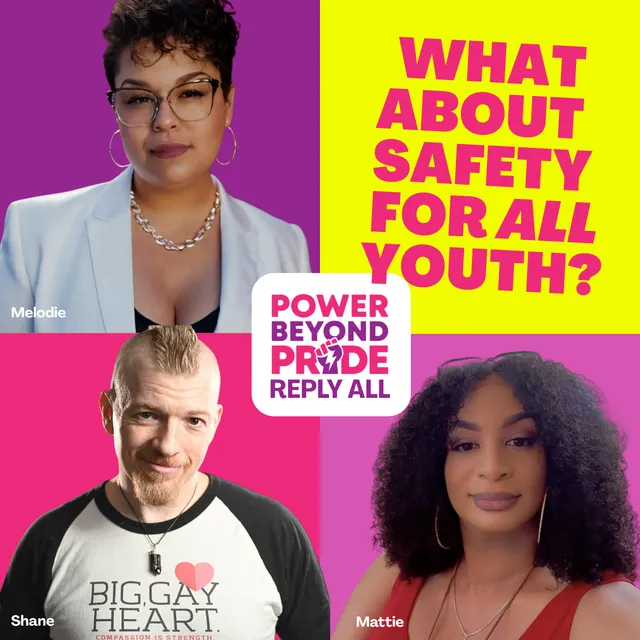
Co-hosts Mattie Bynum, Melodie KG, and Shane Lukas delve into recent anti-LGBTQ+ legislation, highlighting how these issues directly impact the real safety and development of all youth, respond to ramped up attacks on queer and trans+ people from the recent headlines, and reach into the mailbag to reply to listener questions.
But I feel like we’re always on the defense because they’re approaching something that I think queer communities still haven’t made a good internal sort of reconciliation with, which is that we feel like we still have to defend ourselves from a moral and ethical standpoint. And we don’t. Queerness is inherently moral, it is inherently ethical, and it is a beautiful thing that has always made the world better.
Melodie (00:00:27 –> 00:00:46):
Hello and welcome to Power Beyond Pride, a weekly queer change making podcast bringing you voices and ideas from across our fierce and fabulous spectrum to transform our world. I’m Melody kg, a Minneapolis based artivist and provocateur, and I’m one of your co hosts on today’s Clear Cast journey.
Mattie (00:00:46 –> 00:01:00):
And I’m Mattie Bynum. Um, activist, singer, actress. I think I changed my bio every time we do this, but let’s just stick to the key high points, which is comedian, actress, activist, and, ah, all amazing cook from the South.
Shane (00:01:00 –> 00:01:39):
And I’m also your co host, Shane Lukas. See, him is. And I am a lifelong activist, harm reductionist, owner of a great idea, and I like to dance in the shower. I know it’s not safe, but I’m, um, still gonna do it because it brings me enormous amounts of joy. So that there’s that. So if someday my obituary reads, person danced in shower, and that’s what happened, put me on the Darwin Awards, it’s fine. But it was worth it just for the joy. Each week on the Power Beyond Pride podcast, we invite you to join us as members of our host team. Welcome and get to know an LGBTQ activist, movement, organizer, and inspiration that is actively transforming our world.
Mattie (00:01:39 –> 00:01:56):
Once a month, some of us, uh, Power Beyond Pride co host gathers together in what we like to call Reply all, where we focus on issues or questions impacting our communities in every way. We share insight from our own work as activists and take questions from the Power Beyond Pride mailbag.
Melodie (00:01:57 –> 00:02:16):
As of this recording, we are closing out a newsworthy Pride month. And we talked last month about how it looks challenging going in, sponsors pulling out, cities getting nervous, and World Pride attendance goes flaccid with less than a million attending of the 3 million projected for the parade alone.
Shane (00:02:16 –> 00:02:19):
I take credit for all of the double entendres.
Melodie (00:02:20 –> 00:02:21):
I love it.
Shane (00:02:21 –> 00:02:43):
I was at the World Pride Parade and the market event in D.C. all of which seemed to underscore the commitment people made to show up and the very real absences by those regionally and globally processing the current moment’s risks. I mean, it was really unexpectedly quiet. I, uh, shouldn’t say Unexpectedly, I guess we knew going in, people were cautious, but it still felt weird.
Mattie (00:02:43 –> 00:02:44):
Right?
Shane (00:02:44 –> 00:03:05):
I’ve been to a lot of Pride events. I’ve been to a lot of stuff that feels very energetic, enthusiastic, and this felt just awkward. I think that there’s definitely something in the air. And the events seem to underline the significant and repeated attempts of the current administration to roll back both the resources and recognitions for LGBTQ people, I gotta say.
Mattie (00:03:05 –> 00:03:47):
But I also do still with you saying that not only was Pride a little bit more flaccid, it sent that forward because. To go with for today, but I think it’s also does so like the. The event that had been leading up to it, including the stripping of Harvey Milk’s name from barrel shifts, the removal of funding for hotlines that assist people with Trans plus and queer experiences from behavioral health support, and just this past week, the Supreme Court ruled that not allowing parents to opt their children out of reading storybooks that are a part of an LGBTQ inclusive literacy curriculum burdens their religious freedom. That’s the lot going on in our world right now. Yeah.
Shane (00:03:47 –> 00:05:12):
Yeah. I mean, that’s an understatement. I think, again, there’s so much there. There’s so many different pieces at this moment where the idea of queerness is being called into question. And at the end of the day, I. And I. I have to come back to this idea of, uh, what it means to. When I talk about this, really about saving the children. Right. There is this constant sort of peace that’s going on right now. And I think one of the biggest challenges that we have when we’re having this conversation is how do we have a healthy and really constructive conversation about what it means to. To think about younger people who are encountering concepts and moments that they have not been given opportunities to process. And I get. That’s one of the big things. But, like these children that the right so desperately want to save, I just keep coming back to this idea of, who are these children really? Are they extensions of the bigots themselves? Or is there legitimate research, Is there a legitimate conversation that suggests some people exposed to the existence of queer people does harm in their development? Like, I. I have a hard. Like, I’ve been around. I’ve been out since I was 17. I remember being a young person. I’ve worked with a lot of young queer people over the years, and I just. I, uh, haven’t seen one piece of research that suggests the harm in encountering the existence like, that queer people exist. I don’t Know, do you all have thoughts on that?
Melodie (00:05:13 –> 00:05:49):
There’s no research. Because that’s not. People are scared for reasons that have nothing to do with fact or re. Like reason. Right. There’s no. There’s. I, as a person can tell you that I was actively harmed as a youth by being exposed to cishet patriarch normative. I like just regular non queer people. Those folks did the most harm to me psychologically, developmentally. Nobody’s studying that, right?
Shane (00:05:50 –> 00:06:09):
Yeah, no, uh, absolutely. I mean, I think that there’s real research about gun access. There’s real research around. There’s. There’s so many things that do specifically harm children. And so. But yet this message comes up over and over again when. Particularly when we talk about trans transplants, athletes.
Mattie (00:06:09 –> 00:06:09):
Right.
Shane (00:06:09 –> 00:06:28):
When you talk about access to the. The A bathroom that aligns to someone’s identity, like, all of that being, like, where is this harm? And like, why is it so potent at galvanizing a population? Why does it work so well and yet has no basis. Well, honestly, I do believe that as.
Mattie (00:06:28 –> 00:07:16):
A kid, I know my upbringing. I did. I suffered more harm from m. The church and from religious, quote, unquote. Supposed to be people that were supposed to protect me, but those were the ones that hurt me. And it’s interesting how every child. I can pretty much say every child has some type of memory of that woman or that person that was in the community. There was no relation to them, blood wives or name wives, but they always seem to be that person in the community that had the safest place. And a lot of times that was of the LGBTQ community. It was the drag queens, it was the trans women, it was the gay men, gay women, the people of the community. It’s funny how we’re perceived to be evil and scary, but we’re actually the safest place for the children and people.
Shane (00:07:16 –> 00:08:48):
And what a healthy message it is that there is difference in communities. Right. Every young person is going through this process of figuring out who I am, even if I’m going to identify as a cishet male, all these different things. The idea that there’s difference across communities is oftentimes just an acknowledgment of multiplicity, which I can’t think of as a somehow inherently negative concept. And yet we get adults who show up as if there’s this moment in a young person’s experience where they encounter something different, as if the difference alone is going to cause them harm. When, as you pointed out, Melody, and actually, as you talked about as well, Mattie, it is the institutional harms that, that do the most damage. It is the religious institutions that say like anything outside of this very strict parameter is just makes you a uh, non person or this system that says if you don’t fit into this box, you are not a person. And I know, I just don’t, I just can’t. I just don’t see a lot of young people who are like well that was good for me like that somehow like hearing those messages of the, the reductive nature of experience was somehow good for them. That I don’t hear very much. And yet again we often see that this idea that the uh, existence of a queer person, the existence of, and we could extend this to non faith participation or anything that just lives outside the box is somehow a threat to young people.
Melodie (00:08:49 –> 00:10:30):
Yeah. I think like for these conversations it’s helpful for me to use a framing of like evolutionary psychology, right. Where like take our sentience away from um, for just a minute as an example. As kind of animals walking through this earth, we have patterns that we have learned, right. Throughout generations and generations. We also have inputs that, and instincts that tell us what is good, what is bad. And it’s all in the name of propagating the species. Right. And so I think when it comes to these bigger societal issues, there’s not always a conscientious understanding that like we as sentient human beings are able to like take a step back, realize those instincts and move beyond them. Right. Which is why like all kinds of prejudice exists. Right? Prejudice exists from an evolutionary psychology standpoint as like a very real and actually important thing for us as species to enact. Right. It’s good to say don’t go into a stranger’s van because generations have told us that doing that will get you snatched. Right. And it’s these things that morph into institutions that are then like upholding these things. And we as queer people, I think, and maybe this is a little bit woo woo and I’m just like saying this off the cuff kind of, but.
Shane (00:10:30 –> 00:10:31):
It’S I like a woo woo.
Mattie (00:10:31 –> 00:10:32):
Bring it.
Melodie (00:10:32 –> 00:11:18):
Maybe queer people are like the next evolution of this thing. And people are scared inherently because they don’t know what it means. They’re fearful that their own thing will be outnumbered and outgrown. Right. And at a very like, at a very like carnal level. That is scary to us as beings when we don’t decouple that from our like humanity. Right. So people are just not okay. People are not okay. And they’re stuck in this. They’re Stuck in the cycle of not being able to, like, distance themselves from the fear that exists from all of that kind of evolution.
Shane (00:11:19 –> 00:13:53):
So I think that’s interesting in some ways. Mattie, I’d love to hear your thoughts around this. I would say I think queerness is less of an evolution and more of just an acknowledgement of the humanity. Like human beings have always had a multiplicity of desire, identity, expression, a variety of. A variety of ways of being. The gender, even. When we talk about. When we talk about intersex identities, when we talk about, again, there are. There is a wider range than we were initially led to believe existed in this world of ways to be. And I think that queerness is. I love the idea about, okay, we’re kind of evolving it. I would say it’s just more of an acknowledgment of what’s always been here. And the more you dig into history, the more you begin to see that there are. There has always been this greater spectrum of identities and ways of being in this world at whatever age an individual is. And young people, and I really look to young. They’re experts in cognitive psychology and cognitive structures that really focus on young people and their development and ways that they process gender, the ways they process their relationships and interrelationships with other people. And there is so much there that is amazing and insightful and how robust and resilient. And in some ways, I think just vibrant young people are in their way of seeing the world because they want to inherently include people in their perception of the world. And so I love that idea that when young people are processing, they are thinking about. If you tell the, uh, if you tell a young person that, like, hey, plants have feelings, they’re likely to be like, hey, you know what? I can kind of get that when I water it and I take care of it and I talk to my plant grows. Like, you don’t have to understand, uh, the full science of it, but they understand that if I have an effect on the world that’s positive, that is a beautiful thing. And there are great ways to think about cognition in that context. And yet, like, a lot of these rules are being sort of put on as if children can’t find the heart to see the humanity in other people, as if they can’t find a space to love in the way that we all should come to the table and care about the wellness and wellbeing of other people. And that, to me, I think, is probably one of the more cumbersome elements of this. And why I think Young people push back from it most often.
Mattie (00:13:54 –> 00:17:35):
But you know, and I do agree with you, Shane and Melody, but I think it’s more so than the evolution or the evolving of. I think it’s just the idea of the eradication that they could not do with us. Because think about the supreme patriotic society that we live in. One of the biggest issues that I think that especially the top 10, top 1% and the supreme white patriarch, patriarchal, I don’t know if I’m saying the word correctly, to be honest, but the. One of the issues that they have is that they have an issue with black people. And it’s the fact that they’ve never been truly been able to eradicate black people. So I also look at cisgender and heterosexuality because Shane was saying homosexuality, trans sexuality, lesbian sexuality, all these different genders and all these different lifestyles have been here for so long and have always been a part of our society. But we’ve always tried to wipe it out and control the narrative. And so now that we’re coming into a space and time of 2025 where you can’t control the narrative and everybody is just being who they want to be, when they want to be, and the beauty of community is starting to truly show through. I think that’s where it’s becoming that we are now the enemy or we’re so evil. Because as you think about it, you tried to erase us, then you tried to scare people away from us. So now if you demonize us, then we might leave. And I don’t think that’s also going to get rid of us because I love to say it like Bebe’s kids. We don’t die, we multiply. We’re here, we’re queer, and we’re not going nowhere. We love it. And also too, we also know that it is a whole thing stemming of, uh, if I can hide my life. Because we also know that the same people who want to get rid of everybody who doesn’t look exactly the same are the same ones that are doing sneaking and creeping and doing their own thing behind closed doors. But it’s interesting to me how we always go to children, like you were saying, Shane, before Aunt Melody, uh, you don’t go to the stranger danger. But what constituted as a stranger. Because I can also remember hearing that growing up that you don’t talk to strangers, but they’re dangerous. But it was my uncle who raped me. You don’t talk to strangers because strangers are dangerous to you. But it was also another male figure in My family that abused me. So what is stranger danger? It was also the deacon at church that had way too many children hanging around him. But yet again, because he is a deacon and he is a man of the crawl or he is a figure, then he is completely surpassed of all demonic or, uh, all demonizing. I saw a video the other day. It said that, uh, men in, in the church and religious beliefs are the highest of the patriarchal society of church. Because a woman gets demonized for adultery or for looking at a different man, a woman or a younger person can be demonized for stealing, for, um, homosexuality, pedophilia. But how often do we look at the priest and say, hey, well this is what you’re doing. You should be set down. Or how often do we look at the pastor and say, hey, this is what you’re doing. You should be sat down. And it’s the same thing in all society. Let’s look at our president. Hell, he’s sitting up here with 34 different counts that are actually been proven and legitimately put against him, but yet he’s trying to get rid of all the immigrants. But your wife is here illegally. Let’s make it make sense. Like, she wasn’t even here properly. She’s here on an Einstein visa. What has she contributed to science or to the modern society? You know what I’m saying? So why would we think it would be different in any other way?
Shane (00:17:35 –> 00:18:15):
I think that’s, uh, powerful to really think about. Again, hypocrisy that’s there. And I guess it comes back to what I’ve heard both of you share and I think is really powerful. And Melody. I know, I know, I’m sure you have thoughts on this is it comes back to the actual risk. Who are these children that we’re trying to save? Who are they? Because what we do know statistically is that young people who don’t get gender affirming care, uh, put themselves at mortal risk. When we see young people who are struggling with identities, when they’re struggling with, as you mentioned, Mattie, and thank you for sharing. I want to honor, honor what that courage means to share a statement like that. When we talk about issues at home, when we talk about real risks.
Mattie (00:18:15 –> 00:18:15):
Right.
Shane (00:18:15 –> 00:19:00):
Uh, we talk about the real violence like there is data. And I want to share, uh, just real quick because the National Women’s Law Center’s Fatima Gossip Graves recently spoke in Congress and I thought it was really powerful what she shared because she said, because we were talking about trans people in sports and she clearly stated that what young women in sports face is not a threat of transgender participants, but they face sexual assault from adults, inequities of resources, discrimination. Right. That, to quote her, the fixation on harming trans kids, it will not fix the problems of the American people. Right. This idea, uh, is just a distraction from what the real harms are, where the real power lies. And those are conversations we just don’t want to have. And I feel like queer people have to push back at it.
Mattie (00:19:01 –> 00:19:44):
Can I just say something real quick to all the people out there that think that trans people in sports is a horrible thing? Let’s just be honest. But time a girl gets to being in college, and she has been taking hormone therapy for that long, her body is no longer a man. I need y’ all to get that through your thick head. There is no difference. Like, people. I hate when people get, like, the ignorance. It’s the level of ignorance that you hide behind to prove a theory that doesn’t even have a thesis, let alone a point to be proven. Because if a person’s on hormones for that long, genetically, they are no longer producing the testosterone that would make them better, different, or stronger than the other women they’re competing against. It doesn’t. Go ahead, Shane. I just had to put that out there because that bothers me every time.
Melodie (00:19:44 –> 00:21:28):
Yeah, uh, it goes back to, like, yes, it’s a tactic to distract us from real issues because people in power know that, that. That they could lose that power. Right. That we could take it from them. And again, I think it’s like, people are scared that their own ways of life are going to be eradicated. It’s the same argument we get for, like, white nationalists. Folks are scared. Folks are scared that the whites won’t exist anymore, which is okay. But, like, at a deeper level, like, I think it’s ignorance. Absolutely. And it’s fear based off of that ignorance. And the actions of, like, intentionally othering people is rooted in that fear based on ignorance. So, like, uh, your points are absolutely correct. I. I feel like this art, uh, this, this sort of, like, putting children as. As the reason for these bills and things is really just. It’s based off of that fear. People want to make sure that they are able to stay in power the way that they have been, and kids are sort of the future of that. Right. And so if we expose kids to queerness, if we expose kids to drag, if we let them be different and participate in society, then we no longer have the power as CIS white males to, like, do what we’ve been doing because it, it denotes that there’s other ways of being that are okay. And that’s like, the point is to eradicate that.
Shane (00:21:29 –> 00:22:01):
So, so what does a, what does it look like to have a good faith gender and queer affirming discussion about the well being of children? I feel like we’re always on the defense, as if we have to defend what it means to have queer people in conversations and talk about the care, caregiving of children, the well being of children. When we care about the well being of children. We were children, right? We want to see young, uh, people succeed and live in a world where they belish, relish, multiplicity. What does it look like to have that conversation?
Mattie (00:22:01 –> 00:23:02):
And I’m not a pessimistic person, so I don’t want to seem like that coming off with this saving. But I don’t think there’s a place for us to have that conversation until the other side, the opposition, is ready to receive that same conversation. Because I think the biggest thing that we’re looking at is we’re trying to have a conversation, but it takes two people to converse. That means one person has to listen, one person has to talk, then the other person has to take turns listening and then respond. But if we’re just being tolerated, if we’re just being seen and not heard, if we are like, I remember growing up here in this, when you can be gay but don’t do gay shit, if that’s the mentality that we’re bringing to the conversation, uh, then how are we supposed to have good faith that you’re going to hear what we have to say? Because the reality of it is you spend all your time accusing me of something that I have nothing to do with or no concern about. But because that accusation is so loud in your head, I could sit here all day and tell you what I want to tell you. You’re not going to hear me because you’re going to hear your accusation over my own words.
Melodie (00:23:02 –> 00:25:31):
Absolutely. And something deeply related to that. Mattie. So in, in my consulting work, I’m the owner and lead consultant of Orange Cap Consultation. Check us out@www.orangecapconsultation.com. um, I am often trying to work with a mixture of diverse community members and institutions like government, city programs, sometimes law enforcement, sometimes it’s, it’s health departments, institutions that are typically charged with maintaining a certain status quo or whatever. But when I’m helping these folks build like consensus processes, what I’ll often do is start with a visioning. What does it mean to you to be equitable. What does that mean? What does that look like? Right? And give everyone at the table like the ability to vision together. Right? What does this mean? What are the outcomes that come from quote unquote equity or programming around like diversity and inclusion, right? What does that actually mean? And at the end of the day, these folks from very different sides of a spectrum will come to the same conclusions, right? That it means people have autonomy, that people have good choices, that people have resources, and that we all sort of flourish together. And I think the ability to have that conversation in a container is really rare. So to your point Mattie, like there’s not a place that exists on a large scale for us to have these conversations and really pare down together what it means to, to be human, to be healthy, to be safe as trans kids, as black kids, as low income kids and as rich kids. There’s no central place to have this. We’re having these discussions like on the Internet, which is deeply problematic. And we’ll probably get to in, in a minute here talking about stuff on the Internet. But like that’s not a moderated, contained, facilitated space that’s really generative. Right. We end up vilifying each other more than we can make those connections that actually what we want at the end of the day might look the same even if the way that we get there is not.
Shane (00:25:32 –> 00:28:06):
I love that I would probably add a little bit of a counter where I think they don’t want to come to the table, that this, there’s too much power in creating this image, right. Of this, of this idea of purity that doesn’t exist, that isn’t there. Right. Like it’s a version of humanity that just doesn’t exist. And I really would love us to find a way also that was less defensive and took on a more offensive. I would rather see them on the defensive. I realize like, you know, part of my question was like a good faith argument. I would love to think that they would come to with a good faith, uh, conversation. I, I have a hard time believing that that will necessarily happen. And so my, my, my tension is really, I don’t want to be on the defensive in these conversations because I don’t feel like I should be. I’m really coming from a values centric space to say the well being of every kid matters. The well being on their journey, their gender identity, their expression, their relationship to their heritage, to their legacy, to their immigration, all of these things matter. And I want that kid to sur, I want that kid to survive. And I want that kid to thrive. That to me is the start of a good faith argument. But I feel like we’re always on the defense because they’re approaching something that I think queer communities still haven’t made a good internal sort of reconciliation with, which is that we feel like we still have to defend ourselves from a moral and ethical standpoint. And we don’t. Queerness is inherently moral, it is inherently ethical, and it is a beautiful thing that has always made the world better. And yet whenever it comes up in the room in these conversations, it is that it is the somehow diminishing element. And I think that to me has we have to be able to put them on the defense. Like why is that the diminishing element? And I think that to me that’s the place where we always end up kind of losing conversation because they get to hold that when actually we actually care about the well being of the kids far more than they actually do. Because their system puts kids with religious trauma, puts kids in on suicide hotlines with their gender identity like it, it puts them in harm’s way because it doesn’t actually attack a system that abuses power in the way that our family members or leaders in positions typically cishet folk actually cause the harm. And so I feel like we should be the ones putting them on the defense.
Mattie (00:28:06 –> 00:29:18):
But I think we do actually put them on the defense just by being out loud and proud, being I’m here and I’m queer and I’m not going nowhere. I’ve heard many a times, well, you just make people feel uncomfortable when you walk in the room. Well, that’s not a me problem, that’s a you problem. Cause I’m very confident in who I am. And I think just being confident in me automatically puts them on the defensive, which in turn, Shane, makes me get defensive. Because now I’m, um, feeding off of the energy that you’re giving to me. I didn’t come to the table defensively, but because I gracefully came to the table and sat down like the grand dame that I am and the queen that I know that I should be, that you should look at me as it automatically made you feel defensive. And yet again, I can’t fix that for you. I can’t. That’s a you problem. Because the reality of it is my problems are no greater than yours. Your problems are no greater than mine. The only difference of our problem is I’ve lived my problems my way. You lived your problems your way. But instead of you coming and talking and realizing that we Actually have probably some of the same struggles. You’re defensive all uh, because I choose to not hide who I am. That’s a you problem, not me.
Melodie (00:29:18 –> 00:30:48):
Yeah, no, that’s a great point. And I think too like going back to there not being this sort of like shared space to, to name what it is we’re trying to do. Right. I think there are so many folks in the CIS whiteery, Right. That do think that the well being of children means that they grow up a certain way. Right. That they are groomed into the church because the church is what is going to make them have a good life. Right. Or it’s the, the denial of their queerness because society is such that it is that sort of deficit mindset. Right. To your point Shane. And I think again with this fear piece, right. People are scared that kids aren’t going to grow up and thrive and they don’t have a place to really unpack what it actually means to thrive. Right. What it means to, to grow up and be safe and healthy because folks themselves are brainwashed. Like people are brainwashed on a large ass scale and they don’t have the resources or the bandwidth or the place to really unpack that. And to your point Mattie, a lot of them don’t want to because why would they?
Shane (00:30:49 –> 00:31:37):
Well, at this point we need to take a short break and we will come back. It’s been a great discussion and I uh, thank you both for very much for joining this discussion. It’s a difficult discussion and yet so many of the current conversations, so many of the attacks on our queer community members are uh, housed within this narrative. So I, I think we just need to, in some ways we need to encourage us to have this conversation so that we can show we hear what the real issues are and we need to make sure that we’re talking about queerness in a way that says this is very real and that the well being of kids like we want them to survive. I’ve spent most of my life when I talk about even my own sort of moving into my older years. My job is just to make sure young people don’t kill themselves at the rate that they did when I was a young person.
Mattie (00:31:38 –> 00:31:38):
Mhm.
Shane (00:31:38 –> 00:32:03):
And that, that to me that’s my job, that’s what I care about. That’s a lot of the work that goes into it. And I think a lot of people who are part of our movements, they see that and they know that because they’ve experienced what it’s like to be isolated. They understand what that feeling is. And so again, I think, I think this is just a healthy conversation now. Thank you for having you Today. We are gonna dig into some deeper, dive into some headlines right on the other side of this break. Thank you for staying with and stay tuned, informed and connected.
Mattie (00:32:06 –> 00:33:09):
Welcome back. This is Power Bi on Pride, a queer change making podcast and I am one of your fierce hosts for tonight, Ms. Mattie Bynum. And I am, um, joined in an intense, wonderful conversation by the beautiful Melody and the awe inspiring Shane Lukas, who is like the Oz to our wizard and we love it. Or more like the wizard to our eyes, more so. I had that a little backwards, but you know, Shane, it is who you are, you know, but we love you. So we were having a very intense conversation earlier about what’s going on currently and I do want to bring to light some of the current things that are happening in the news that actually involve these topics. We want to talk about the fact that bill did get passed. I don’t want to actually say the name out loud because there’s nothing beautiful about the horrific things that are in this bill. But this is a part of our society now, where we are right now. So I would love to hear some topics. So Shane, do you want to start us off on your ideas or feelings?
Shane (00:33:10 –> 00:33:31):
We could talk. We could, yeah. Uh, there’s a lot to say about the big Turbo bill. A lot of it’s been said, I feel like, in some of it, but I’d love to hear your thoughts around it. Just because there’s a lot of distraction in the bill and then there’s a lot of damage in the bill and the damage doesn’t unfold for years. So. Melody, I don’t know if you want to share like what parts of the bill really stuck out for you.
Melodie (00:33:32 –> 00:34:33):
I’m going to be a hundred percent honest with you, Shane. I had to look this up the other day because I, I am terrible at following legislation because I’m an anarchist and I think it’s all fucking terrible. The writing’s been written on the walls for like 100 years. We knew all of the things were coming and uh, it’s all garbage. So I actually don’t really fully know myself what the fuck this bill is, except for what Chat told me, which is that it’s a big. It’s some sort of budget and policy mesh that reduces Medicaid and reduces the ability for or uh, like completely removes the ability for trans kids to get trans affirming health care. That’s sort of what I know, but I know that there’s a lot more pieces to it and that there’s more nuance. So why don’t. Why doesn’t someone else give us the overview?
Mattie (00:34:33 –> 00:35:17):
Can I just wait a minute? Before you say anything, Shane, can I just say this is why I love Melody. Because of the fact of the nod of the fact that you already know what I’m about to go with this. Who I’m actually referring to. She is, y’, all, if y’ all don’t know this, if y’ all are just tuning into the show for the very first time since we started. Melody is in Minnesota. She reminds me very much of a particular person that is from Minnesota who considered himself to be an anarchist just a little bit, who also did not follow. Uh, Come on. Did not follow politics. Had nothing to do with politics. As a matter of fact, he used to let it be known very quickly, especially when he was on different shows, that. I do not have nothing to do with that. I love it, Melody. I love it.
Melodie (00:35:19 –> 00:35:22):
I am deeply honored. I’m so honored in this moment.
Mattie (00:35:22 –> 00:35:26):
Thank you so much. And you got a purple hand guitar.
Shane (00:35:26 –> 00:35:30):
Solo to follow, to follow along that, like, just to give, like, a little, uh.
Mattie (00:35:30 –> 00:35:31):
Just a little.
Shane (00:35:31 –> 00:35:31):
Yeah.
Mattie (00:35:32 –> 00:35:40):
As she’s sitting there from the lighting, y’, all, I just need y’ all to understand, like, this is the most beautiful, eloquent thing, but no purple rain.
Shane (00:35:40 –> 00:35:44):
And I mean rain with an E, I, G, N is what we’re saying right now.
Mattie (00:35:44 –> 00:37:32):
Yes, that’s what we’re going with. Count on to say some of the things to you, Melody, about the bill. I will say is a lot of the people don’t. If you didn’t read the bill, you didn’t see what all was in the bill. So this bill also gives power to the executive branch to be able to delay or cancel future elections. It also gives the Supreme Court a little bit more power than they should have, which. That’s a whole nother topic by itself, because I don’t think that should be a lifelong ship in the first place. It also strips judicial power from your local court. So all these different current judges who keep suing the administration and trying to get more time for things to happen and allow other groups to come in and do class action and lawsuits, they now have no power to do that. It strips away their power to be able to do those things. It also. And in the process of that, South Carolina this past week has already completely defunded their Planned Parenthood, and 22 other states have followed in suit and said that they would because of this. So yes, Medicaid is a big issue. Medicare is a big issue. Food stamps are a big issue. But I need y’ all to understand that this bill also gives the right to defund and to take money out of public schools. So now that when public schools completely deteriorate and your child needs to find a school to go to, now you have to pay for education to go to a private school because now they are monetizing education in the United States. Now every country has free education. However, we are uh, the country that’s gonna make you pay to learn one plus one. And that, uh, it takes A to B to get to C. But I mean, hey, that’s who we are. We are a country that is greedy, hungry and full of money.
Melodie (00:37:33 –> 00:37:35):
Well, well, that’s really bad, Matty.
Shane (00:37:35 –> 00:40:53):
Wow, that, I mean that’s pretty bad. That is a really great summary, Matty. That covers definitely. And that’s the thing is they really, the intention was to put a lot into it. This is one reason why they bundle it is because there’s so many details in there. A few things got voted out, but by and large they, they really. In fact, what was interesting is that it went from the representatives and then typically a bill would get softer going through the Senate because the Senate’s. The Senate is not as beholden to specifically small regions in the way that House members are. And so House members tend to be a bit more extreme because they tend to be, especially here in North Carolina, heavily gerrymandered districts. And so they typically see themselves as safe. And so senators tend to be a little lighter only because they have a larger electorate that tends to span a bit more of the, of the state or the, or the full state. And so that didn’t happen. So this went from the House and then got more severe in the Senate, uh, where it got passed and then came back to the House and was managed to come back. So again, there’s definitely a lot to hear about and you’ll be able to hear about M. Uh, listeners can listen to a lot around it if you’re not familiar with it. The Medicaid piece is particularly brutal as well, simply because it does a work requirement. So it games the system by talking about the mythologized 28 year old who’s sitting back and cashing in Medicaid checks, which does not exist. Again, these systems have been here for a long time. And while we can always talk about optimization of systems, the percent of a percent of abuse within these systems is really a Very small price to pay for the universal care that went to single parents, children, people with disabilities, a variety of the community members for whom this will become pretty much a useless system at this point, uh, the way it’s going to be done. I do want to sort of turn a little bit to I guess the upside note of what happened or a theoretical upside note that happened recently, which is that New York seemed to have a moment where the city overwhelmingly elected, or I, uh, should say elevated because it hasn’t been a full election yet. A, uh, young one time Muslim assemblyman identified with the Social Democratic Party to be the mayoral candidate. The Democratic mayoral candidate. It’s pretty significant. Typically the person who wins the Democratic primary in New York oftentimes gets that role. It’s usually a very uncontested race. However, everybody in the country has been sort of singing praises of this, uh, prior to the bill’s passage. And I’m curious about all of your thoughts around this because is it really the turning point? People want to talk about it as it certainly feels like a reaction certainly to the Trump era politic. There’s this idea to try to iterate it across the country. Oh well, this is going to happen a lot more often. And hey, I, I’m a hardcore progressive so I make no bones about it. I love that there’s a progressive candidate who got this kind of foothold. But I think it’s just the beginning and we’re going to see a lot of nasty rhetoric, we’re going to see a lot of anti Muslim slurs, we’re going to see a lot of calls for deportation and more. So like, how do you both feel about this? Does it feel like a uh, win at all? Does it feel like we’re making way too much out of it? Because in a moment we all feel very under pressure. What are your thoughts around this in this current moment?
Mattie (00:40:54 –> 00:41:56):
I do think it’s a good step towards getting to a better place because I’ve been doing my little research on him and my homework and he does seem to actually have some really great values and what he stands for and different things. I do feel like he’s biting off more than he can chew politically and I do think that he’s making more promises than he can actually come into. Like one of the biggest things is talking about how he’s going to take corporate grocery stores out of the city of Manhattan and make it more of a city driven grocery base. So that way now it’ll bring the prices down because it’s now going to be city led and city ran. And they’re going to take control over the grocery stores. That way the prices come down. But yet again, from history in the United States, anytime the government steps in, it doesn’t quite work how you say it’s gonna work. So I’m a little concerned on that portion on how we’re gonna get things to actually happen. But at the same time, I do think that he is a breath of fresh air in some ways. So that’s really my stance on him. Does that answer your question?
Shane (00:41:57 –> 00:42:38):
I didn’t actually say his name, so Zoran Mandani is his name for those of you who may not be familiar. And you’re right, like there is this desire to, to bring in some institutional half some of these pieces like grocery stores where there haven’t been controls on food and there’s reasons for caution. But, uh, you know, I guess. Is it constructive to talk about a democratic socialist in, in America at this point? Do people understand democratic socialism? Melody, do you have thoughts around. I know as an anarchist, like there, there may be maybe some different perspectives on it, but I’m curious about how you take democratic socialism, which is pretty progressive by American standards.
Melodie (00:42:38 –> 00:42:59):
Yeah, I mean, I think all of these ideas are great. Right? Less representative democracy, more sort of democratic socialism. Yeah. I think feels. And Mattie, you said it perfectly, it feels like a breath of fresh air. And Obama felt like a breath of fresh air until he didn’t.
Shane (00:42:59 –> 00:42:59):
Right.
Melodie (00:42:59 –> 00:43:41):
And so again, it just is like another part of this cycle where we, like, we take some big losses, we have a little bit of wins. Right. That re. Engages us. Maybe in four to six years things get overturned and it’s an Obama part two. Right. We feel some kind of hope. Maybe in six years, like elections won’t exist and there will still be like this authoritarianism and then the occasional like, democratic socialist that pops. Pops up and at the end of the day, I think it’s all kind of doomed anyway. But just from like a policy standpoint. Right.
Shane (00:43:41 –> 00:43:43):
I mean, like, there gotta be a Hallmark card for that.
Melodie (00:43:43 –> 00:43:49):
Melody, I’m gonna call on you for that merchandising. I think that’s, that’s a great idea.
Mattie (00:43:49 –> 00:43:50):
I’m just saying.
Melodie (00:43:51 –> 00:45:42):
Yeah. And not to say that like, individual policies do affect the lives of people. Right. On an individual and on a large scale basis. Right. I know that. And so much of politics is just performative. Not to say that this, that this young gentleman is performative. I think more than anything, like the GOP is performative. Like they’re all performing. You’re all drag queens. Okay, you hate to admit it, but I promise you, you’re all drag queens. Your drama and your big sweeping, uh, legislation, like, you’re just. It’s ridiculous and it’s a performance. And I think the more that we can as collectively see and understand the drag performance that is politics and strip it down and just create communities of care, create systems that, that don’t rely on a mainstream politic in order for us to, like, relate to each other is also idealistic. But I think that is, that’s more of the world that I want to see, right? Less of us relying on policy on the governor, the president, the chambers, the whatever. Let’s be in community with each other outside of these institutions, because we know that politics, regardless of intention, like, y’ all gonna be corrupt. We were so. We were so hoping that Bernie and AOC would be the next saviors. And here they are, many years later, profiting off of, like, being anti war. You know what I mean? It just is all drag performance and it’s not a very good one.
Mattie (00:45:43 –> 00:46:30):
So I have. One of the things that I did read in the newspaper was that he was anti Semitic because he didn’t support Israel. And I have to say this. Just because I need people to stop throwing these allegations around, just because I don’t support an endless war that makes no sense to most people, doesn’t mean I’m anti Semitic. I don’t know about him and I can’t speak for him, but I do get where he’s coming from and some of the things that he has taught about the war between Israel and Iran. But the thing I hate that we do this generalization that it’s like, well, if you don’t stand for Israel, then you’re anti Semitic. No, not necessarily. Because some of the policies that come out of Israel I can’t stand behind. But that doesn’t make me an anti Semitic. It doesn’t. So I just had to put that little piece out there because I don’t like how we’re doing that well.
Shane (00:46:30 –> 00:48:45):
And I think that gets that people can’t handle the nuance of conflict, right? So I think that to. And again, without spending too much time on. On Israel Hamas discussion, which is a longer conversation, it is this idea to hold Israel and have critique of Israel is not to hold inherently anti Semitic values. Like one can support and should support the vitality and the existence of people of the Jewish faith to exist in this world. Right? That there is a. There is a human value that exists within all faiths. And we can honor that while holding in critique nations that may have. Those may have a state religion or have. Have been sort of representative of a state religion. And I mean, as Americans, I think we have essentially, you have a Christian fascist nation, and we have plenty to critique about Christianity that we can critique without necessarily having to reduce all faith participation in the country. So. So again, I think people have a hard time with nuance. I think Mandani, again, is a human being is going to have flaws, there’s going to be challenges, and there are places we should have conflicts with all of our leaders. As Melody said, it is a performance. I think it’s just whether or not we can learn to manage a system or respond to a system and be able to create performances and people who may live into values of performances that deliver better existences for more individuals. That would be great. I’m okay with that. I agree systemic change has to happen. I do appreciate Melody, you talking about. There’s a vision of this world I would love to have, and I think it would benefit us to talk about what a vision of government could look like so that we could talk about putting people in the leaders in positions and trust those positions to hold in institutions that we all value. And I think we don’t have a con. We have a plenty of critique, but rarely are we talking about what it is we want to build. I wish we were able to do that more. So I know we’re, uh, probably, uh, I’m sure at time for break, so we probably won’t get to any other conversations today. But stay with us. We, uh, come right back. We’re going to come back with our mailbag here in a few minutes. And right, uh, after this tiny break, foreign.
Melodie (00:48:48 –> 00:49:27):
Welcome back to Power Beyond Pride. I’m Melody KG here with my co hosts Shane and Mattie, and we are the queer change makers ourselves. It’s time to check the mailbag for your questions. Our first question comes to us from Sam in Rochester, N.Y. m. My question is, what is the difference between queer activism and pride activism? And how should we prioritize one over the other? Or if there’s a difference in that. Good question. And kind of like the crux of our whole. This whole thing that we’re doing here at Power beyond pride. Very apt. What do y’ all think, Shang?
Shane (00:49:27 –> 00:51:26):
Oh, dear. This is such a big question, right? Like, uh, the difference between queer activism and pride activism. Right. I feel like pride activism is this notion about what it means to be representing these identities Like, I feel like there’s a push and an imperative to be seen. And so pride activism has value because to invisibilize a community is significant. And there’s certainly a compulsion on the right to invisibilize the things that don’t fit a parameter. And that can extend beyond queerness. It can extend to agency of CIS women. It can extend, uh, reproductive justice. It can. It can. It can extend to a variety of things that people just don’t want to see. And I think pride activism is that. Queer activism, on the other hand, is, to me, a recognition of the multiplicity of self that is possible. And that is a lot harder because it does cross so many different parts of identity. Exploring expression, relationship construction. When we talk about asexuality, it is part of the inclusion of queer activism. To choose to make a choice, to not have, if you will, sexual expression as part of your identity is weirdly something we have to fight for because everybody in a quote unquote, normative society has to be sexualized, has to be structured in this way. And so I find queer activism, to me is a. Is a much. It’s a much bigger palette of ways that we talk about our rights in those intersections. And I think pride activism, to me is a focus solely on. On what it means to represent, which is important, but I think limited to this idea of representation. It’s a. It matters what other people think of you. Whereas correctivism is really about, to me, the agency of self.
Mattie (00:51:26 –> 00:52:34):
And I agree, I definitely want to add to that. I think that you can’t put one before the other. It’s almost like, do you count the chickens before the egg? You can’t put one above. Because when I think of pride activism, I think that’s the space not only for us, uh, to be more prideful in understanding who we are, but I think that’s the space where allies are able to stand with us and able to be activists with us and able to stand and be strong with us. Whereas queer activism is more of a singular plural. Is your journey. This is the expression of your journey versus pride, as in the group thereof. So that, I guess that’s how I would look at the two. So I don’t think there’s one stronger over the other. But I would say that there should be one more important, and that would always be your queer journey. As you are growing and evolving as a person. Be whatever part of the community that you fall under with us, uh, I think that’s your own personal journey. And, uh, you have to be just as dominant and active in it as you are with pride and being a pride activist.
Melodie (00:52:34 –> 00:54:46):
So historically, pride activism was sort of like this initial visibility into sort of modern society, right? Like we’re fighting, we’re doing pride activism as a way of trying to shift a narrative, trying to uplift the lived experience of queer people. The legacy of that still lives on today, right? Like, we have a literal pride activism that exists where people organize around the yearly pride activities, right? And to Shane’s point, there’s a realm of activism that is around individual self determination as uniquely different than what the sort of status quo is. And in doing that, this, like, self liberation that exists and acknowledgement that we can and often are, um, different than what the dominant society sort of tells us we should be and celebrating that. And so for me, like, queer activism goes beyond the, uh, this idea of pride because it’s. It feels societal, it feels systemic, right? It feels like it’s not only challenging, like who it is we’re attracted to and who it’s okay to marry, but it’s also what is okay to say, right? How I’m allowed to express myself, how I’m allowed to interact with other people, even outside of sexual or romantic relationship, how I’m able to interact with and criticize institutions. Right? That feels very queer to me, even though that in and of itself is not a thing that’s predicated on. On sexuality necessarily. Right. So for me, it’s almost like an evolution of pride activism is this sort of, like, point in time that’s been carried forward. And queer activism is sort of like this, this fuller umbrella that challenges dominant culture.
Shane (00:54:47 –> 00:55:01):
Would you say any of them are more important? So to Sam’s question, like any, I feel like they’re integrated. I think one, if you don’t see it, it’s hard to. It’s hard to do it any other way. So I do feel like there’s an integration of them. It’s hard for me to think of them as hierarchical.
Melodie (00:55:01 –> 00:55:03):
Yeah, I would agree with that.
Mattie (00:55:03 –> 00:55:04):
I agree as well.
Shane (00:55:05 –> 00:55:30):
Well, our next question comes from. Thank you, Sam, by the way, for that question. Our, uh, next question comes from the infamous and fabulous Mistress Midori Prodom Shibari, expert and educator. So, hi, Mistress Midori. Thank you for listening. They say, I’m Midori. My question is, when we find ourselves criticizing our comrades and other activists or critiquing them, how do we know the brass might not be lashing out of frustration at the bigger picture? How do we know that?
Melodie (00:55:31 –> 00:57:33):
Ooh, how do we Know it. That’s such an interesting question, because it’s certainly true that call out culture within and cancel culture within, even queer and pride activism, um, is very real. And I think it’s really hard. It’s hard because so much of the time it feels like we’re butting heads because again, like, we. We have this sort of shared vision for what we want the world to be, and we’re fighting over resources. Right. There’s only so much. There’s only so much funding that goes to activist groups. Right. Or so it seems. It’s all driven, again, by fear, by capitalism. We’re trying to survive. And so we’re often in. In conflict with one another. Something that I firmly believe as an activist is that we actually need a little bit of conflict in order to move forward, in order to. But conflict doesn’t have to mean harm, right? So I think when it comes to being in dialogue with communities that you’re overlapping with, being in conflict is okay, but where folks are sort of intentionally creating harm or even unintentionally creating harm, and there’s not a concerted, uh, effort to reconcile that harm, I think that’s when, you know, right. Is like. Like this person is lashing out. This person is. Is bringing up or projecting past traumas into a situation. There’s an element of urgency that’s almost unprecedented in a lot of these situations. Right. And again, I think if you can identify some actual harm coming out of any given sort of conflict, then that’s how you know that it’s maybe not about you and it’s about them.
Shane (00:57:33 –> 00:57:34):
Well said.
Mattie (00:57:34 –> 00:58:58):
I was about to say, and I agree with Molidi, uh, I think to a level, criticism is a good thing in a way, because it does challenge you to think and challenges us all to think and grow. But I think it starts within the person. Because my thing is. And this might be taken the wrong way, but say if Shane has criticism for Melody, if I don’t have frustration in my heart, then how do I know that you were lashing out shame in your criticism to Melody? So I think it does go back to what is the bigger. I guess, like, whenever you think of lashing out of frustration for the bigger picture, then that might be a conversation that is, what are your thoughts and intentions? Because I think that there should be a level of, uh. Because if we get to a place where we can’t critique each other, then we have an issue. If we get to a place where we can’t offer constructive criticism to one another, then to Me, that’s the issue, because we should be able to sharpen each other. Iron sharpens iron, so we should be able to do that. But if you’re doing it with a disdain or if you are lashing out, then I would urge you to. You need to search yourself before you offer any type of criticism or any type of words of encouragement or you receive it. Because I could easily give criticism, and because you already have frustration to the bigger picture, you can take it another way that I didn’t necessarily mean it to come out, I guess.
Shane (00:58:59 –> 01:03:26):
Yeah, absolutely. I. This question is just really powerful. First of all, I was also. I practically fainted getting a question from Mr. Smedori. But also admiration and gratitude. So, uh, absolutely love this. But also this question is really poignant, and I think both of you are, to me, kind of circling around a really important part of this conversation, which is this work. Part of what makes activism and community organizing challenging is. And I’ve said this before, but I’m going to say it again, it takes enormous courage for someone to want to step into a space oftentimes after experiencing a trauma or related to an ongoing trauma that they have due to an injustice that’s occurred. Right? Whether that is direct to them, whether that’s something they witness, whether that is a more systemic injustice, whatever it is, it takes a lot to show up in the room and say, I. I not only experienced this thing, but I want to see it different. I want to see the world different. And I don’t believe other people should have to experience the thing that I had to experience. That’s not good. The challenge when you’re doing organizing is that you have a room full of people with this level of courage. And we. We oftentimes because the political is personal. Anybody who says otherwise probably doesn’t come from the margins. It is personal. And so it is a skill and a challenge to go into those conversations and be able to take those separate pieces, those pieces that are about your personal experience and your personal trauma, and set them not aside, don’t get rid of them. But you have to look at what is the shared value? What’s the goal to put in the middle of the room? And so to answer Mr. Smidori’s kind of response is that, to me, I think you have to agree on what those values and the goal is at the center. And then what I love about our community is that accountability. And, Mattie, you hinted at this, which is if we cannot talk about accountability, because even if whatever you experience, whatever your experiences, your Identities are all that. You are still likely participating in all of the injustices that happen in the system in which you live. It does not absolve you from participating and affirming the same things. Whether that’s ableism, whether that’s massage, whatever it is, we all participate. We don’t live in a vacuum. We all live among it. And what I’m grateful for is among organizers is there is this accountability. Accountability to say, hey, what I heard you say in your value is this. But, uh, this sort of outcome probably reaffirms a misogyny or some kind of injustice that I don’t think we. We find it. We find agreement on in terms of values. I think we need to be able to have those conversations, and they’re hard conversations. The right doesn’t have to do this. People who want to hold systems that already exist, that enable injustice don’t want those conversations because they don’t have to have. We do. And so it’s a skill set that I wish we could encourage more. And that I think. How do we know that? I think that’s where you come into the conversation and you say, look, I am grateful for the courage of everyone who comes into the room. Can we agree on what we are trying to do here? And then we can really talk about the way we need to manage when harm is done, whether intentional or not. As you mentioned, Melody, be able to strategize around it. And I mean, I’ve been part of movements. Melody, you’re a part of movements where we see this a lot. And so I feel like, uh, it ends up doing a, uh, disservice to the individuals on. For whom the benefits of this work would be most felt. And so I always come back to who we do it for. And I think that’s the hard part, is because it is difficult for us to take the courage that comes from personal experience, be able to put that in a space that we’re comfortable with, that is safe and secure and trusted, and then come into a conversation very much with an open mind and an open heart to say, hey, we all do want to move toward the same thing, and we don’t have to be on each other’s greeting card list. We also. That’s another mythology and movement work. We don’t all have to be besties. I mean, it’s great when we are. I love my best. I love all my besties that I have in the movement. I also have been able to do great work with people I don’t necessarily like because we May share a vision of what we want to accomplish together. And I’m okay with that. Like, I’ve got plenty of people on my Christmas card.
Mattie (01:03:26 –> 01:03:27):
I don’t.
Shane (01:03:27 –> 01:03:52):
I look at list. I don’t need more. Right. Like are, uh, my holiday card list, my. My New Year’s list, whatever. But like, I don’t need people for that. What I need is community that want to see change happen. That matters to me a lot. So I would say to me, I think it comes out. The lashing out. I think comes because we don’t have a, uh. We don’t have the skills to separate. And it would be really helpful if we started to talk about what those skills are as we organize.
Mattie (01:03:52 –> 01:04:43):
I definitely agree. It’s just the thing of we have to relish sometimes in our differences to understand that we are more alike than what we think we are. And it goes back to the. Sometimes you gotta take two steps backwards to see the 20 steps forward ahead of you. So sometimes we have to have to sit in the fact that our activism is the same, but our actions may be different. And that’s what I think about when I think of that. I think of and I as a bad. Well, it’s a good example, but I think of Martin Luther King and I think of Malcolm X. They were very. Two opposites of the spectrum, but they had the same goals. So it’s like sometimes you gotta be able to see the opposition as your friend and your parallel more so as your opposition. Cause a lot of times what we assume to be our opposition is not actually our opposition.
Shane (01:04:44 –> 01:04:44):
There we go.
Melodie (01:04:46 –> 01:04:46):
Solved it.
Shane (01:04:46 –> 01:05:51):
With that being said, solved it. Well, again, I think, yeah, like you say opposition, Mattie, there are thousands. I mean, I’m a designer, right? Like, I spend all my time doing communication solutions, and there are a thousand solutions to the same problem. Make it red, make it blue, make it. Add an outline, whatever it is. If we had the answers for how we were to solve the injustices, we’d be on it. But we don’t have the answer. We are trying things. We are working hard. We are, uh. There are so many factors that influence a solution that we just don’t know what the outcome could be. So I love when there’s a good discussion of people who have different versions of solving a challenge. I think that’s great. I think that accountability in our community is a gift. I think it’s something that makes us more vital and vibrant. The challenge is how do we respond to it. Because as Mr. Smidori said, how do we change from anger at other people who are trying to solve the same issue as us and rather a recognition that there are many different approaches. The multiplicity of ourselves is just as much, is just as much an important part of this challenge.
Mattie (01:05:52 –> 01:05:53):
Mhm.
Melodie (01:05:53 –> 01:07:39):
And to that point too, like, just to go back to this, the meat of this question, which is really like, when we find ourselves criticizing others, how do we know that we might not be lashing out of frustration like we as people. Again, I’m gonna, I’m gonna bring it back to evolutionary psychology. Don’t me. Like, we as uh, people tend to do a lot of projection. We see things in others that frustrate us or, or that feel that. Feel like others doing things that, that we’re not okay with. And uh, so much of that often comes from seeing things in ourselves and other people that, that we don’t like. Right. Other folks that we’re in community with often act as a mirror. And so sometimes we’re seeing things in other people or acts come out of other communities that, that are spiteful or that are rooted in something that we recognize in ourselves. Right, right. Jealousy, whatever, that we recognize and don’t like about ourselves. So then we project out on others and say, hey, I see you doing this really fucked up thing. And again, this ability to introspect and say to yourself, like, well, where do I see this manifesting in my actions that I can’t see that I’m actually maybe causing harm? Uh, at the same rate that I, you know, see someone else creating that same harm?
Mattie (01:07:40 –> 01:07:50):
That’s a very good point there. A lot, like you just said, a lot of times it is the projection of what we actually are doing to ourselves and we project it onto others. Uh, yeah, I definitely agree with that.
Melodie (01:07:50 –> 01:08:59):
So I just encourage folks to take some time to reflect, do some introspection, maybe just chill out for a bit. Everything doesn’t have to be a fight. And certainly I think a lot of folks, even myself, right, I’m guilty of this. We like to fight ourselves. And I think in the spirit of pride, right, like it’s okay to just unplug, relax and do some introspection, right. You can utilize that time to really like harm, reduce whatever is happening inside yourself such that you don’t create harm elsewhere. It’s so wonderful to get these questions from activists and icons across the country. If you’ve got questions about your activist experience or how queer change making can impact your communities, please reach out, send it to mailbagowerbeyondpride.com or visit the site at powerbeyondpride.com to submit your question, I will have to say mailbag sounds dirty. That’s a you’re dirty, you are dirty chain.
Shane (01:08:59 –> 01:09:12):
I don’t know how that name happened, but we have stuck with it for at least these episodes. Mailbag. Mailbag does sound like it should be a euphemism. And we can decide what we want to make it a euphemism for.
Mattie (01:09:12 –> 01:09:43):
You know what, though, Mel? I know when you said mailbag, all I did was flashback to PB Herman and Blue’s Clues, and I could just think of Mailbag. Okay, so look, so since Mailbag is a little dirty, we will say this. Then how about this? Send in your videos. We do live in that age where you can just go ahead and pop up a video and just send it to us. You can send it to our various social media, uh, channels. Also, you can still come to Power beyondprod. Can they upload it directly to the website? Can we do that?
Shane (01:09:44 –> 01:09:47):
They can upload it on the question on the format. Yeah, yeah, there you go.
Mattie (01:09:47 –> 01:10:05):
So just. They can upload it. You can send it directly to us@powerbeyondpride.com as well. So, you know, that’s all we have time for. This episode. This was a really great episode. I know I say that about all of them, but I really enjoyed having the conversation here with Mel and Shane, y’.
Melodie (01:10:05 –> 01:10:05):
All.
Mattie (01:10:06 –> 01:10:15):
I learned something. I got some things off my chest I don’t know about y’, all, so I feel a little bit lighter leaving this conversation. Do y’ all feel the same way?
Shane (01:10:15 –> 01:10:17):
I love being in community with y’. All.
Melodie (01:10:18 –> 01:10:19):
This is the dream team.
Mattie (01:10:21 –> 01:10:49):
Yes, yes, yes. Well, I am your co host, Mattie Bynum. Um, like I said, I’m the hostess with the mostest. I am a singer, actress, comedian, activist, and most of all, I am a loving being that loves. You can find me at maddysimone737 on Instagram or just simply Mattie Bynum at Facebook. I am also, um, here with my two favorite. Well, y’ all are my favorite co hosts. Y’ all are more like, I think everybody’s my favorite. Now, hold on, because I’m going to sound like a mother real quick. You can’t say that.
Shane (01:10:49 –> 01:10:54):
We can’t say that. Our other co hosts. We love you all, too. Hold on.
Mattie (01:10:54 –> 01:11:07):
Every one of my co hosts are favorite in their own right. So. But for this conversation, I think y’ all were my two favorite to have this conversation with. Yes. And so I stand by my words. I Love us all.
Melodie (01:11:08 –> 01:11:10):
Thanks. Thanks Mattie.
Shane (01:11:10 –> 01:11:11):
Thank you Mattie.
Melodie (01:11:11 –> 01:11:21):
And I’m your co host, Melody kg. Uh, Minneapolis based, artivist, provocateur, writer, consultant, activist.
Mattie (01:11:22 –> 01:11:22):
Yeah.
Melodie (01:11:23 –> 01:11:45):
And you can follow me on instagramlodykg or on Substack at the Public Nuisance Feminist. Remember to subscribe and get your friends to subscribe to Power Beyond Pride on Spotify, Apple Podcasts or wherever you get your podcasts. And check out our site@powerbeyondpride.com and I.
Shane (01:11:45 –> 01:12:12):
Am your co host, Shane Lukas. I’m an activist, harm reductionist, owner of a great idea, lover of the Mattie Bynum, um, and the Melody kg as well as a uh, shower dancer which I mentioned earlier, which I’m going to continue to do even after this. You can follow me at. Ah, the socials for a great idea. We are AGI and on the social channels or a great idea dot com. Power uh, Beyond Pride is a project from a Great Idea. It’s a queer owned design and content agency. Learn more about them at a great idea dot com.
Melodie (01:12:13 –> 01:12:24):
This episode is produced by Shane Lukas. Smita Sarkar is our project developer. Our editor is Jarrett Redding with support from Ian Wilson and we are all.
Shane (01:12:24 –> 01:12:40):
Part of this podcast awesome host team and we love all of the host team we do and grateful to have everybody here together. Please reply all episodes Remember to send in your questions and comments. As Mattie said to powerbeyondpride.com and check.
Mattie (01:12:40 –> 01:12:50):
Out a new episode each week. We are looking forward to queer change making with you next time. So until then, have fun. Um, and what does Power Beyond Pride mean to you?