audiogo-pixel
Power Beyond Pride Podcast

Community, Cookies, and Constitutional Law with PBP Co-Host Hunter #2

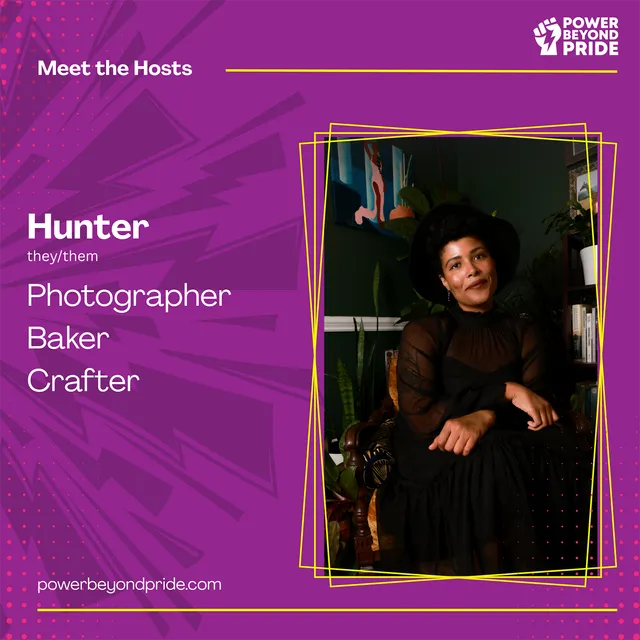
Get to know Power Beyond Pride co-host Hunter, a queer femme photographer and advocate. In this interview with Mattie Bynum and Melodie KG, they discuss how their experiences contribute to a cosmopolitan worldview and their commitment to health equity, education, and advocacy for BIPOC people, LGBTQ+ community members, and individuals with disabilities while making space for cooking up their cherished, secret chocolate chip cookie recipe.
Hunter (00:00:00 –> 00:00:44):
I think once I found myself out in a situation where somebody didn’t have the tools to help themselves, and I was able to triage that in my head and be like, oh, this is what this person needed. And I was able to talk with them, get their consent, and then turn around and leverage that to somebody in a way that they were going to understand that this is a medical necessity. And then that need got met. I was like, oh, like using those experiences from not being asked or being brought into means of leadership, or having bodily autonomy and capacity and consent, culture worked in my behalf. Why don’t I use that? I want to give people the tools to be able to advocate for themselves and.

Mattie (00:00:44 –> 00:01:08):
Hello. Welcome to Power Beyond Pride, a queer change making podcast bringing you voices and ideas from across our fierce and fabulous spectrum to transform our world. I am Maddie Bynum. I am not this country in person, I promise you, but for some reason it came out today. However, I am fabulous and beautif and I love to be involved in the conversation. I am joined today by my co hosts.

Melodie (00:01:10 –> 00:01:47):
Hello, I’m Melody kg. I’m also fabulous. Thank you for opening the door to that. Yes, I’m a spicy worker, writer, consultant and artivist based in Minneapolis. In this episode, we are talking to Hunter, a passionate environmentalist. Other area of interests for them are health equity, education and advocacy work, as well as the intersections where marginalized communities exist. Hunter’s education, training and lived experience has accumulated in a cosmopolitan approach to the world and how to leverage their privilege to benefit others.

Mattie (00:01:48 –> 00:02:06):
When Hunter isn’t participating in advocacy work and technology, they are a photographer whose specialty is portraitures. I think I said that correctly again. And photography, Photographing the lived experiences of queer and trans people and their families.

Melodie (00:02:06 –> 00:02:20):
Whether you want to talk about community engagement, research, counterfactual dependence. Hello, stats, nerds, Appalachian food and culture, foraging, the supernatural, and more. Hunter’s the person to geek out with.

Mattie (00:02:21 –> 00:02:25):
Hunter, welcome to the show. Baby. How you doing? I’m good.

Hunter (00:02:25 –> 00:02:35):
I’m good, y’ all. I think, Maddie, I think I’m gonna blame myself a little bit for the country coming out of you. Please do I hold responsibility? Yes.

Mattie (00:02:35 –> 00:02:41):
It was your whole time talking about it. No, not Ms. Twin Cities up there. No, it’s not you.

Hunter (00:02:42 –> 00:02:50):
No, I think as soon as I got a little frustrated, it just comes out and it’s in full gear. I don’t know how long this presence will be with me.

Mattie (00:02:50 –> 00:02:54):
It is all good. Well, Hunter, go ahead and introduce yourself. Tell us a little about you.

Hunter (00:02:55 –> 00:03:53):
Yeah, so my name is Hunter. I am a transplant to the south, and my family is from Appalachia. My family is country, and I was raised between Ohio and West Virginia. My next adventure, as I’ve been looking into it more, is law school. So as a kid, I was obsessed with the idea of going to Harvard Law because, hello, Legally Blonde. And I’d had that as my goal from the time I was like, I think 11. And I went. I applied to Harvard. I applied to a number of schools. I didn’t get into Harvard, but I had. I was accepted into, like, University of Chicago and a few other places. However, ended up changing the trajectory of that because I felt like maybe I couldn’t do it, but in my big grown age, at 35, I was like, you know what? I actually really do still want to go to law school. So.

Mattie (00:03:53 –> 00:03:54):
Never too old.

Hunter (00:03:55 –> 00:04:00):
It’s a journey. It won’t happen right away, but it’s something that I’ve been wanting to do for a long time.

Melodie (00:04:00 –> 00:04:20):
That’s really cool. I thought for a hot minute about law school and then the student debt and also the sleep debt that that would cause. Just. I couldn’t. So would love to hear how you ended up there or, like, ended up wanting law school to be the thing.

Hunter (00:04:20 –> 00:05:38):
I got so angry one day that I said, f it, if I want anything to change, I need to be. I need to go to law school to do it. I was just so fed up that I finally was just like, if anything’s gonna get done, I need to be able to, like, help in that change, and who knows to what capacity that’ll be in yet? But, yeah, it was. I was having a conversation with my dad one day, and I had mentioned that I wanted to go to law school, and he’s like, funny. I was gonna go, he’s a. He’s a doctor. So of course he’s very dry. He’s like, funny. I was gonna go into law school, but then I just thought it was probably better if I go to be a doctor. But at least this way, one of us will be a lawyer and one of us will be a doctor. I think there’s just the anger that I’m trying to. I’m trying. I’m focusing my anger in good ways of how do I help make a change? And leaning into that privilege of, like, I’m, quote, unquote, well educated. I’m articulate. I’m able to conceptualize things and to articulate them in a way that I’m like, okay, this is wrong because of X, Y, Z, and working in so many different capacities. My family’s always told me I’ve never known a stranger. And I think that a lot of those privileges that I have should definitely be leveraged.

Mattie (00:05:40 –> 00:06:12):
You said something while just now that really stoked my interest. And you said using your anger to channel, to challenge yourself to do better. And I think I might have mispronounced what you said, but it’s along the same gist of using your anger because I just had this conversation with someone else about how when you get angry, how do you use that? So my question to you, I would say is how do you allow one, your anger, but also two, your queerness and also your self identity to be the catalyst of change that you’re trying to be in our nation today?

Hunter (00:06:12 –> 00:07:28):
You know, there’s always unfortunately the stereotype of being the angry black woman. Like that is initially what people will see when there’s anger. And I had to think about that of like, well, why is it just when I express something, why is that angry? And I realized that I could put this energy, I’m a passionate person. And I was like, why not put that into something that’s constructive? And that’s how I’ve always expressed my, my, my passion, whether that is through anger or through grief and sadness, is that I’ve expressed it through art and I’ve expressed it in ways that have been constructive because of just the ways that I think having so many intersections of marginalization, I wasn’t allowed to express it without there being implications or without there being a negative connotation to that. And I think it’s just, it’s. Overall, for me, it’s healthier if I do that in that respect of finding constructive and restorative ways to express my being fed up with this shit. Ness.

Mattie (00:07:28 –> 00:07:48):
But like, how do you balance the anger and not allowing to get too angry? Like how do you that fine line? Cause I know for me, sometimes whenever I’m thinking of things that are going on in our community, in our world, and I get angry, I have to sometimes go in my house and shut the door because I’m like, I’m too angry. Angry. If I speak now, I can’t say what I want to say.

Hunter (00:07:49 –> 00:09:16):
Hallelujah. That’s it. Like I am a homebody and I love to be at home. I love to like manifest the way that I want my cocoon to look like. And so I will do constructive things to help with that. And that also includes solidarity. Solidarity is a gift and a privilege in and of itself. And I’m in therapy. I’ve had the same therapist for about five years, and I am so grateful for that. And, yeah, how do I balance that out is just like, giving myself the space and the time to be like, yes, you’re allowed to have this feeling, but it’s the method of how do you choose to use that feeling? Because I think the first part of, like, why a lot of us get into these cycles of self, like, not self harm, but of basically just kind of, like, being upset with ourselves. I’m not sure how I should articulate that, but of, like, ruminating in a cycle of just like, oh, I shouldn’t have done that, or, oh, like, why does all, like, why does this always this terrible thing happen to me? And it’s just like, in order for me to get out of that cycle, I needed to just allow myself, like, to say, it’s okay that you’re mad. Because the longer I would deny that, I’d be like, no, I’m not bothered. No, I’m, I’m okay. When clearly all the signs are telling me that I’m not okay. But giving myself permission was the most restorative part into all of that.

Melodie (00:09:16 –> 00:09:53):
I have a question for you, Hunter. So I know for me, I’m someone who really relies on seeing, like, representation matters, right? I’m wondering for you if there’s any one, either person or group of people who are lawyers or who are in the legal field that you are taking cues from as a black queer person, who. Who are you sort of modeling after or are you just kind of trailblazing?

Hunter (00:09:53 –> 00:11:45):
So I’m not gonna lie, like, I. I definitely have such adoration. And I just, I low key reached out to Jasmine Crockett via Instagram just to tell her, like, you’ve inspired me to go to law school straight up like that. Like, she came through as her most authentic self because she knew that that was what was going to help people to listen. And she’s done phenomenal job at getting people across the board to listen. And so I appreciated that, like, because she just wants to, like, be able to communicate with people about, here’s the thing that we’re trying to communicate, like, so that you can also be involved in what is going on in your local communities. But I think the thing that really struck out to me was seeing the representation at home. And by at home, I mean, I was in the hair salon getting my hair done, and there was three black women in there that were all attorneys, and they were just talking about, like, what law firm, they were working out, or like, what new thing they had just, like, started, you know, doing or whatever it was. And I could just see that visibility in a place that was so sacred. And I remember seeing that, like, this was in the last year, and I saw that and I was just like, oh, oh, okay. So I think that my motivation and the people that I’m taking cues from are the people that are in my community. Like, people that are, like, here and doing the thing. And so, yeah, I’ve been reaching out to people that I’m like, hey, you’re a lawyer, aren’t you? Like, can I ask you questions like, how did you find this for yourself?

Mattie (00:11:45 –> 00:12:10):
Do you find that there is a lot of welcoming in the space when you reach out to people, like with Jasmine Crockett and different people or mentors that are already established in the entity of law, but now coming in with the community involvement, do you find that there is openness? Do you find that there’s space for you to be more open and involved?

Hunter (00:12:11 –> 00:13:39):
I think it’s what you make of the space. I didn’t reach out to certain people with the utmost expectation that I feel like they’re obligated to respond to me. And I’ve already, at my big grown age, I’ve gotten. I have three degrees. I understand that people are busy, people have things to do, but also that I’m not entitled to anybody’s time. And I approach the situation in that respect of like, hey, I appreciate your time and energy, and if you don’t have the capacity for this, please let me know. But 100%, I’m just the type that will go up to somebody and be like, I really admire what you do. This is something that I’ve been wanting to get into. And you’ll find yourself, like, in a really great spot with people when you just come from it from that perspective of like, I admire what you do, and I want to get like that. And more often than not, I think it’s our own internal biases that keep us from wanting to go into that space. Because you’re like, oh, no, they’re not going to like me, or they’re going to think I’m wasting their time or duh. And I had to think about that as a photographer, and I’ve been a photographer for over 15 years, is like, when people come up to me and they ask me like, hey, can I ask you some questions about this? Or do you mind if we, like, if I shadow you? And I’m like, yeah, absolutely. Come for it like that. I want to talk to people about these things. And I had to think about it from that perspective of just like, the worst somebody could say is, no.

Melodie (00:13:39 –> 00:14:10):
Thanks so much, Hunter. Let’s take a short break here and get back to you in less than a minute. Please don’t leave us, because we’re just getting warmed up with our conversation with Hunter, and we hope to have you back. And we’re back. Power Beyond Pride with our guest of honor, Hunter. Thank you for joining us, Hunter. Maddie, I think you had a question you wanted to ask them.

Mattie (00:14:10 –> 00:14:23):
Yes, Hunter. So I was asking you, with everything that has gone on through your journey and how you have gotten to where you are, how do you use that to inspire change in the community and in just in others as well?

Hunter (00:14:23 –> 00:17:12):
I had to find that for myself. It was hard to come to the idea or at least conceptualizing what I wanted to do, because I’m an elder millennial, and we grew up during a lot of times where we have a lot of. There was a lot of directionless meandering, I think, especially for, like, just what we wanted to do as we got older. And I needed to, I think, test the waters for myself and to see what did that look like for me, because I don’t think I had ever really been perceived or asked to take on a leadership role. So I think once I found myself out in a situation where somebody didn’t have the tools to help themselves, and I was able to triage that in my head and be like, oh, this is what this person needed. And I was able to talk with them, get their consent, and then turn around and leverage that to somebody in a way that they were going to understand that this is a medical necessity. And then that Nick got met, I was like, oh, okay. Maybe it’s like using those experiences from not being asked or being brought into means of leadership or having bodily autonomy and capacity and consent culture worked in my behalf, why don’t I use that? Like, why don’t I come from that position of privilege now and start talking about those things and making it a point to be like, I can help in this respect? And I think that’s where I land on with having folks see that about myself so that they can see that in themselves. And by that, I mean I want to give people the tools to be able to advocate for themselves. And so what that can often mean is, like, maybe they didn’t know about this route, like, about this resource, or maybe they didn’t know that they could ask for this Thing. Like, one of my favorite lines to tell folks that they’re in a medical. In a hospital and their physician rejects something that they’re asking for. I tell them. I tell. I’ll tell. I told somebody just recently. I’m like, tell them that you want that written in their. In your. In your medical chart. Say that you asked for this thing and your doctor said no, and you want that in the chart. Yeah, that’ll change the narrative too quick. And that’s the thing that I want for people, is to just give them the tools to be able to come out of a situation feeling more empowered.

Melodie (00:17:13 –> 00:17:53):
Absolutely. I think that’s so important, especially because as someone who, like myself, is neurodivergent, it’s so hard to know what I don’t know, to see the systems of how people operate and just assume that’s what it is. And I can’t ask for anything different, really. Having the tools is such a game changer for a lot of us. So I’m wondering, Hunter, was there a point where you knew that this was your role or that this was what you wanted to do, that you were called to sort of be this resource? And I’m wondering if you could tell us about that.

Hunter (00:17:54 –> 00:19:02):
Yeah. Yeah. I know I mentioned this a little bit earlier, but I’m going to be like, obviously, because this was so long ago, I’m just going to be vague about some of it, but this person was having a medical emergency in a public space where they had every right to get the services they needed, and they were significantly older than me, and I don’t think that they just had the means to ask for that. And so I heard what they said, and I said, got it. And I went over and I talked to the person in charge of the train, and I was like, this person requires these things. It’s actually like, this would be a violation of health rights. And they’re very understanding. After I kind of, like brought up a few things and immediately wouldn’t help this person out. And afterwards, I sat back down with this person and they were just like, I didn’t know I could have that. And it was a light bulb moment for me. And I think I was like, maybe 21, 22. And it was a light bulb moment for me of just like, that’s what that is. Oh, okay. That’s okay. And I’ve been rocking with that ever.

Melodie (00:19:02 –> 00:19:40):
Since you were lawyering at 21. Like, no, this is part of your rights, and we gonna get it. I love that. I’m curious about how Your work as sort of stated as being kind of driven by health equity and then you have your photography. Thinking about law school, what is the, the through line there? Like, are you thinking about health care as a, as a venue for, for your lawyer in or like what is, what’s that through line?

Hunter (00:19:40 –> 00:20:59):
There’s so many ways it could float, to be honest. I want there to be that, like that intersection because that’s where I exist and in all the things that I do is there’s an intersection and I want some of that to also be within disability and help and closing some of those gaps as well as. Here’s an interesting little story I just found out over the weekend is that I’m like the seventh great grand niece Patrick Henry, who was a founding father that said give me liberty or give me death and also related to George Washington and there’s another founding father and I’m just like, that’s interesting. That’s suspicious, that’s weird. And I definitely have had stuff like constitutional law that I considered for a long time. That was one of the things when I was a kid I wanted to get into was constitutional law. So why not? But at, at the heart and soul and at the end of the day it will be a multiple. Like there’s going to be just like multiple ways that I find myself intersecting, including with health and disability and advocacy.

Melodie (00:21:01 –> 00:21:57):
Let me ask you, just zooming out really quickly because we are in a current moment that feels very chaotic and also potentially interesting for lawyers everywhere who work for any sort of civil society organization or even the federal government or state governments. How do you see the future of your work given that like the government at this current moment is being sued left, right and center for four things that have to do with queerness and with racial identity and with all of these things, what insights do you have about the role of the rule of law in these times?

Hunter (00:21:58 –> 00:23:31):
I think I’m allowing, I guess in some respect I’m allowing spirit to help just guide me in that. And it’s okay sometimes to go into something without like to just go into something blindly. Like in this situation I’m just like, okay, let’s find the direction as it becomes available. And so I’m not like just going into it willy nilly. I’m creating a plan on, in the ways that I know I can create something right now. So it’s like, what does that mean regarding, like financial, you know, like, how do I make this something that’s financially responsible to get into school? Because as I’ve learned Things happen in divine timing. Things happen when they’re supposed to happen. And I have to keep that in mind to not allow myself to get discouraged is that things happen in divine timing for a reason. And there was something I recently heard that I cackled the second I heard it because I was just like, man, if that is not relevant to just our world, the planetary alignments. It was this divine timing of hearing the phrase God always keeps a calendar. And I’m not overtly religious, I am spiritual. And there’s just like this snowball effect of things happening. And then I heard that phrase of just like, God always keeps a calendar. And I just started cackling because I was just like, wow, if that’s not relevant, I don’t know what is.

Melodie (00:23:32 –> 00:23:32):
Yeah.

Hunter (00:23:33 –> 00:24:31):
And I also think of stuff like that as like a nice little nod from my grandma who recently passed because she always said stuff like that. Very country. And she would say things like that. And I’m just like, yeah, that feels like a little message from her. Oh, but yeah, in the long run, where do I see myself? I see myself doing what I was meant to do. And there’s always going to be a need. And I’ve had to learn about, like, where do I find myself in the grand scheme of like helping with progress or helping others and helping to make changes. And all changes don’t have to be big changes. And so that’s where I lean into. And so for me, that can mean that what I’m like, what’s supposed to be revealed for my purpose will come as that purpose is needed is that purpose comes presented. And so I’m just preparing myself now.

Mattie (00:24:31 –> 00:24:32):
That’s beautiful.

Hunter (00:24:32 –> 00:24:33):
Absolutely.

Melodie (00:24:33 –> 00:24:57):
That’s beautiful. In thinking about how we sort of capitalize on the, on the small wins or, or celebrate the small wins. What are some small, like day to day things that, that you’re doing to both keep safe and sane, but also like to move whatever work you’re doing forward.

Hunter (00:24:58 –> 00:28:05):
So right now I’m actually going through a period of grief and loss. Another person that was like a. This was somebody that is probably the closest I’ll ever have to a sister. Passed away recently. We met. Thank you. We met in preschool. And so it’s harder when it’s someone that you’re just like, I’ve created this, the narrative of which is like, my life has been so connected with this person and that there’s been a. There’s been a stop on that or at least a pause. How do I live and grieve and cope in that. And so my grandma passed away in June, and I learned a lot about as an adult, how do I cope with grief? How do I cope with loss? How do I cope with death? And for me, I get so excited about tearing things down and reorganizing them and categorizing. It helps to bring. It makes sense. It brings sense and, like, just organization, breath of fresh air to a situation when I can just, like, redo something, when I can make changes in ways that are meaningful to myself. When my grandma passed, I was a hot mess for a long time, but I went through and reorganized my entire kitchen. And I’m a home cook and a forager and a baker, and so that meant a lot of work. And I went through and also decluttered, reorganized, and categorized everything that was in my baking pantry as well as in my deep freezer. And I have a living. I have, like, a living pantry list, an inventory list in my phone that gets updated regularly. So, yeah, the small wins for me are the cocooning and making sense of a world that sometimes seems senseless. And so, yeah, that’s another reason why I’m a homebody, because I just love to be able to, like, manifest the things that bring me comfort and stillness by being able to just, like, mess stuff up every once in a while. And, yeah, I think that that’s where I found a lot of peace lately. And fortunately, with the beautiful weather we’re having now, also starting my garden again, and I can’t wait to be out in the woods with some of my friends and foraging for mushrooms. I find great joy in finding mushrooms. And that was another thing I did to grief to help me with the grief process. After my grandma passed, I got very fortunate and could go rummaging through the woods and found I learned so much this past summer from people who are experts in mushroom foraging. And so learning is even a small victory for me. Like, I just want to learn about everything.

Melodie (00:28:06 –> 00:28:33):
Yeah, that’s beautiful. I can really relate to the having things, like, organized in a very specific way. I will admit I try to keep a living list of things in my fridge and my adhd just like, it’s like, I haven’t had chicken in the fridge in weeks, and it’s still. It’s still on the little whiteboard. So. But like, the.

Hunter (00:28:33 –> 00:28:35):
You’re leaving that space holder.

Melodie (00:28:36 –> 00:28:59):
I’m leaving. I’m manifesting chicken. But, yeah, the sort of organization and then like, giving your space to blow it all up when you need to. I love that. Thanks so much for that. Hunter, we are going to take another short break here. Please stay with us, and we’ll be right back.

Mattie (00:29:04 –> 00:29:19):
All right, so welcome back to Power Beyond Pride, the podcast where we are sitting here with the beautiful Hunter and having a lovely discussion about reorganizing our lives so that we can stay in a calm place. Is that correct?

Hunter (00:29:20 –> 00:29:21):
Yeah, that seems pretty accurate. Yeah.

Mattie (00:29:21 –> 00:29:23):
All right, Melody, I think you had the next question.

Melodie (00:29:24 –> 00:29:26):
Yeah. Should we do rapid fire?

Mattie (00:29:27 –> 00:29:30):
Oh, you know that’s my favorite topic. Anyways.

Melodie (00:29:31 –> 00:29:39):
All right, Hunter, so we’ve got some rapid fire questions for the audience just to get to know you just a little better. Are you ready?

Hunter (00:29:41 –> 00:29:44):
I’m never ready for anything in life. Just put me in.

Melodie (00:29:44 –> 00:29:55):
Great, Great. I’m gonna throw it at you anyway. You’re gonna do great. So answer quicker than you think, the.

Mattie (00:29:55 –> 00:29:56):
First thing that pops in your head.

Melodie (00:29:56 –> 00:30:02):
Absolutely. Okay, so number one, what’s the craziest thing you’ve ever done to get someone’s attention?

Hunter (00:30:03 –> 00:30:04):
I’m a Libra. That could be anything.

Mattie (00:30:07 –> 00:30:11):
Yes. That’s an interesting topic by itself. You love libras.

Hunter (00:30:11 –> 00:30:13):
Yeah, I. I don’t.

Mattie (00:30:14 –> 00:30:18):
Let’s see if you can answer this one. What’s the best pickup line you’ve ever used to get someone’s attention?

Hunter (00:30:19 –> 00:30:33):
Probably one of my biggest mistakes ever. I was in a grocery store looking at wines, and I was. And I told this person, I said, you know what would go really great with this wine? They were like, what? And I said, me. And it worked.

Mattie (00:30:36 –> 00:30:38):
I might have to use that one. I liked it.

Melodie (00:30:38 –> 00:30:45):
It worked. Yes. That’s amazing. Well done.

Hunter (00:30:45 –> 00:30:51):
Like I said, I’m a Libra Scorpio Cusp. But I lean into the Libra energy sometimes, and I don’t know where it goes.

Mattie (00:30:53 –> 00:30:55):
That was a Scorpio statement, though. That was a Scorpio.

Hunter (00:30:57 –> 00:30:58):
Yeah, I think so.

Melodie (00:30:58 –> 00:31:01):
Okay. What’s your biggest guilty pleasure?

Hunter (00:31:02 –> 00:31:50):
I love terrible movies, like, Tubi movies. So I love stuff like the Room. It’s a horrible. Yes. Okay. Yeah. I even went to, like, there was a screening at a local theater where one of the actors came and did a Q and A and talked about all this stuff. Yes. So, yeah, I have a sweet love for terrible movies. I also love the things that are just, like. They’re funny for no reason. Like, I. Because my goal is to just be entertained and have that moment of, like, mental escapism. And sometimes if it’s really corny, like, you’re just like, okay, this was good. This helped me to kind of get out of my bubble.

Melodie (00:31:51 –> 00:31:52):
It’s A catharsis.

Hunter (00:31:52 –> 00:31:55):
But it’s also, you know, it’s a cult classic film, too. The Room.

Mattie (00:31:56 –> 00:32:02):
This might be a weird question, but it’s a compound question onto what you just said. Have you ever laughed at a funeral?

Hunter (00:32:03 –> 00:32:03):
Yes.

Mattie (00:32:04 –> 00:32:07):
Okay. I have to. So I’m not alone. Okay, perfect.

Hunter (00:32:07 –> 00:32:18):
I think. I don’t think that funerals should be just about, like, expressing one compartment of human emotion.

Mattie (00:32:18 –> 00:32:19):
Yeah.

Hunter (00:32:19 –> 00:32:48):
And black folks will find any way to. To laugh. And I think that that’s part of the way that we heal. And I know my grandma, for instance, when she passed, she says she didn’t want people to be, like, you know, wailing and crying and everything like that. And so, you know, we were cracking jokes and stuff, and, you know, that’s how she was in life and. But yeah, I’ve laughed at a funeral.

Melodie (00:32:48 –> 00:32:52):
Another one. Funeral related. What do you want to happen at your funeral?

Hunter (00:32:52 –> 00:32:54):
I want to be a big cookout.

Mattie (00:32:54 –> 00:32:57):
Oh, yes.

Hunter (00:32:58 –> 00:33:41):
Yeah, I want it to be a big cookout. You know, I come from a family that we express our love and appreciation through food. I’m, you know, Appalachian country at heart, and that has always been the way that we’ve gathered in community. And that’s how I show up for people, too. I’ll be like, let me fix your plate real quick. And I’ve told my partner and everybody else, I said, my. My chocolate chip cookie recipe goes to the grave with me. So I think. I don’t know how. I don’t know how I choose to, you know, have my end of life or where I’ll rest, but I might have my cookie recipe on my headstone.

Mattie (00:33:42 –> 00:33:51):
Here lies the now, you said these are chocolate chip cookies. Anything special about them? Like, are they brown sugar, chocolate chip, peanut butter, chocolate chip?

Hunter (00:33:53 –> 00:33:58):
I’ve been perfecting this recipe. I’m a cookie hoe. So first and foremost, yes, cookie hoe.

Mattie (00:33:58 –> 00:34:00):
Not a cookie monster, a cookie hoe.

Hunter (00:34:01 –> 00:34:50):
And I have been perfecting my recipe for, like, the past almost 20 years. So there’s something like probably 15, 16 ingredients for my recipe. And it comes from a long history of trial and error of, like, what do I like about this texture? What brings out the chewiness? What brings out, like, this richness of depth and the dark chocolate without it being overwhelmingly saccharine. And, like, you need to have some of that draw of something on the opposite end of that. So having the flake salt on it. And yeah, I mean, here’s a little. A little hint or a little secret. When you make your chocolate chip cookies, make the Dough and then refrigerate it for 24 hours before you bake it.

Mattie (00:34:50 –> 00:34:51):
Okay.

Hunter (00:34:52 –> 00:34:53):
Because it allows all of those.

Mattie (00:34:53 –> 00:34:56):
So to come together, all of the.

Hunter (00:34:57 –> 00:35:32):
Fat and the sugar that was separated in the preparation process. It allows all those things to start to congeal and to bind to other ingredients. So it’s going to create a depth that you weren’t going to get, if you, like, when you first started making it. And instead of having just like this chewy texture, you’re going to get more of the depth. You’re going to get more of that caramelized flavor in the back. You’re going to get that buttery, crispy sweetness to it like that you’re looking for with a really good homemade chocolate chip cookie.

Mattie (00:35:33 –> 00:35:35):
Well, you know the best place to get your butter is where?

Melodie (00:35:36 –> 00:35:38):
Land O Lakes.

Mattie (00:35:43 –> 00:35:54):
Good old Minnesota. Yes, honey, yes. Well, I definitely want to try your. Well, this is going to sound bad, but I promise you it doesn’t mean it the way it sounds. But I would love to try your cookie sometime, Hunter.

Melodie (00:35:54 –> 00:35:58):
Okay, same here. I’m also a cookie hoe.

Hunter (00:35:59 –> 00:36:15):
Look, I do cookie exchanges with people. Like, I have a friend or two that, like, we will mail each other cookies, like, especially around the holidays. Like, we do this thing where I’m like, look, I’m gonna make these and you can make this, and then we’re gonna mail them out to each other. And it is a highlight.

Mattie (00:36:17 –> 00:36:24):
But you know what? I actually. That is so cool if you ever do it, because I just tried a new recipe. It’s a sour dough chocolate chip cookie.

Hunter (00:36:24 –> 00:36:25):
Heck, yes.

Mattie (00:36:26 –> 00:36:32):
So I would definitely. If you ever do a national cookie exchange or do something, I would bring my sourdough.

Hunter (00:36:32 –> 00:36:37):
I’m more than happy. I’m more than happy to coordinate the cookie exchange if y’ all want to get on the cookie train.

Melodie (00:36:38 –> 00:36:43):
Yes. Cookie train. Okay. So Girl Scout cookies. Yay or nay?

Hunter (00:36:44 –> 00:37:00):
I. It involves hardly two questions with me when it comes to, like, getting girl Scout cookies, because I know I want those caramel delights. And so I’m the quickest sale you will ever make. If you got them caramel delights and if you got about six boxes of them, I’m get all of them.

Mattie (00:37:01 –> 00:37:02):
Melody, what’s yours?

Melodie (00:37:03 –> 00:37:04):
Thin mints and Samoas.

Mattie (00:37:05 –> 00:37:07):
I must say, I’m thin mints and shortbread all day.

Melodie (00:37:08 –> 00:37:08):
Yeah.

Mattie (00:37:09 –> 00:37:12):
Especially if you freeze them first and then take them out the freezer and eat them.

Hunter (00:37:12 –> 00:37:12):
Yep.

Mattie (00:37:12 –> 00:37:14):
Thin men’s and shortbread.

Melodie (00:37:14 –> 00:37:15):
I.

Hunter (00:37:15 –> 00:37:29):
You know, I appreciate anybody that can eat mint and chocolate or mint and Orange together. Cuz that ate me. Love it. I. It’s a sensory thing for me and I just can never get with those things together.

Melodie (00:37:29 –> 00:37:30):
Yeah.

Hunter (00:37:30 –> 00:37:39):
Also I can’t like, I get frustrated with. And once again, it’s a sensory thing for me. Cheese and seafood. They’re very seafood. Yeah.

Melodie (00:37:39 –> 00:37:40):
There’s shrimp, grits.

Hunter (00:37:41 –> 00:38:00):
Oh, no, I’ll tear that up. So like that. There’s very few exceptions. There’s very few exceptions when it comes to like. But I can also have that separation of the cheese grits and the shrimp. Yeah, that. I think that that’s where some of like my little unique quirks around food exist.

Mattie (00:38:01 –> 00:38:13):
But I get what you’re saying because if I’m eating shrimp and grits, I prefer not to have cheese in my shrimp and grits. As, as. Unless you use sour, I mean, cream cheese when you’re actually making the grits to make it creamier.

Hunter (00:38:14 –> 00:38:19):
Yes. So I do use cream cheese. Yeah. That is in the grits itself.

Mattie (00:38:20 –> 00:39:01):
But cheese on top of with. I get where you’re coming from. That’s too much. That’s too much. Too many flavors. So now. And I’m loving our cookie conversation because everything, if you think about life and everything that we do, everything is a recipe. Activism is a recipe. Community change is a recipe. Building a better society is a recipe. So the great thing of finishing our conversation around cookies, it does bring it back to that. So I guess one of my last questions for you would be how can we as individuals get involved on your platforms? Or how could we get involved in general? What are some things that you see that we as people of the community can do more?

Hunter (00:39:01 –> 00:40:09):
I want to see more gathering around local resourcing. Like sometimes we can’t depend on things on a larger scale. Well, how are we creating those means on a more local scale? How are we creating projects towards getting people a box of producers for free that they didn’t know they were getting? Or how do we get somebody connected with dental care or at least, you know, some toothpaste and some, you know, things like that. Like how do we connect these bridges and make it like free if not at a reduced cost? And I want to see that where there’s much more of this, like, support at the local level, because that’s where we can also see big changes happening. And I know I’ve been in that space before where I’m just like, oh my God, what am I gonna do? And then the community shows up and I’m just like, oh, that’s what I’m Gonna do lean in the community.

Melodie (00:40:09 –> 00:40:11):
And that’s beautiful.

Hunter (00:40:11 –> 00:41:19):
I wanna see that. And that also means being involved in that. And I’ve done that in a lot of respects with the projects that I’ve done with queer advocacy and health and I want to see that grow into more. So yeah, I think when it comes to respects like that of just or programs like that, I really want to see community. I want to see how we show up for one another in community. And that can be somebody knows a skill that somebody else doesn’t know. Like how do you use a tiller for your garden or how to change your oil or how do you install a toilet seat? How do you do these things around the house? Like for folks that don’t know. I know we have like a lot of different skill sharing events that we do in the area for somebody to be like, hey, I know this thing. If you don’t know this thing, I’m happy to teach you. Yeah, yeah. Because there’s so many different privileges that sometimes we don’t know we have until like we’re confronted with somebody asking I don’t know how to do X, Y, Z. And then you’re like, oh, I know that.

Mattie (00:41:19 –> 00:41:24):
Do you find that as a hangup in our community nowadays? A lot of people are afraid to admit what they can’t do.

Hunter (00:41:24 –> 00:42:51):
I think it’s something we’ve always had. We as in, in the community, we’ve always hadn’t maybe as a, an insecurity because there’s also a huge emphasis on being self reliant because maybe others won’t be able to protect us. And so I think that we get into this perspective of being so hyper independent that it’s a, it’s a, it, it hurts our ego when we have to confront ourselves with the thing that we don’t know how to do. And so I think this is something that’s generationally inherited. And so we’ve, yeah, we’ve inherited this from the people in our surroundings because maybe they didn’t know how to do it. So then we weren’t taught how to do it because you know, it wasn’t seen as important or you’ll never learn how to do this. I didn’t know how to do this, so why should you know how to do this? And so I think that that’s part of breaking the mold, breaking the bias that comes with preparing ourselves. But not only that, but preparing our future generations for outcome success that we couldn’t achieve at a certain age or that we couldn’t find at a certain age and making that available to people when they need it without having to feel the fear of saying, I don’t know how to do this.

Melodie (00:42:52 –> 00:43:25):
Yeah. Yeah. And what you’re describing is so important, and it. It really. It’s community care. Right. Like, we’re. We’re utilizing the skills and privileges that we have to help raise the village. Right. To make sure that our folks know how to do certain things. And in return, like, there are things that we don’t know that we can learn from community. And in that way, absolutely. That reciprocity is what keeps communities going.

Mattie (00:43:26 –> 00:44:27):
I know this is an old catchphrase, but I always go back to this, and it’s reach one, teach one. Like, we have to. We. That’s what we have to do. We have to keep each other accountable. We have to. If there’s something, like you said, I know that you don’t know, I have to tell you. If there’s something you know that I don’t know, please tell me, like, if there’s a skill that you have, because I agree with what you were saying. I think a lot of times when we, as. Especially as the LGBTQ community, we’re always seen as if we got it together at all times. And to me, I know that’s far beyond the reality, because most of the time, I’m just barely keeping my wig on and got my Spanx on. Good. And I’m just be sitting there thinking to myself quietly, if I could just come home and let my boobs finally hang out, my stomach relax, I’d be good. But we have this Persona that we are put together that whenever a question comes up or something comes up and we don’t know, it’s almost like you kind of get to the point where you can’t say, I don’t know, because they assume that you know everything or they assume that you got it together. And so I love that we have the space.

Melodie (00:44:28 –> 00:44:28):
Yeah.

Hunter (00:44:28 –> 00:45:04):
I’m all for people, like, just saying, hey, I don’t know how to do something, or, you know, could you teach me about this? There’s never any harm done in asking for help. You know, I have to think about what. What was it like for me in this situation where I didn’t know something or what was it like for me when I was that age? And so when people come to me and ask me questions about something, I really try to think of it from their perspective of who was I at that age and. Or who was I when I was in that circumstance or in that situation. Where I didn’t know.

Melodie (00:45:04 –> 00:45:06):
Yeah, yeah.

Hunter (00:45:06 –> 00:45:23):
And sometimes, you know, it’s just about. Even if you don’t have the capacity to maybe help somebody in that moment, you just say, hey, thank you for this question. I don’t have the capacity for that right now. But this could be a conversation for another time that’s first and foremost also about like self care and self advocacy like that. You can also say no.

Mattie (00:45:25 –> 00:45:30):
And it’s a complete sentence. I am learning that at the beautiful age of 40. No is a complete sentence and I don’t owe you shit.

Melodie (00:45:32 –> 00:45:32):
No.

Hunter (00:45:32 –> 00:45:34):
Hilar. Hilar.

Mattie (00:45:34 –> 00:45:39):
No. Well, Hunter, thank you so much for joining us today.

Hunter (00:45:39 –> 00:45:57):
Thank you, Thank y’ all. I have enjoyed this so much. It always feels so awkward to talk about myself and yeah, I felt so at home. So thanks, y’ all for just giving me the capacity to talk and to feel seen.

Melodie (00:45:58 –> 00:46:02):
Absolutely. And Hunter, where can we follow you or find your work?

Hunter (00:46:03 –> 00:46:22):
So I have my photography page which is hntrphoto.com and folks can find me on the Internet that way and connected to my. My website is connected to my Instagram, but yeah, amazing.

Melodie (00:46:22 –> 00:46:36):
Well, thanks so much, Hunter. It’s been great to talk with you. I’m your co host, MelodyKG. You can follow me on Instagramlodykg and find out more about me and my work.

Mattie (00:46:37 –> 00:47:02):
Well, I am also your co host for today, Ms. Maddie Bynum. And you can follow me at Instagram, Instagram, maddysamone 737. That is not Maddie’s mom. I get that a lot. But it’s Maddie Simone 737. And then my Facebook is Maddie Bynum. Definitely DM me. Hit me up. Talk to me. I love talking to new people talk and we’re having good conversations, so we’re always here.

Melodie (00:47:02 –> 00:47:22):
Power Beyond Pride is a project from a great idea, a queer owned design and content agency. Learn more about them at a great idea.com we are both part of this podcast host team and we invite you to send in your questions and comments@powerbeyondpride.com.

Mattie (00:47:23 –> 00:47:44):
So this episode is produced by Shane Lukas. Samita Sakar is doing our project development and our editor is the wonderful Jared Redding with support from Ian Wilson. All right, we look forward to queer change making with you in every aspect with Power Beyond Pride. Have a great day.

Frequently Asked Questions
What is Power Beyond Pride?

Power Beyond Pride is a weekly podcast featuring LGBTQ+ individuals from across the identity and expression spectrum who are leading or participating in meaningful organizing and transformative activism. The show shares their stories, the power of their purpose, and how listeners can engage in their own communities. Two of the host team will lead each conversation. Once a month, all hosts will engage in a group chat about movement trends and the latest news.

To be a guest on Power Beyond Pride, you must identify as a member of the LGBTQ+ community and be engaged in community organizing or movement work. Contact us at guest-@-powerbeyondpride.com with your information and interest.

If you are an ally, we encourage you to subscribe, share your questions, and help elevate and celebrate queer changemakers in your movement work and communities.

The Power Beyond Pride Host Team is created from queer changemakers across the country bringing lived experience and movement expertise to each interview and interaction. Learn more about them here.

Power Beyond Pride has a talented and skilled production team that records and edits each episode. Learn more about them here.

Power Beyond Pride is an initiative of A Great Idea, an award-winning LGBTQ+-owned and operated brand and design agency serving nonprofit, education, and healthcare partners across the country. Learn more about their community engagement initiatives as informed by their values at https://agreatidea.com/values