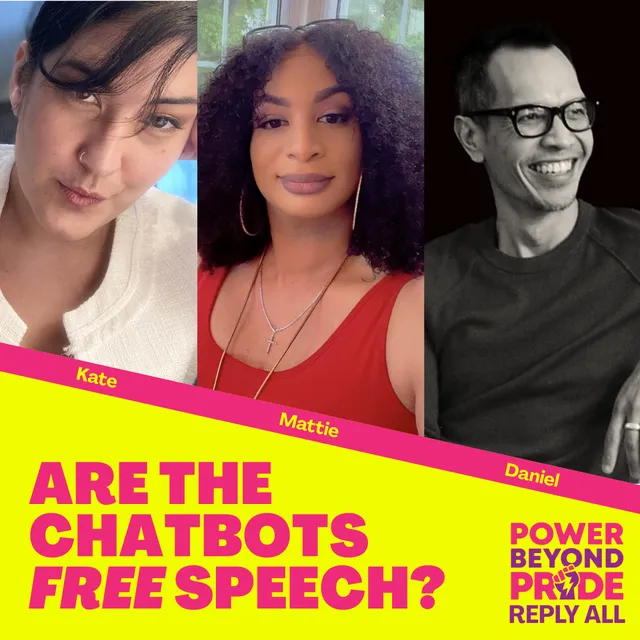
This monthly “Reply All” episode features members of the co-host team (Mattie Bynum, Kate d’Adamo, and Daniel WK Lee) discussing the political optics of Meta’s new anti-woke AI advisor and a Pete Buttigieg’s remarks on trans athletes, as well as the importance of community support for activists. The team also takes listener questions and invites you to submit yours!
I don’t think the leadership of the DNC wants to talk about trans people or Israel ever again. They know how different the DNC’s accepted stance is from the people that they consider their base. The DNC has catered to wealth, capitalism, and really maintaining structures of violent white supremacy because the DNC still benefits from it. I think they have feelings and I don’t actually get shit what those feelings are, because at the end of the day, their actions say everything that I need to know.
Hello, and welcome to Power Beyond Pride, a weekly queer change-making podcast bringing you voices and ideas from across our fierce and fabulous spectrum to transform our world. I’m Kate, high heart, femme in residence, and I’m just one of your co-hosts on today’s Queercast Journey.
Mattie (00:00:50 –> 00:01:03):
Today, I’m joined by. I’m Madi, the hostess with the mostess. I am an actress, comedian, lover of all things, creator of very few, Yes, but I’m a dynamic person all the way around. I think so. Hey, I’m a Leo.
Daniel (00:01:05 –> 00:01:09):
And I’m Danielle W. K. Lee, poet, author, and wannabe house husband.
Kate (00:01:11 –> 00:01:24):
And once a month, some of us at Power Beyond Pride gather in what we call a reply all, where we focus on issues or questions impacting activists, share insights from our own work across communities, and take some questions from the Power Beyond Pride mailbag.
Daniel (00:01:24 –> 00:02:09):
And I’m gonna get us all started. There have been recent reports that indicate meta has appointed an anti-Dei, anti-LGBTQ conspiracy theorist named Robbie Starbuck as their AI bias advisor. Now, for those who don’t know Robbie Starbuck, he is a right-wing influencer, failed filmmaker, and failed congressional candidate. And according to the Advocate magazine, was appointed to make Meta’s chatbot less, quote unquote, woke and that he believed, quote, pesticide turns children LGBTQ plus and that the COVID-19 vaccine caused Matthew Perry’s death. Do you think he’s the right person for the job?
Kate (00:02:11 –> 00:02:14):
I mean, I’m sure he’ll make Meta less woke.
Mattie (00:02:14 –> 00:02:42):
I don’t know if I think that he’s the right person for the job, to be honest with you. But I’m also a little leery about any of the fact checkers that are out there right now or the, I guess, advisors that we want to say about information, because a lot of people have their own different interpretations. So I don’t know. I think it’s interesting that they chose him to be the keeper of less woke chat box.
Kate (00:02:43 –> 00:03:51):
Yeah, I think it’s, I think he’s certainly going to make Meta’s chatbot less woke. I think it’s a question of what job they think he’s right for. And I think if we look at Meta and their business practices, we can say over the last eight to 10 years, but let’s be realistic. Let’s not forget that this is the platform A, that was started out of a dude who wanted to like sexually harass and judge women that he couldn’t speak to directly. And eventually they evolved into a platform that did things like force people to use their legal names, regardless of what that looked like. kicked people off. There is rampant abuse, trafficking on that platform that no one’s ever been interested in. And so if we’re going to talk about meta, what is the job that they’re looking for? They have spent years hiring consultants to say, what do we do to make our platform more friendly, safer? They’ve had reports on reports on reports on how to do that. They’ve never done anything like that. And so what’s the job? Is the job making meta safer for the shittiest people that you know? yeah. And is he gonna do a great job at that? Phenomenal.
Mattie (00:03:52 –> 00:03:53):
Yeah.
Daniel (00:03:53 –> 00:03:57):
I mean, it all seems to just align with just the past, I don’t know, three years of.
Kate (00:03:59 –> 00:04:00):
Just, you know.
Daniel (00:04:00 –> 00:05:05):
Culturally and politically, economically in terms of, like, Corporate America just peeling back on Dei stuff. And I was just, I think, in a way, signaling to a degree. to other people or just an example of just, oh, qualifications, fuck that, don’t need that. I mean, we definitely have an unqualified predator in the White House. So what does it matter? I mean, also it’s worth noting that I guess the hiring of Starbuck, which is quite the last name, was as a result of a settlement with Meta as a result, I guess their AI chatbot falsely linking him with the riots and for being a QAnon believer or something like that. So it’s odd and I don’t really understand the, even the optics of it. I guess currying favor with his conservative followers, it doesn’t make much sense to me.
Kate (00:05:05 –> 00:05:21):
Yeah, it feels like it’s just going the way of Twitter is now the platform that you, if you have to be on it, you have to be vigilant. You know, you’re going to be jockspite in cells. What’s going to happen on that platform? And meta just feels like it is trying to align itself with that.
Daniel (00:05:22 –> 00:05:56):
And it follows what actually, what Tick Tock has recently done, which is hire a, I believe, a former IDF or almost IDF, I OF policy person or something to be there in charge of quote unquote antisemitism and survey the content. Speaking broadly about it, but I mean, it’s really aligning with other social media platforms doing hiring the oddest kinds of individuals to, it’s asking the wolf to safeguard the sheep or the chickens. Is that the metaphor?
Kate (00:05:57 –> 00:05:57):
Pretty much.
Daniel (00:05:58 –> 00:05:58):
Something like that.
Mattie (00:05:59 –> 00:06:19):
Yeah. But, I mean, but yet again, like I said, I mean, they’re picking a person that believes that pesticides turns children LGBTQ plus. So yet again, my biggest question is, what is it that he’s going to be, I guess, advising other than he’s going to end up being the future fall guy? That’s what it looks like to me.
Daniel (00:06:20 –> 00:06:53):
What’s a chatbot advisor? What does that really entail? I mean, if these things are often like large language learning models and everything, is he going through data sets and figuring out like what’s web or trying to correct queries to the chat? I mean, I don’t use AI in anything. I actually, every time my Mac wants, the operating system wants to get upgraded or whatever, they’re like, Apple intelligence, you want to set it up or whatever. And I’m always like, skip. I’m like, no, I don’t want fucking Apple intelligence on my damn computer.
Mattie (00:06:55 –> 00:07:26):
You’Re not by yourself. I feel the same way about AI and chat gbt. I’m like, how much can we really truly trusted one? But I don’t know. I think, in all honesty, if he’s going to be advising the chat box, that does take me back to AOL and to the chat rooms of Yahoo Messenger days and Hotmail days. And it’s, okay, is he gonna be that scary man on the other side of a mo, I guess. B emoji and you don’t really know who you’re talking to. That’s what it just screams a little scary to me. Yeah.
Daniel (00:07:27 –> 00:08:30):
Oh, for sure. Like all these tech companies can scan and survey all your emails, your chats and everything like that. And you have to just like sex in a way. You have to gauge your risk tolerance and decide whether or not you want it, like how much exposure you want. And actually yesterday I just started, I’m pulling back from like Google and everything too. So I’m doing my own little baby steps here and there because I, oh, I mean, surveillance is real and I guess there, you have to answer the question of like, how much of yourself do you want out there? And, and I think actually what makes it interesting to a degree as you do this is that you really understand how you’re curating your presence online and how that is a artifice of who you are, quote unquote. It’s not like social media isn’t you. Social media is like what you want to present, right? So yeah, this is a very curious thing, but seems kind of online with just social media platform fuckery for the past, I don’t know, ever.
Kate (00:08:31 –> 00:10:44):
Well, I mean, I guess I’m curious about, because I totally agree, like this is what’s happened to social media. And I also want to be really thoughtful about when these platforms came up, when they were being developed, they were developed by the people on them. Facebook wouldn’t have mattered except for the people who went on, shared their content, connected to others, and developed it into a place like everything that social, any social media platform owes everything to the people who were initially on it. And as like, queers of a certain age, I’m gonna guess that all of us, like the internet was really important, especially when we were younger, especially when there was like zero representation where you had Ellen and that’s about it on TV, and maybe you knew a queer person, but you’re 11 and you’re trying to figure shit out. Like the internet was really important and finding people and connecting to people was essential to that. And so I guess, you know, what It’s hard to look at these platforms and see them, basically remember that they have always been an arm of capitalism that didn’t give a fuck about anything. And they’ve really become, they’ve really embodied, that’s who they have, that’s what they have lived into. How, what does this mean? I guess, like, when you are trying to figure out your identity and the internet is the safe place where you can’t talk to your family, maybe you’re in a small town, maybe you’re just too young to leave the space that you’re in. The internet was so important, at least to me when I was growing up and trying to figure out what, who I was and what my sexuality looked like, especially as a queer person, as a mixed race person. I feel like we’re almost seeding the space, even after we were the ones that built it, that made it worthwhile. And now it’s being taken over, now it’s being abused, now it’s showing its true colors. and I’m wondering, like, are we seeding space that we shouldn’t? Is this just gonna die and something else comes up? ‘Cause that’s gonna, that is still so important, especially to, like, young queer people who are trying to figure it out. And especially as we’re losing more representation.
Mattie (00:10:44 –> 00:11:45):
I was gonna say, I do wanna play devil’s advocate for two seconds, though, because in a way, yes, I do agree with you, Kate. Like, for a lot of the generations, I remember it, when you was talking about how it helped you to get out of the area you were in. all I could think about was reading Rainbow and I could think of the theme song that could take me anywhere. So the internet for us, when we grew up with AOL and Yahoo and all these different things, it was a way for us to get outside of where we were at that point in time and to get things. But on the flip side of that, I am a little nervous about what young people can learn on the internet because it is such a vast array of information, especially now that we know A lot of the information may not be fact checked or may not be accurate. So do you think there should be some type of advisory to it? But at the same time, where do we draw the line at what’s considered advisory and what’s considered oppression of freedom of speech? Because that’s where I’m getting at. And you know what I’m saying? That’s why I look at it at.
Kate (00:11:46 –> 00:13:29):
Oh, that’s absolutely valid. We should be going through education about sex and gender and identity. from the day we’re born and we should keep learning until the day we die. And so, you know, part of the reason why we’re on the internet seeking things out, and you remember the shit that we used to believe, we, you remember the crazy, oh, absolutely know that Pop Rocks and Coke are gonna blow up your stomach. And you just believe that for your entire life until someone does it in college and doesn’t die. And so I really think We seek out that information, and especially young people seek out that information because we’re looking for answers to very valid questions. And it should be easy. Like, we shouldn’t be sending young people to be like, go figure it out yourself and just type in a search code and you have no idea what’s coming. That is an unfair thing to do. And it puts an onus on a lot of different areas that are not looking to be the information center for young people. And so I think more information, clear information, direct information, neutral information should be accessible everywhere to people trying to figure it out. And so I think part of this is about, part of this is about making sure that information is available from places. And when we take, and so I think what you’re talking about is such a bigger problem when we don’t actually commit to educating people or talking to people. in ways that are comfortable and are safe. Because that’s when you seek out the only person who’s willing to talk to you. And sometimes especially like on the internet, that’s not a great source, but it’s what you’re looking for when you have nothing else. And that’s unfair.
Daniel (00:13:29 –> 00:14:39):
Yeah. I mean, I hope that they’re the kind of the consequence of this thing is more offline kind of seeking and knowledge garden. Garnering because honestly, I mean, I’m, I guess, a little bit of a different generation that, that I didn’t use the internet really to meet people, queer people as a young person. I went to a queer youth group, two different ones and stuff like that, to, to meet people and get my information and everything. I mean, I’m not saying that all young folks will become social media lattices or whatever, or just askew it. But I think there’s a kind of fertile ground for young people to pull themselves offline and to engage in a kind of an old school way. And maybe that’s just me being hopeful, but you never know. I mean, I think you’re right, Kate, and I think we have seeded ground and maybe it’s because It’s a part of a general feeling of disaffection and disempowerment.
Mattie (00:14:40 –> 00:14:53):
Well, at this time, we do need to take a quick short break, but we will be back very shortly here on Power Beyond Pride. We have so many topics to discuss on this episode of Reply All. And so stay with us and we’ll be right back.
Kate (00:15:01 –> 00:16:40):
Welcome back. This is Power Beyond Pride, a queer changemaking podcast, and I’m Kate here with my co-host, Manny and Daniel. That’s a really interesting conversation, and I’m excited to pivot us a little bit. So recently, Pete Buttigieg has been doing some interviews and has had some conversations really specific to his feelings about trans athletes specifically. And so he got some blowback, and then on Monday, I was speaking to NPR’s Steve Inskeep and tried to clarify some of his comments. Whereas before he talked about questions of fairness when it came to trans athletes, his response was shifted a little bit and added some to what he had previously said, where he said, you, approach starts with compassion. Compassion for transgender people, compassion for families, especially young people who are going through this, and also empathy for people who are not sure what all of this means for them. I think that when you do that, that calls into question some of the past orthodoxies in my party. For example, around sports, where I think most reasonable people would recognize that there are serious fairness issues if you just treat this as not mattering when a trans athlete wants to compete in women’s sports. Steve Inskeep followed up and said, meaning the parent who’s complained about this has a case. And Pete responded, Sure. And that’s why I think these decisions should be in the hands of sports leagues and school boards and not politicians. Least of all politicians in Washington trying to use this as a political pawn. So first and foremost, what are your thoughts?
Daniel (00:16:41 –> 00:18:20):
It’s so idiotic. It’s so idiotic. It’s so idiotic. It’s, oh, let not the hands of politicians as though sports leagues and school boards aren’t politicized. That it, like, that doesn’t even add up anyways. That doesn’t add up anyways. But what it shows, at least to me, is that P. Buddha Jag has a trans issue illiteracy. Like, he doesn’t actually know how to, talk about trans issues, refocus on actual trans issues rather than getting mired into something that no one really, it’s not a real thing. Like the con, there’s not so many trans athletes in, in, in these high level, like world championships and the Olympics or whatever that like, it’s just, It seems like it’s blowing up and it’s becoming bigger than what really should be talked about, which is would be healthcare access and employment and all these things. And instead of doing that, instead of saying something like, oh, actually let’s, if we want to talk about trans issues, let’s talk about these things. And I know there are some trans folks who are really invested in trans People in the military, but those are a small minority to people, the trans people I know who are invested in healthcare and employment and all the, and the basics of life or even violence. So it seems like he just wasn’t savvy and also just doesn’t know.
Mattie (00:18:21 –> 00:20:05):
I mean, I do agree with you, Daniel, on that one, because I think at some point in time, why does it matter? and this might offend somebody. And I have some people, and I don’t mean it to be offensive, but why does it matter? Because does it matter if a person is a man playing a sport? Does it matter if a woman’s playing a sport? Does it matter if it’s a black person playing a sport? Does it matter if it’s a white person playing a sport? Same thing with trans. Because my biggest argument I think I have with people who have an issue with people, trans people in sports, is that you still think they’re coming in as their former gender and they’re not. if a man has to transition into a female and is now playing in female sports, their body is made up like a female. They’re not coming in raging in testosterone and oozing with all this masculine energy. They’re already transitioned into a female. So therefore, it’s still a female coming into a female sport. So I think when we start talking about politics and schoolboy, it’s all a smoke screen to me. I feel like they’re still using that, like you said, Daniel, to draw your attention away from the fact that we have bigger issues when it comes to the trans community, like gender-affirming care, housing, hate crimes, people dying. These are issues, the bathroom bill. These are more political bills that need to be discussed than children playing sports or people in sports in general. Because like I said, if we let females, I mean, there’s school districts that let young women play football with young men, but that’s okay. That’s fine, but a trans student cannot compete in the gender that they affirm in. What’s the difference?
Kate (00:20:06 –> 00:20:53):
I also think that this is the, these are the comments and opinions of people who are not in around intense athletes. Like, whatever you were born, whatever you were assigned, however you identify, if you have been training for 10 years to play football, there’s some physical dynamics to it, and there’s also running backs. This is not a serious conversation when it comes to trans folks. It’s also not a serious conversation when it comes to sports. Wait, and the question I also want us to talk about is when I see this, sure, it is absolutely a messaging issue. It is absolutely a political issue. When I see this, I see Democratic white gay assimilation politics.
Daniel (00:20:54 –> 00:20:55):
100%.
Kate (00:20:55 –> 00:22:01):
And I see someone who really wants to run for something and really wants to be a non-scary gay person and is really trying to ingratiate themselves to people who do not know and are afraid of this topic. And I think that says a lot about the DNC. And I think that says a lot about who we allow into leadership positions. And I think it also says a lot about what the DNC considers leadership. And because if you are saying like, oh, this is a non political issue, I’m going to leave it to school boards. Are you kidding? Are you really serious right now? Or is this really about where you don’t think that the people who are going to push back on this are going to support anyone else and you think who you’re going to be comfortable with are the people who don’t support trans folks, who don’t support queer people. I mean, I think that what we’re talking about is someone who doesn’t want to be a leader on these issues and doesn’t want to be a leader, period. They want to be elected. And that’s a different conversation.
Mattie (00:22:02 –> 00:22:35):
To what both of y’all said previously, I think what Pete did was he tried to talk on a topic that he thought he knew information about and then realized that he didn’t know enough to fully stand on his own two feet. So then he tried to usher it back real quick. and say, well, I think this should be left up to the school board. Well, no, you don’t put it out there now. Like, you, you, you don’t brought the topic out. You can’t bring it out and then come back and say, well, it should be to the school boards and to, it shouldn’t be political. What, but you made it political.
Daniel (00:22:35 –> 00:26:20):
So, yeah, there’s a, there’s this calculus that, I mean, to what Kate is saying, there is this calculus that the DNC and their perspective electables, quote, unquote, are making with respect to throwing out their solidarity with people within their alleged community, like LGB, LGB. That’s what like Pete is trying to basically say, because by seeding this idea that trans athletes or trans women’s trans women are different from other women in women’s sports is the erasure of saying, oh, you’re actually not a woman. And that’s fucked. And so Pete Buttigieg is doing what kind of all politicians have done so far, which is to build their electability, their political career on the bodies, the erasure and of others that he completely has decided in this kind of a calculus are dispensable, which is so par for the course at this point, right? Like we have seen a democratic party absolutely think very little about what’s happening in other places in the world and fail to have a reckoning with what transpired. with the last election, it’s like they, they’re, it’s not even ideology. They’re working with the idea only of opportunism. It’s like whatever the opportunity is, that seems to be good. Let’s go with that. And maybe something will be different rather than like having a stance. And that’s why it seems the DNC doesn’t have or they’re so resistant to endorsing Mamdouh in New York because Mamdouh has a stance. He’s trying to be a leader. He’s clearly articulating something that’s, that resonates with New York. And this kind of idiotic, like, treating him like he’s like a leper is so toxic and so it’s not even strategic either. It just makes zero sense. And it’s sad because what the Democratic Party seems to be doing yet again is trying to prop up a minoritized, quote unquote, identity. He’s still a white man, but a minoritized identity so that they can get the quote unquote left or woke liberal or something like vote that didn’t vote for Kamala, not because she wasn’t, not because she was a woman or biracial or whatever, but all data points to not voting for her or sitting out because she supported Israel. That’s it. And they don’t want to have a conversation or reckoning about that simple fact. and now we have, I don’t know, whichever milk toast candidates out there who are the lesser evil, you know, trying to get elected. And, you know, the people who are, have, who have opened their eyes to all this are just, I think it’s gonna happen again. Just sit it out and be like, nope, you haven’t learned your lesson. Another four years of I don’t know, the couch fucker or something.
Mattie (00:26:21 –> 00:26:23):
Well, can I ask this question? You so crazy.
Daniel (00:26:24 –> 00:26:35):
J.D. Vance got hassled in a really amusing way being called a couch fucker at the Capitol. It’s great.
Kate (00:26:35 –> 00:26:36):
Couch fucker and pope killer.
Daniel (00:26:37 –> 00:26:37):
Yeah.
Mattie (00:26:38 –> 00:26:41):
Oh, wow. Two names in one day. All right.
Daniel (00:26:42 –> 00:26:46):
It’s chef’s kiss. If you’re gonna heckle, I mean, But.
Mattie (00:26:46 –> 00:27:23):
I do want to ask the question. So do we think of these topics, like with trans and sports and even Israel, do you think that the DNC is actually using these topics and platforms because they care, or is it because it’s just another platform they think could get them reelected? Like you were saying earlier, Kate and Daniel, it’s more of a platform to stand on versus, I really care about these calls. I really want to debate these issues. I really want to find something that could help alleviate these issues, but instead it’s more of a photo op and a platform to get more votes.
Kate (00:27:23 –> 00:28:41):
I don’t think the leadership of the DNC wants to talk about trans people or Israel ever again. And I think it’s because they know what– I think they know how different the DNC’s accepted stance is, how different that is from the people that they consider their base. I think that for a very long time, the DNC has catered to still wealth, still capitalism, still carceral capitalism, and really maintaining structures of violent white supremacy because the DNC still benefits from it. And so I don’t think they want to talk about any of those issues. And I think that the people that do, we see how marginalized they get. We see how unsupported they are. We know exactly what happened to Corey Bush. We know what happened to Jamal Bowman. We watched it in real time. We saw exactly how the DNC does not support, especially black leadership. And so I don’t think they want to talk about either. And I think they have feelings and I don’t actually give a shit what those feelings are because at the end of the day, their actions say everything that I need to know and their feelings are about them and God.
Mattie (00:28:41 –> 00:28:41):
Yeah.
Daniel (00:28:41 –> 00:31:11):
I mean, I agree that I think that if they want to talk about it, they perhaps would. But really what they have failed to do is articulate a vision of what voters should vote for, which is like they haven’t really, I mean, Bernie did it, but he’s not, I mean, he’s a quote unquote Democrat, I guess, but I guess technically independent, but caucuses with Democrats. But the Democrats haven’t offered a vision of what to vote for. They’ve offered only to try to scare you and to not to, so you don’t vote for the other guy. Well, that’s not anything anyone wants to do either. And that’s why you have 19 million people who sat out the election. So, yeah, this, I think this is goes back to what I was saying before that they’re just trying to be opportunistic and be part or make themselves, quote unquote, relevant within a discourse, a public discourse, so they can put their five cents, even though the five cents absolutely means nothing. I don’t have a lot of, well, I haven’t been a Democrat in a long time, and I don’t have a lot of hope for them in this cycle either, because just as I was saying, they don’t have a vision, they don’t have, they haven’t articulated something to vote for. I wish progressives would mobilize and do the very hard work of empowering another party. It’s incredible. I mean, I used to be a kind of active person in the Green Party, and there are so many systemic obstacles, not the least of which is money or the, or election commissions. they’re incredibly, I mean, they’re basically in bed with the existing power, power structures of the parties, like creating less options, fewer options for people to vote for something. So I don’t know, like, our democracy needs democratizing and, and I don’t think, and it’s not sexy and I don’t think People have the kind of fortitude to fight for it at this point. That’s just, which is sad, even though we’re just, because, and also we’re, we’re just fighting for what, quote unquote, used to be ours, right? This marriage or, or abortion access, which.
Mattie (00:31:11 –> 00:31:11):
Is.
Daniel (00:31:13 –> 00:31:14):
It’S a dystopic world.
Mattie (00:31:15 –> 00:31:35):
Sounds like to me, meta isn’t the only thing that needs advising. I think our government and democracy needs an advisor to come and make sure make sure they are doing their job correctly. Yet again, y’all, we do have to take a quick break, even though we hate taking breaks because we love the conversation, don’t we, y’all? I mean, I could talk for hours. I know, Kate.
Daniel (00:31:35 –> 00:31:37):
We can just keep on going, though.
Mattie (00:31:39 –> 00:31:47):
But we do have to pay the bills, just like everybody else does. So, look, stay with us. We’ll be right back, and we have more interesting topics along the way.
Kate (00:31:54 –> 00:32:03):
Welcome back to Power Beyond Pride. I’m Kate and I’m here with my co-hosts Mattie and Daniel. And we are queer changemakers ourselves. It’s time to check our mailbag for your questions.
Daniel (00:32:03 –> 00:32:10):
Our first question comes from Charles. And Charles’s question is, what are some.
Mattie (00:32:10 –> 00:32:22):
Of the emotional and psychological challenges Lgbtq+ activists face in their work? and how a community is creating support system to prevent burnout and promote long-term engagement.
Daniel (00:32:22 –> 00:32:23):
Who wants to take that one first?
Mattie (00:32:24 –> 00:33:28):
I could talk about the emotional and the psychological challenges that we face as activists. Definitely as an activist, as an activist in general, being the activist itself is an emotional psychological challenge and journey because you have to constantly Keep yourself in check. I know for me, I do. I have to make sure that I’m always staying true to my calls. I always have to make sure that I’m staying true to my word, and I’m not contradicting myself or I’m not being hypocritical. So I know for me, the emotional part of challenge of it is just making sure that my head is clear and I stay grounded so that I can continue fighting. Now, also as a LGBTQ+ member of the community, that in itself is a whole nother box. of tricks because I gotta be able to hold my head up high just being Mattie, not activist Mattie, but just being Mattie. So I will say, yeah, just trying to stay true to yourself and not be hypocritical is one of the biggest emotional psychological challenges that I deal with.
Kate (00:33:28 –> 00:35:46):
I think in this question they also answered it. I mean, burnout is so real for activists. Some of the emotional challenges about being an activist in general, but especially an activist working out of your own experience, your own identity means that often you’re also working out of your own trauma and you are trying to figure out the difference between healing and activism. And especially if you’re not surrounded by activists who have gone through that process, I know for me, so much of my work was, so much of my activism was rooted in trauma. I was rooted in trying to figure out how to heal that trauma with very justifiable rage. And that is a recipe to just destroy yourself and wonder why you’re not healed at the end of it. Still, I think that’s just one of the challenges that I really want to name alongside of you give everything, you give your resources, it’s hard to, you’re broke all the time. You’re living on, I don’t know about anyone else, but like, When you throw an event and afterwards you’re like, well, I didn’t get paid for it, but I’m going to take the leftovers and then I’m going to eat this tray of rice for three days because that’s what’s left over. Yeah, like those are all really hard. And so I think one of the things that I’ve seen in community, especially queer community, is a commitment to organizing and create social support systems for activists, for community engagement that are rooted in joy, and love. Like, I think with LGBTQ activists in general, like we go to a protest to meet the next person we’re going to fuck or date or been with. We, and we figure out, I think it’s Act Up who said we protest all day so we could party all night. And so I think preventing burnout and promoting long-term engagement, the ways that I’ve seen it, the ways that I’ve experienced it is Creating spaces that embrace that very justified rage and remember that the root of what we have to do together has to be joy and love, or else we’re all going to burn out and quit and we’re going to come back for a very long time. If this is the place where we find our people and love each other.
Daniel (00:35:47 –> 00:38:38):
Yeah, I think what you said is, I think what really struck me, what you said is that this work, isn’t your therapy, isn’t your healing per se. And I think that kind of if you take a step back, you have to acknowledge that the work shouldn’t be an extension of your ego or it’s not your personhood, even though you might be close to it, that you need to actually strike a balance between your quote-unquote activist life and your regular life and even is intertwined as they may be, still being able to like find value in your, in yourself that’s outside of the work, quote unquote. And I think that the kind of that, that serious parsing will help strike a balance and give you that power to be like, you know what? I’m not going to answer that text. I’m going to turn off my computer or laptop and I’m going to disengage with those problems because I don’t want to, I don’t get paid to in these things. And like the long-term ramifications of this constant, like putting pouring yourself into it is, is burnout, is the engagement dwindling, thinning out. And just speaking to your like, assistance of support, I think what would be beneficial if I were to be prescriptive to organizations or activists is to bake into your kind of your programming and your professional development, like these opportunities to let off steam and try to get that funded. Because again, long term, you can’t, this can’t be sustained. and there is truly a justifiable reason to keep your employees and yourself happy to maintain that work. And funders have to be like, oh yeah, that makes sense. Let’s fund retreats where we’re not talking just about the work, but actually we’re just trying to be people with each other. And that kind of support and sharing space is a part of a part of that work, but not necessarily directly. And I, I would encourage folks to, to look at those and make, try to make those opportunities happen. And again, try to get that funded because it’s really needs to be part of that structure, that system to let ourselves continue to be on front lines and not front lines.
Mattie (00:38:38 –> 00:40:11):
And I would definitely also to add to everything that we’ve all said was the biggest thing is, like you said, the answer is in the question is community. Because also too, we have to remind ourselves that, like you said, the people who sponsor the event, let’s say, for instance, all three of us are activists. And if you’re doing an event, Kate, and me and Daniel are attending as community of activists, we should also pour back into you after the fact and say, okay, what do you need from us? as a community support member, because a lot of times we forget in activism, we have the people who are on the front lines, but it’s the people in the background that do just as much as well. Because when that person gets tired of being the activist, the face of it, we as a community should come back and pour into that person to continue to give them the energy to continue to do that. Because I think a lot of times we have conversations about creating systems, but instead of creating a system, let’s just be the community that we’re supposed to be. ’cause if we stand together, it’ll make it all easier. But that’s how it should be. Like, I think that, ’cause you’re right, how many times have you put it all out there? And Daniel, we’ve all experienced this. And the first question we asked ourselves, did I give enough? Did I care enough? Did I do enough? ‘Cause you never hear those responses back. But then what we do hear is, in 10 minutes later, okay, well, but I need you to come and do this now. Now you finished this event, but now can you come and sit on my board to help me do this? And it’s like, We gotta, yeah, we gotta be able to feed into each other and to be that safety net for one another to be able to recharge each other.
Daniel (00:40:12 –> 00:40:49):
Yeah. And it’s actually invaluable too. I just want to add that I like have friends that are nowhere near your work. Cause honestly, sometimes it’s actually your quote unquote community that disappoints you. Like if you threw an event and no one within your field or community showed up, They’re kind of the problem for you at that moment. And so the person that you want to be like, or the let off steam with hopefully is someone that’s not anywhere near it. Is your fun friend that like doesn’t know shit about, I don’t know, sex work or something like that. That’s fine to have because you know what? You’re not married to the movement.
Mattie (00:40:50 –> 00:40:50):
Exactly.
Daniel (00:40:52 –> 00:40:56):
So, yeah, that’s my best bet on that.
Mattie (00:40:59 –> 00:41:18):
Well, our next question comes from Trey in Jacksonville, Florida. This is an interesting question because I’m interested to see how this goes. Why is it more acceptable for a woman to be openly lesbian or queer affirming than a man to be openly gay or queer affirming?
Kate (00:41:19 –> 00:42:50):
Misogyny! Misogyny is about the oppression of women is about men and is gender, it is aggressive gender roles. And men in the United States, the gender roles for men, traditional, what that looks like, means homophobia. It means transphobia. It means rejecting everything that isn’t this violent, actual homo-romanticism of other men. And so the same It’s okay for a woman under those conditions to be openly lesbian because if you view love, quote unquote, as an oppressive heteroromantic structure, then you’re a woman who also wants to oppress and violate another woman. And that makes sense. If you are a man who wants to do that to another man, that is an affront to gender roles. If you want to be in a different kind of relationship with men, that is an affront to gender roles. And so women are held to a standard that is different. Men are required to be rejecting. They are required to be homophobic. And so the reason is why is it more acceptable for a woman to be a willing lesbian? Because no one cares. And that gets contextualized as here’s a woman who wants to oppress another woman. And that makes sense under gender roles. so, yeah, I. That’s my answer. It’s misogyny.
Daniel (00:42:52 –> 00:44:17):
And I’m gonna point to our no masculinity that at least concerned conceptions of it, at least here in the west, I would say global north, maybe that men like to legislate and control other people, not just other men. but obviously women’s bodies and trans folks bodies and such. And to being gay would be, is an affront to masculinity, right? Is a front to, it’s a relinquishment of all their, all the power, your quote unquote God-given power to have dominion over the, over others and to have the potent you know, procreative power and yeah, to dominate. And so this, my feeling is that it’s hard to be openly gay is because it’s rejecting the kind of understanding of what being a man is, and that’s not acceptable. And even with your queer affirming, it’s seen as a softening. It’s always this kind of, oh, you’re like, oh, you’re soft on this or you’re empathy seems, empathy is villainized and also feminized.
Mattie (00:44:18 –> 00:44:18):
Right.
Daniel (00:44:19 –> 00:46:17):
So it just seems that, like, it’s not palatable. It’s not okay with, with certain men or society. I think it’s changed for sure. I don’t think in my early life, I definitely didn’t see as many kind of so openly pseudo-homo romantic relationships between men where they’re just very, they’re very open and frank, but it’s not a romance, but it’s a kind of relationship that doesn’t have a particular mainstream archetype that is looked upon where men can be vulnerable with men and not be feminized called gay or all these things. Like that’s so atypical, but I think it’s becoming more typical. And I’m really happy about that. I’m really happy with, especially as we also break down gender, like rigid gender expressions that also has given that energy as well that, you know, heterosexual identified men can still wear nail polish and all these things and say that they love their male friends and not feel weird about that. I love that. And I’ve actually, if anything, I wish gay people weren’t so gatekeeper-ish about it being like, oh, these two guys were, are tight or they hold hands or they whatever, and they’re like, oh, that must mean they’re gay or whatever. stop that. Like you’re actually not allowing men to have these intimate relationships without being stigmatized. Like you’re part of this energy of stigmatization. So, yeah, I mean, that’s my five cents. I think that the toxic masculinity is alive and well.
Mattie (00:46:19 –> 00:49:02):
Very much so. I definitely agree. I think, and both of y’all are right. It’s just. To me, I think it’s a long here series of women have been overly sexualized for way too long. So, I mean, if we think about it, it’s okay for a woman to be a lesbian because that’s a man’s fantasy. It’s okay for a woman to be a lesbian or we’re affirming because she’s sexuality, so she’s supposed to be fluid regardless. It’s okay for a woman to come out on TV like Ellen did and be the first woman in the 90s to stand out loud and proud and say, I’m a lesbian. But it’s okay because not one, not only was she a lesbian, but she’s also a comedian. She’s also not what you would typically find. Like, I remember watching an interview Barbara Walters did with Ellen DeGeneres and she said that people referred to her as the younger version of Joan Rivers because they’re not really pretty, but they got a little bit of looks and they’re funny. So it’s a whole package. And I was like, well, first off, that’s– but that’s how we view– like, I think it’s a fucked up situation. That’s how we view women, but that’s how we so view women. now, even going back to just women in general, whether it be lesbians, heterosexuals, cisgender, trans, intersex, look at how we’ve treated women over the years. I mean, I’m gonna be honest. Growing up, Wonder Woman was a whole lot cooler than Superman. But Superman got more leverage, you know what I’m saying? He got more screen time. He got everything over Wonder Woman. And I’m like, but she’s got an invisible plane. Do y’all not understand this woman? is so much more and she can reproduce. But that’s a whole nother conversation because she’s an Amazonian and Amazonians are considered to be asexual people. But I said, that’s a whole different conversation for another day. But instead of looking at their strength, we look at women as sexual objects. Like, I even remember watching Insecure and there was an episode where a girl was dating a guy and he had gotten his dick sucked. in college. He tried it. He was like, I tried it. That was something that I wanted to experience was being with another man. It was cool, but it just wasn’t for me, blah, blah, blah. But then the woman was looking at him was like, so you must be gay. Well, why does that make him, first off, how does that make him gay? One, two. But how many women have had same sex experiences throughout life and didn’t have to live up to a stereotype or a title of some sort? All because they decided to freely explore their sexuality in themselves. So I definitely think a lot of it has to go back to overly sexualizing women. It’s just, that’s something we’ve did to women over the years down through centuries, always.
Kate (00:49:03 –> 00:49:20):
It’s so wonderful to get these questions from activists and icons across the country. Got questions about your activist experience or how queer change making can impact your communities? Send it to mailbag@powerbeyondpride.com or visit the site at powerbeyondpride.com to submit your question.
Daniel (00:49:21 –> 00:49:31):
Even better, send us a video to some of our socials or any of our socials. We want to see you hear from you and be in community with you.
Mattie (00:49:31 –> 00:49:41):
And sadly, that’s all the time that we have for this episode of Reply All. We’ve enjoyed it. I think I’ve enjoyed it. Did y’all enjoy our conversation today?
Daniel (00:49:41 –> 00:49:43):
It’S great. Great conversations.
Kate (00:49:43 –> 00:49:44):
There’s so much more to talk about.
Mattie (00:49:45 –> 00:50:08):
I know, girl. So that means y’all please stay tuned and continue to listen because this is just the beginning of the conversation. I’m your co-host Mattie Bynum, the hostess with the mostest. You can follow me on Instagram at Mattie Simone 737, also on Facebook at Mattie Bynum. And I am thankful to be here with my two beautiful co-hosts Kate and Daniel, Their and I socials.
Kate (00:50:08 –> 00:50:26):
Will let them And give I’m you Kate, your high hard femme in residence. And you can follow me at reframehealthandjustice.com and on Instagram at harmreductionfemme. Remember to subscribe and get your friends to subscribe to Power Beyond Pride on Spotify, Apple Podcasts, or wherever you get.
Daniel (00:50:26 –> 00:50:40):
Your podcasts, and check out our site at PowerBeyondPride.com. And I’m your co-host, Danielle Poet, an author of Anatomy Daniel of W. Want. K. And Lee, you can follow L.E.E. me at strongplum on on Instagram TikTok and and Blue Sky.
Mattie (00:50:40 –> 00:50:48):
Power Beyond Pride is a project from A Great Idea, a clear owned design and content agency. Learn more about them at agreatidea.com.
Kate (00:50:48 –> 00:50:53):
This episode is produced by Shane Lukas. Mattie Bynum is a project developer.
Mattie (00:50:54 –> 00:51:02):
Our editor is Jared Redding with support from Lukas. And we are all part of the podcast Awesome Host Team, questions three of us, and comments and remember to to powerbeyondfraud.com.
Daniel (00:51:02 –> 00:51:12):
Send us your check out our new episodes each week, and we look forward to queer change making with you next time. Thank you from all of us at Power Beyond Pride.