

Episode #54 · May 12, 2026
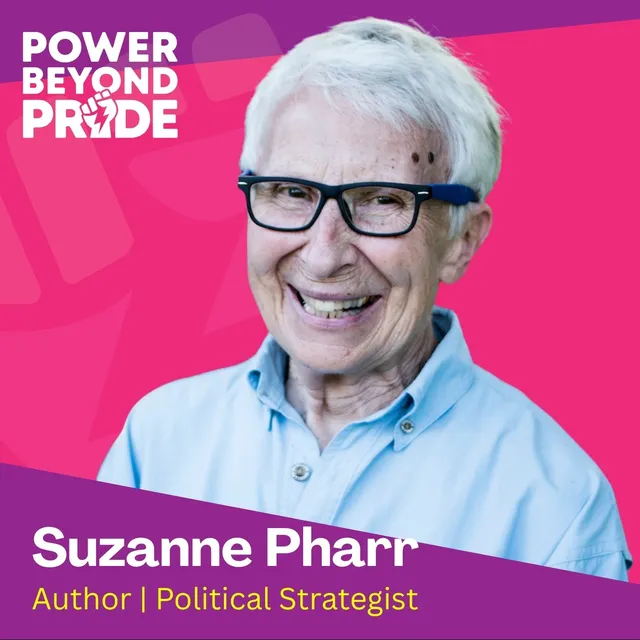
Hope, Power, and Community with Suzanne Pharr
Listen or watch
In this episode
Kenyon Farrow and Mattie Bynum welcome legendary organizer and writer Suzanne Pharr for a moving conversation on movement-building, queer liberation, and the urgent need for community. Suzanne reflects on her decades of activism, from anti-violence organizing to writing landmark books about homophobia, authoritarianism, and democracy. She explains why reconnecting with one another is essential in a time of isolation, fear, and political division. The episode also explores how pride becomes power when it is turned into action. Through wisdom, humor, and clarity, Suzanne reminds listeners that hope is built through relationships and collective struggle.
TranscriptRead the conversationAbout 42 minutes to read · 6,236 words · Suzanne Pharr, Kenyon Farrow, Mattie Bynum, CBOpen
- Suzanne Pharr
- I think particularly in the queer community, it was difficult for us to find another person like us that we would even see ourselves mirrored in because so many of us were isolated, like me growing up in the country. So now we've built this movement in which you can see yourself and you can see people like you. But what we had to put in that is that connectedness. It's not enough just to see the reflection of ourselves in another person. We had to feel some sense of connected humanity. And if we lose that, We are in tact.
- Kenyon Farrow
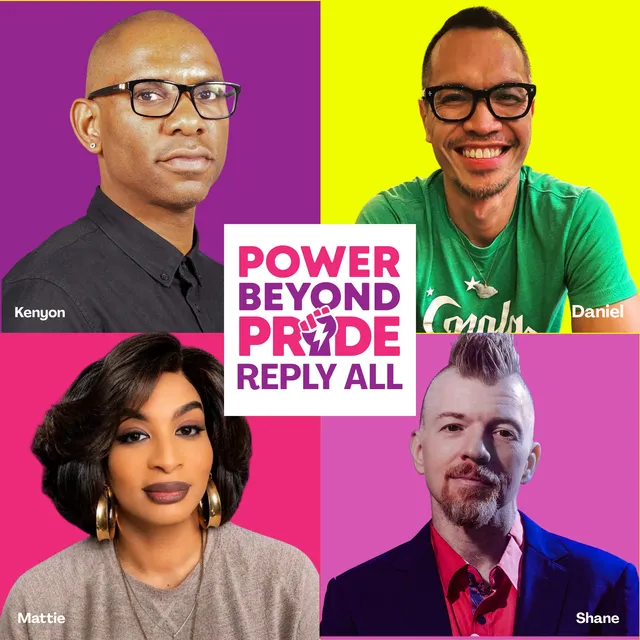
- Hello and welcome to Power Beyond Pride, a weekly change-making podcast bringing you voices and ideas from across our fierce and fabulous spectrum to transform our world. I'm Kenyon Farrow. I'm a writer and activist, and I am the biggest fan of our guest tonight. And I'm Mattie Bynum, your hostess with.
- Mattie Bynum
- The mostest, and we are your co-hosts on today's Queer Cast Journey. In this episode, we are talking to the iconic Suzanne Pharr, organizer, writer, strategist, and political handmaiden. Suzanne is a Southern, queer, feminist, and anti-racist organizer. She founded the Women's Project in Arkansas in 1981 and was co-founder of the Southerners on New Ground in 1984.
- Kenyon Farrow
- Farr is an organizer and political strategist who spent her entire life working on a broad-based, multi-racial, multi-issue movement for social and economic justice. So first of all, again, I just want to say welcome so much, Suzanne, to this conversation. And I know a lot about you and having been mentored by you and worked together going over 20, 20 some odd years. But I think for our audience who may be unfamiliar, how did you become an organizer?
- Suzanne Pharr
- So into it, I think, or maybe it came from being the youngest of eight children, or you had to organize your way into a situation to getting what you need, that kind of thing. But really, actually, I think, would say that I started organizing in the early 1970s. I would start, I'll say 1969, when I basically walked right into the women's movement. And I was already working on, protesting the Vietnam War. But when it got to the women's movement, it was basically organizing a new world. By creating a community center for women. Discovering that Brazilian women were being raped and realizing we had to organize. We had to create some way to work with those women that we followed that, which was we realized that women were getting beaten, so we had to create a women's anti-violence movement, a domestic violence movement. So we were looking to be able to both rape and Also just violence on the street as well as violence in the home, particularly violence in the home. And then there was just so many things to organize. We organized women's land where we would have land communities organized events where, for example, the music, the creators of the terrific women's music, feminist music, were just going across country at that time, and you could hear them even if you were in smaller cities, because that was the thing, to write music for a new generation of people, write music for a new movement. So it's on and on. Will we organize it out? And then there were serious organizing when I say Covid. Was actually, and I'll talk about this probably a lot tonight, after coming into contact with the Combahee River Collective Statement, which was the great feminist, black feminist statement, talking about how all of our issues are intersecting and that what we need to do is intersectional work. And that was like the mid 70s. And I had a great number of people, all the people who founded Song with Me, the other six, by people, we were grounded in that idea that we would not be doing identity politics, that we would be doing politics where social change would be about all the people and their suffering and all the people in their advancement connected together.
- Mattie Bynum
- And now I love that. I mean, you were talking about writing a while ago. I've noticed that you have penned a lot of literary books. I mean, I just want to go over a couple of the titles, but you have Homophobia: A Weapon of Sexism in 1988, then you authored In the Time of the Right: Reflections of Liberation in 1996, and Transformation Towards the People of Democracy in 2021. When you are writing these books, how do you organize your thoughts and context to put into the book? And do you sometimes feel like you're writing to yourself? What is your style? Do you write to yourself or do you write to someone else?
- Suzanne Pharr
- What's been different with each book? The first one, the Homophobia with Women's Sexism, that was, for me, groundbreaking. And I was gifted by being able to do, this came out of the domestic violence movement, out of the National Coalition Against Domestic Violence, us recognizing that the issue of homophobia was existing. Within our organization and that we had a conference where women walked out for two reasons. One, they walked out because a group of black women had organized and the other one was lesbian women. And so it's one of those times where you saw some misdirection where they were like, no, we can't have lesbians in this. It would destroy our reputation. And so out of that, I mean, National Coalition of American Women once decided they wanted to send a couple of us around to do speeches and to do workshops on homophobia. And doing those workshops, it didn't take very long to get more and more information that sort of settled in my head to make me understand really clearly that this is not just about dislike of queers and fear of queers. This is a means of suppression. It's a means of suppression of us and our gender. And so you see that move through time where as awareness grew about trans people, it moved heavily to that. So queer people began to receive some recognition of maybe this is close to being like the rest of us, because they're getting married now. If it was a moment of, whether that was a good moment or not, I think it moved people to some sort of adoption of, okay. So then it turned, and this is the right wing making this turn for us of saying, oh, look at this. This is the worst. You think those queers are, look at this. This is like a version of even homosexuality. It helped, I think, all of us to understand But homophobia was definitely connected to gender and sexism. And so it was late in my life through doing the work. You do 30 or 40 workshops and you get to hear all these smart people talk because everybody who comes to one is smart. When I wrote in the Time of the Right, this was something I had been organizing since around the right, watching the right since 1980 when Ronald Reagan was selected. And so what I wanted to do there, I saw this thing growing, this effort to divide people, to shape the way they thought, and to basically destroy civil rights for everyone across the board, but particularly basing it on race. And it was clearly a threat to democracy and was going to become a greatest threat. So I felt that, necessity to write about what I had seen. I had just also come off working on a ballot against a ballot initiative in Oregon, which we'll probably talk about later, in which the riot was, had made one of their first moves to try to actually embed this kind of thing in the Constitution and were making a law that was prohibited almost I also, any recognition of queer and trans people, whether it was in schools or whether it was through being on government property, the whole long list of things. So I thought this is, I had a sense of urgency with that. I wanted to write something that was not too long, that was filled with those examples and stories so that people could read it in an easy kind of way and a language that was understandable. And that would be able to be used in a high school. That was a dream. Imagine now anyone considering the possibility of that. But the idea that in an 11th grade it would be good to read something like that. And so I published that in 1996, but the most writing of it was in 1995. And it was just critical to me. Each of these things as it rose up, each time I would see this kind of violation of our rights, watch the beginning of the attack against immigrants, you know, that that kind of thing. But really watching the slow takeover of governance and government both. So that that book then led me into the third book, which was based on articles that I wrote for our new sort of the Women's Project over almost two decade period. Of what we were seeing, what we were seeing in all areas is very intersectional that you thought it was. And so I would have an article in that four times a year. And so that book is a collection of many of those articles talking about not only the right, but the fact that we have to have transformation of our society. And I think we know that. We know that now more than ever.
- Mattie Bynum
- I understand that. And that definitely, I've enjoyed, like I said, I started reading your book, the Time of the Right and Reflections of Deliberation. So I am enjoying getting into it. I can't finish it. But we do have to run to a quick break and when we come back, I know Kenyon had another question about that book. So we'll be right back.
- Kenyon Farrow
- Welcome back. This is Power Beyond Pride, a queer change making podcast. And I am Kenyon Farrow here with my co-host Mattie Bynum, talking with the amazing Suzanne Pharr. So a quick question I have for you, Suzanne. We were just talking about your book In the Time of the Right, which you recently have re-released, originally published in 1996. And you were getting to this at the end of your response. But, Why re-release that book now? What about this particular political moment made you say, I think I want to revisit this for audiences in this moment?
- Suzanne Pharr
- Spring of last year, when I decided to republish it, it had been suggested to me before, but by the spring of last year, early summer, it was really clear. That we were heading deeper and deeper into authoritarianism and fascism. And I had written so much about it in this book, the way it worked, the way it was built, all the ways in which it intersected piece after piece to build power and to take away power from others. And I thought, I need to get this thing out. I think there's a great possibility with this much activity. And then, of course, by fall, you had Project 2025, where it was just laid out in front of us. Okay, Suzanne, you don't have to imagine what's going to happen. Here it is. Here it is for all of us to look at and say, wow. And of course, the inclination for a lot of people, I think, was, this can't be wrong. This can't be true. This is too much, too many details, too many pages. No. It turns out, I think, we've been had. It was perfect planning. Planned it since the last presidency of Trump. And so I wanted to get it out as soon as I could so it would be in the hands of people to be able to understand what they were seeing and what was happening without having to Go to Project 2025 and look at the details there. In 1996, a lot of people thought that I had really overreached, you know, but I was writing kind of wild things. I'm sorry.
- Mattie Bynum
- Really?
- Suzanne Pharr
- What can I say? I can always say I did not have big enough imagination in 1996 to dream of the horror that we're facing right now and how closely built it is, how perfectly in many ways it's execute imperfectly in some, but it has stacks of people ready to act, ready to stand in line and say, yes, that's not the, that's not if they won't be using that one, I will not use the other. With gesture that they would use out of Germany. But with so many are standing in line, and I'm sure we'll talk about this. I see a lot of darkness, but I also see hope. That's why I added the reflections on liberation that two-thirds of the book is about. This is really bad news. Look out for this. And the last was, we do have ways to work against this right now. In '96, we can take these ways, we can start working in community, we can build a base, we can build connection, we can have strategies, we can be well-trained organizers.
- Mattie Bynum
- And I'm going to be honest, I recently watched your speech that you gave on June 4th, '97. And it's crazy how that's nearly 30 years ago, but all I could think about listening to you talk is, This is right now. Did we not pay attention to you then? Like, I don't understand how we could have heard that speech and still ended up in the same position. Like, I think that's all I could think about while I was watching the speech, 'cause I was like, this was given in '97, but this actually correlates to right now. When you was talking about the National Parks going to private corporations, I'm like, that's what they're trying to do right now. The prison system constantly going and becoming private. I'm like, oh my God, it's crazy, but it also shows that the dynamic of nothing new has been created. This is all the same cycle that has just been brewing and brewing. And so I love how you take especially aspects of the female liberation, queer liberation, pride liberation, all those things, and you piece them together to create the melting pot of your activism. And I love it. I definitely wanted to quote one of your quotes that you had recently said while you were on tour, and I want to get your opinion behind that. Because it was very interesting to me. You said, this is what we must be ever mindful of. To create self-hatred and low self-esteem and people is to weaken their will for survival. It is then a more simple task to dominate free of the threat of organized resistance. In order to resist, we have to believe that we are worthy, our lives are worthy, And our people are worthy enough for us to live and die for the struggle for freedom, equality, and justice. When you make that statement, see, do you see evidence of that happening now? Or do you, what do you think that we need to do that more people understand? That's really the weapon that we have to use to fight.
- Suzanne Pharr
- I was just going to say that is the work now. I think in many ways we have done a lot of that work. I think particularly in the queer community we have, because we started this place where we were told we were of zero worth. And it was difficult for us to find another person like us that we would even see ourselves mirrored in, because so many of us were isolated, like me growing up in the country. Who is there? That looks like me or acts like me or talks like me. So now we've built this movement in which you can see yourself and you can see people like you. But what we had to put in that is that connectedness. It's not enough just to see the reflection of ourselves in another person. We had to feel some sense of connected humanity. And if we lose that, we are in dire trouble. So that's one of, I think, strategic things is how do we build a sense of empathy with other people, a sense of connectedness? And I think we're, I talk about this a lot, but we are in such a hard time because after Reagan and now we moved to such general international work, moving jobs abroad, not jobs abroad, just moving factories abroad. Workers suffering here, people here moving just all over the place trying to find jobs. We suddenly found this tremendous loss of community and tremendous loss of family because, you know, your nephew is over here and your uncle's over there and your aunt's over here because they're trying to get a job. And so they're in three different states and you can barely get home for a family reunion. Where do you have that sense of connectedness and responsibility for each other? And so I think that we have to add to that, add to the diminishment of family and of community, then add COVID. And COVID put us in isolation from one another. So one of the things we have to do now and do it more rapidly than we are is move ourselves out of that isolation and move ourselves into connection and whatever way that we can do that. And it makes sense that we don't all live in the same place. It may take just like three people right here being able to talk to each other over a period of time together and see each other's faces. But the more we can get together directly, the stronger we're going to be. So I think what will save us will be community and connection. And those are things that I think we have lost. And so it takes building. They don't just happen. We have to have that sense. We are bound together in our humanness and we are bound to nature and the world we live in. So if those are just standard, got to do it, got to do it, got to do it.
- Mattie Bynum
- I definitely agree. And if we don't take nothing from tonight, just remember, like she just said, we have to be bound together in a human connection.
- Kenyon Farrow
- So, but it's on this theme of what gives you hope right now?
- Suzanne Pharr
- That is a really good conversation. And not everybody has this, but you have it and I have it. And I hope that you have it as well, Mattie. But it is my movement friends. And the way I am bonded with them and the way I work together with them, that gives me the most hope because If we can be in places in ourselves that we believe that it's possible to continue trying to change the world. And we are connected to five, six, 10 other people who not only have that spirit and that belief, but also have the love of one another. That's objective. To have that sense of connection and that sense of we can move. I believe that we can reexamine and rebuild our nonprofits. I think we have to take a very hard look. I have hope in that. I think that people will come to some sort of recognition now that what we have had has not worked for us in building the movement that we want. I have hope that we will move into organizing on the ground. That we will not be talking about nonprofit to nonprofit. We'll be talking about the dozens and hundreds of thousands of people who are out there living in communities who are struggling for their well-being. And I think, so I have hope around that. I think that we will look up and see what is happening is the opposite of what we want. We don't want to have a nation that continues to grow in its willingness to be dominated by money. I think people will snap too at some point on that and say, what does it mean to have so much money in the hands of a few and so much suffering in the hands of many, in the lives of many? I believe those things can be changed, but I think that we have to carefully point them out. And I think it's going to take, it would take a lot of movement integrity and political integrity. I was on a call today with Southerners on New Ground, one of my old places. And we were discussing political integrity and what that is actually acting in the very way you claim to believe. If you say, I believe in the equality of people, you have to then put that in practice. If you believe that we should be working with more than the middle class, then you have to move into working directly with people who are a class below you. I mean, all of those pieces, if we believe that capitalism has us in its grip, we'll stop having yours pay a scale. Be so high at the top and so low at the bottom. I mean, that is political integrity that we put into practice what we say that we believe. And that's, I think that's our response, responsibility as movement leaders. And I think anyone who's active in movement is a movement leader.
- Mattie Bynum
- All right. You know what? Yet again, Mr. Suzanne, you are dropping mic tonight. Like, I thank you for all the work that you're saying because you definitely are hitting home for me because I definitely agree we have lost the community. We need to get back together and work together and my hope is built around seeing my connection with people grow and build. So most definitely. We will be taking a quick break right now, but Ms. Suzanne is not going nowhere. Keisha is not going nowhere. And I personally am not going nowhere. We will be right back with more information and more things to talk about. Welcome back to Power Beyond Pride, where we are talking with the amazing organizer, writer, strategist, political handyman. And honestly, my script says to call her a complete Powerhouse. But she is more than a Powerhouse. She is a brick house and a dynamite all rolled up into one. I love her so far. Miss Suzanne Farr. I cannot say I love you more than enough. This conversation has been the epitome of what my friends and my core group has been talking about and how I feel about hope and moving forward. So I'm glad to be right back here with you this evening. And Kenyon. I can't forget Kenyon. Look here. I'm so sorry. I'm loving on through that too much. I forgot. I'm sorry. Totally fine.
- Kenyon Farrow
- No, it's totally fine. But since we're back, before we get into our, the kind of final segment, one question that we ask all our guests, when we talk about the queer movement, right? We often talk about pride and pride month and the sort of celebrations there. But taking the title of this podcast, Power Beyond Pride, when you hear that phrase, what does that mean to you?
- Suzanne Pharr
- I think what it means to me, took me back when I heard it. It's like power beyond pride. What does that mean? Pride is a great display. When we think of pride events, it's a great display of our joy and showmanship and all of our fun and games. But there's so much more to it. And I think Pride events for me have become very difficult. I haven't been to one in a long time once they started being commercialized so much with major funding and that sort of thing. It lost a lot of the glory and a lot of the fun. It takes more than just pride. Just proud of the fact that we are who we are. And that to me is what pride was always a statement of. That you may shame us in every way you want to. You may throw things at us, you may kill us, but we will take pride in who we are. And what's beyond that is what we do with that pride, what we do with that sense of self, what we do with that sense of community. How do we take the strength that comes from that in order to build something greater? And I think that, I think we have examples of doing that. For example, I was hoping that you would talk a little bit in this interview about the work of ACT UP. And I just thought that what a victory that was to come to that kind of sense of power to bring about, bring out recognition of what it meant to be cast aside is worthless to have people dying and to resist that and to have the intention of survival, not only survival, but continuation of the lives of our people. So I think that's what I think is beyond pride. It's the pride and what you do with it, I guess.
- CB
- yeah, thank you for that. And to talk about, I mean, I'll just say what's interesting now is here in Cleveland, As a result of what has happened in the last election, the former organizer of the ACT UP Cleveland have reconstituted the chapter and they called a meeting and like 75 people showed up to the first meeting and they've been going strong. Yeah, which has been really exciting to see. So I think people are going to be either looking at either past models or building new things. Or some combination of the bow of both. Right. Given the level of collapse that we're facing.
- Mattie Bynum
- Right.
- Kenyon Farrow
- There's no other word for it, really.
- Suzanne Pharr
- Yeah.
- Kenyon Farrow
- So I think, you know, I would agree with your response to my question in that sense. It's like those things and that kind of those moments of like reconnection that are giving me hope right now. So, yes, I'll move us to our rapid fire round.
- Suzanne Pharr
- Oh, no.
- Mattie Bynum
- Get nervous.
- Kenyon Farrow
- So first question. So again, we just will throw out questions and as quickly as you can off the dome respond is what we'll do. So first question is, do you write in silence or with music?
- Suzanne Pharr
- I write in silence.
- Kenyon Farrow
- Okay. Write in silence. See, I write music.
- Mattie Bynum
- And I usually like to hear-- but.
- Kenyon Farrow
- I write with instrumentals because there's lyrics that I'm playing a music video in my head, but I like it from Ambia.
- Mattie Bynum
- So all of a sudden I'm like.
- Kenyon Farrow
- I'm Chaka Khan all of a sudden. If that's what I'm listening to, I'm.
- Suzanne Pharr
- Like, you know, or whatever.
- Kenyon Farrow
- I can't do it with music. I can't do it with lyrics. It has to be like jazz or classical or something ambient that has no words.
- Mattie Bynum
- And anyway, okay, Shaka, look over here. You are every woman in this time. I love it, Kenyon. I love.
- Kenyon Farrow
- It.
- Mattie Bynum
- But you know, I'm the same way. I have to write with music. And I typically listen to jazz when I start writing. So I'm currently writing. Yeah, most definitely. Okay, so my next question is, what is a book you think all organizers what is on our to-do list to read?
- Suzanne Pharr
- I can't make a fast one about that.
- Mattie Bynum
- She said.
- Suzanne Pharr
- That'S a problem of too many books. Maybe. I think maybe one of the best books to read would be Miles Horton's books. And I don't know necessarily which would be better, but Miles Horton was the person who created, was one of the founders of the Highlander Center. And it was one of the best organizers I know, I know around. And so I think something goes deep into organizing would be what I would recommend.
- Kenyon Farrow
- All right. And let's see, who are some of your queer feminist role models?
- Suzanne Pharr
- Oh, my goodness. Audre Lorde. You want more than one?
- Mattie Bynum
- No.
- Kenyon Farrow
- You could speak to Audre. I mean, that's a big one.
- Suzanne Pharr
- I mean, Audre Lorde is so large. And being a model that-- that would be covered. One that I loved with all my heart was Jean Hartercy, who founded political research associates. I loved her integrity. I loved her mind. I loved her willingness to fight authoritarianism with every bone in her body. I miss her so terribly. She wasn't, I wouldn't call her really young when she died, but She was younger than I am now. And over the years, it's been a gap in my life, but that level of integrity and Jean was always, as she studied the right, she would go to their meetings and see what they did. But what she wrote about and her writing about the right was about the ordinary person who was taken in by that. And how this was affecting people that were regular folks in our communities and asking us not to attack them, but attack those who were moving them and keep us clear on that, who we want to take aim at. So don't punish every person who voted for Trump, but to look at those people who led them down that lane. Those are the people you want to watch and that you want to get out of their positions.
- Mattie Bynum
- You got to stop dropping these damn look here. The whole thing is like a good soundtrack to life. I'm telling you, oh my God, don't punish the people that voted for Trump. Punish the people that led them down that road. That's a whole other conversation.
- Suzanne Pharr
- All right.
- Mattie Bynum
- As we go into the summertime, because it's June, I would like to ask, what is your favorite thing to do to relax in the summer?
- Suzanne Pharr
- Work in my garden.
- Mattie Bynum
- Yes.
- Suzanne Pharr
- I am right there with you. I'm a farmer's child and I still love to be in the dirt raising vegetables. And I find it the most calming, soothing. People suggest to me that I could wear a headset and listen to music while I'm doing it. I'm like, are you serious? No, I'm listening to everything that's out here. So, It's my calming place too, in terms of my mind going into too much information, particularly now that it's dark information. So summertime is great, particularly spring, because everything's growing right now.
- Kenyon Farrow
- All right. So next question, let's see. What's one thing you would do different in any of your history of organizing work? What's one thing you've been like, I wish I had have done? A instead of B.
- Suzanne Pharr
- I know there are many things. I'm just having a hard time thinking of one that I want to talk about online.
- Mattie Bynum
- Right. There's that too.
- Suzanne Pharr
- I wish that I had received and sought out more training that I had scaled myself up more. I mean, I did a great deal, but a lot of it, I just got working alongside people. And so I wish that I had more serious training. Like I wish I had training within the labor movement, for example, as one of many places. I wish I'd read more history and studied more history, absorbed it more through conversation than I did study. So I wish I had added that discipline to my life.
- Mattie Bynum
- And for my last graphic round question, I would say is, and being a writer, if you could title your own biopic, what would be the title? Wow.
- Suzanne Pharr
- Stay in the game.
- Mattie Bynum
- I like that. I like that. I like that. Stay in the game. Okay.
- Suzanne Pharr
- Yeah.
- Kenyon Farrow
- And once again, that's another shutdown moment. So as we wrap up for the day, Or where can people follow you and your work?
- Suzanne Pharr
- And how do they find my work?
- Kenyon Farrow
- Yeah, or get in touch. Yeah, if you want places to find me.
- Suzanne Pharr
- Or get in touch with me. Oh, okay. I'm on social media and that's a little bit of a lie. I have someone who works with me. He's kind enough to post things on social media. I do appear on Facebook, but, you know, well, I'm not as adept with social media as others. But to get in touch with me, the best way is through my website. Website, which is susanvar.com and it has all three of my books on it. They're all in the creative commons so that you can download them and read them for free or you can read them right there while you're on the website. And the reason for that is I believe that we have to figure out a way to spread the information that we have. Throughout our people. We can't make them have to pay 25 bucks for a book in order to read what's happening. What kind of analysis is going on and what kind of hope there is. So as much as we can put in the Creative Commons that people can reach it and have it. I mean, you can go to Amazon and order it to the Virginia Tech contract with them. There's a paperback form of the books there, but just in terms of reading it, just the best thing is to download it directly from the website. And that's out of my sense of economic justice, is to try in every way we can to get information to people because there's such an effort now. To take away history, particularly black history, we would take away the actual presence of queer in education, whether it's in books, whether it's in movies or whatever it is. And I think we're looking at the end of public education and libraries are going to have a hard time remaining public as well. I think we had to fight for the ownership of our bodies and our minds, that we cannot let people take that away from us. We had to stand firm on that. That is going to take a lot of resistance. But no, if we had to take every book and keep it at home so that we still have a library, we need to do that. If we had to do peer, I think we need to do alternative things like Parallel education. What would that look like? What would the freedom schools of today look like?
- Kenyon Farrow
- Indeed. So, folks listening, you've got some work to do. I just want to say thank you again, Suzanne, for being with us. And unfortunately, we're out of time. I feel like we get so much more we could have talked about, but I'm really glad to have you here for this spell. And hope maybe we can join you have you come back at some point. Talk some more. It was really lovely having you.
- Suzanne Pharr
- It was such a pleasure being here. You all are both fun and smart. And those are two of my favorite things together. So put those together and I'm having a good time.
- Mattie Bynum
- Well, I'm right there with you. I am having a blast. I'm like, I echo Kenya. Thank you so much. Not just for the feeding us this evening. You have truly fed into our spirits, our souls, our minds. So thank you. Thank you. Thank you for that. And like she said, everyone listening, you can go to susanfar.com, you can download her book. You can find out all her information. What's going on so you can follow her, keep in touch. And as for me, Mattie Bynum, I am your host for the evening, one of your hosts for the evening. I have a co-host, but my social media is Instagram. I am maddiesimon737. Facebook is just simply Mattie Bynum.
- Kenyon Farrow
- And I'm your other co-host, Kenyon Farrow. And you can follow me just at my name at all the socials. And just remember to subscribe and get your friends to subscribe to Power Beyond Pride on Spotify, Apple Podcasts, or wherever you get your podcast. And please also check out our website, Power Beyond Pride.com.
- Mattie Bynum
- Power Beyond Pride is a project from A Great Idea, a clear on design and content agency. Learn more about them at A Great Idea.com.
- Kenyon Farrow
- This episode is produced by Shane Lukas. Smita Sarkar is the project developer. Our editor is Jared Redding with support from Ian Wilson.
- Mattie Bynum
- We are both part of the podcast host team. We are awesome people. And we want to invite you to not only just join us and listening, but send us Ask your questions, comments and concerns to powerbeyondprod.com so that way we can continue to give you content that is helping you like Ms. Suzette said today, keeping hope alive and moving forward.
- Kenyon Farrow
- Check out our new episodes each week and we look forward to queer change making with you next time. Thank you from all of us at Power Beyond Pride.
Transcribed automatically and lightly checked. If something is wrong — a name especially — tell us and we will fix it.
Episode #54
Hope, Power, and Community with Suzanne Pharr