

Episode #53 · May 5, 2026
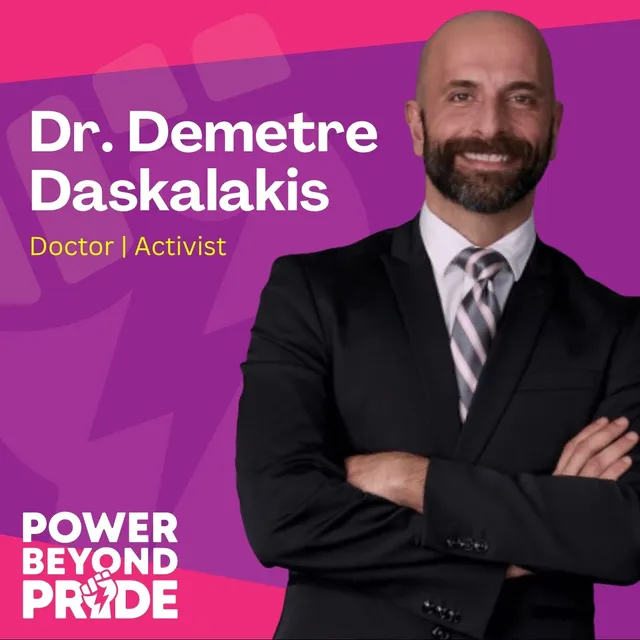
Health, Pride, and Perseverance with Dr. Demetre Daskalakis
Listen or watch
Watch this episode
In this episode
Description:
In this episode, Mattie Bynum and Shane Lukas sit down with Dr. Demetre Daskalakis to explore his journey from a curious kid with a doctor’s kit to a national leader in public health. He shares how witnessing the HIV/AIDS crisis firsthand shaped his life’s mission and why community care remains central to his work.
The conversation dives into the politicization of public health, the erosion of trust in institutions, and what it means to rebuild systems rooted in community. With humor and honesty, they unpack how queer communities can rely on “muscle memory” to navigate today’s challenges. The episode leaves listeners with a call to stay persistent, engaged, and grounded in collective power.
TranscriptRead the conversationAbout 70 minutes to read · 10,531 words · Dr. Demetre Daskalakis, Mattie Bynum, Shane LukasOpen
- Dr. Demetre Daskalakis
- Somebody said to me, I don't trust you because you're in government. And I responded and I said, you should trust me the most because I'm in government. Because I don't trust it either. That's like, the point that as you're feeling bullied, like, this is the moment that you're going to persevere and that perseverance, you will create a place where it's not safe for bullies to do this to people anymore. And so, uh, don't give up.
- Mattie Bynum
- Welcome to Power Beyond Pride. I am one of your hosts for the day, Mattie Bynum. I am. Great day. Wonderful. Sitting here in the studio. A great idea studio. And that with my co host, Shane Lukas. Yes, I did say a great idea. Cause this is like, the great idea.
- Shane Lukas
- This is a great idea. Thank you. And I'm Shane Lukas, lifelong harm reduction and bodily autonomy activist, as well as the gayest man at your dream wedding, True facts. Now we are your co host. Maddy and I are your co hosts on today's queercast Journey. And we have an incredibly special guest today here at meetgrade Idea Studio.
- Dr. Demetre Daskalakis
- We're live.
- Shane Lukas
- We are talking with the phenomenal Dr. Demetre Daskal. And we are so excited for him to be here because in addition to being an infectious disease physician, he's been an flitching advocate for LGBTQ health and has also served in leadership at the CDC as well as in New York City. So, again, incredible. He's leading the work to end HIV. Now, I've been a huge fan of Dr. Demetre for a very long time because he's always provocative but incredibly salient about the work that helps us rethink how we look at HIV prevention and treatment and just gay men's health and queer health in general. And I think it's really powerful, including that around community care. So I want to welcome you to power beyond pride, Dr. Demetre Daskalakis. And how important and incredible it is to have your. To have your voice here in this particular moment, in this particular time, uh, in our culture.
- Dr. Demetre Daskalakis
- Well, thank you so much for having me. I. I'm, um. I am the most wonderful piece of meat in the Sandwich.
- Mattie Bynum
- I am doctor to me, 26, and
- Shane Lukas
- I'm going to say your name a hundred times.
- Mattie Bynum
- So good. I was laughing because I was like, if you put one more medical term is a limit. Yes, we know, we know.
- Shane Lukas
- Well, your bio is so many things. How do you narrow it down for a sniffy's ad? Like, how do you. How do you narrow, uh, how do you narrow that down?
- Dr. Demetre Daskalakis
- I think public health daddy.
- Shane Lukas
- Public health daddy. There we go. Public health daddy.
- Mattie Bynum
- Who's your daddy? Public health daddy. All right. I like that. Simple.
- Shane Lukas
- Perfect.
- Mattie Bynum
- Ph, Daddy. Love it. I love it. Okay, so our first question is going to be, so you stepped into the national leadership at the cdc took continue the trajectory of ending HIV during one of the most intense public health periods in modern history. What was it like balancing multiple public health emergencies at the same time?
- Dr. Demetre Daskalakis
- So that's, like, the point that we just have to be really frank about. When I started in New York City Department of Health, it was in an era where we got, like, a huge amount of funding from the city and the state. And the story is that they were going to give us, like, 13, 14 million. And then one day they said, we're going to double that to end the HIV epidemic. But you have a day to figure out what you're going to do with the other. Other $13 million. And so it was like, a dream come true. Yeah, right. So it was like, let's do all the things that we could never do. Like, we made a program that supported transgender health organizations to be able to actually grow. And one of them Destination Tomorrow. One of my favorite organizations that I got to work with went from a very small organization to a really big one. Even started working in Atlanta, where I used to live. So it was great. And then, like, things like a crystal meth program and all of that things that we didn't have in New York. And so everything was going great. The people were doing better with hiv. The numbers were getting better, like viral suppression. The amount of people who were healthy with HIV was going up and up. And then Covid hit, and that was, like, just threw cold water on the whole thing, because everyone's attention had to be on the pandemic. And so. So that was hard. And so going to CDC and leading the HIV work was, like, about trying to, you know, bring that emphasis back, even in the story of all of the, frankly, national public health emergency that was happening. And so I was able to do that for a while. I wasn't in that space very long because they pulled me right out of HIV into Covid because apparently I'm good at that.
- Shane Lukas
- I love that. No, I appreciate that. And Destination Tomorrow is an amazing program. We had our guest, Dominique Jackson, got some of her early work in the organizing through Destination Tomorrow. And I know you and her have a, have a history as well.
- Dr. Demetre Daskalakis
- Yeah, Shout out Dominique. I mean I love her so much. I mean I think we've got great pictures at a gala that we went to recently together or we were the same gala, but we looked like we were prom dates. That would be a great prom date.
- Mattie Bynum
- So just tall, sexual ass, gorgeous, beautiful
- Dr. Demetre Daskalakis
- and like the loveliest human in the world.
- Mattie Bynum
- Yes, yes.
- Dr. Demetre Daskalakis
- I met Dominique when, when she was doing outreach with HIV space. I'm never going to forget. She had like her autobiography that she self published that she was selling out of the back of her car and she's like, do you want to, do you want this? And I was like, of course. Like I, I still have it at my house and I look at it, it's got like her signature with the heart and like her phone number and we've been friends ever since and so huge shout out to Dominique.
- Shane Lukas
- A big fan society here. So we, we, we, we, we love her and uh, we, we appreciate all the work that you've done in the work that you've done. You've made left the cdc. Yeah, we m. Were, we were so excited to see you there and it was important work that you're doing. And then with the ascension of RFK Jr. Basically it feels like public health has now been more political than ever. Yeah. Right. So you've been vocal about what the anti science approach means for public health and guidance and vaccines. And I feel like beyond that, should queer people be looking at alternative systems for like local health networks or other strategies for info? Because CDC decisions feel like violence to trans and queer people.
- Dr. Demetre Daskalakis
- Yeah, I mean, uh, it's, it hurts me to say it. In the era where the organization is being silenced at best and weaponized at worst, I think it's not a credible source of information for most of our community. And so I think that what you really, what happens is that we need to look to the community to protect the community. Right. And so that means whether it's the medical providers or community organizations, local health jurisdictions, I think that the thing that we're seeing is that uh, even though it would have been easier to not, not have to do it, like we have to be the people that differentiate the signal from the noise, like the truth from just what's not true. And so it's a lot more work and it's hard, but it's, I think, muscle memory. We're familiar. We've been there, done that in the LGBTQ community. And so I think we're there again. And so I'm going to say probably the answer is you can't really trust what's coming out of the federal government, especially when they're trying to erase your community.
- Shane Lukas
- Should we be creating something different? Should we be looking to. Again, as somebody who, like you, started doing a lot of activist work in the, uh, 1990s when there was a need to look outside of existing systems, uh, should queer people be looking to construct systems?
- Dr. Demetre Daskalakis
- Yeah. One of the things in my. In my work, I made lots of different families. I had my family in hiv, my family in LGBTQ health, and now I have this family in vaccine. Like I said, who would have thought that the guy who used to go to bathhouses and do HIV testing would be friends with all the pediatricians in the country? But here we. Right. It makes great sense. Yeah, here we are. And so. So I look to them because the attacks on vaccines have been so substantial that what they're doing now is creating these new systems of looking at data and communicating information in a way that I think that LGBTQ folks and queer health folks need to be inspired by. We need our own council of elders of people that can sort of review what's happening and give us good guidance that's independent of the federal government. Because, again, if they're trying to erase or destroy you in terms of a community, it's going to be hard to believe that they've got your best interest at heart, 100%.
- Mattie Bynum
- So I have a question. I want to piggyback off of it.
- Dr. Demetre Daskalakis
- Yeah.
- Mattie Bynum
- Okay. So when we talk about communities and talk about people being eliminated, we think about a lot of gender affirming care. Yeah. Okay. So I just. Yes or no? That's all I need you to do. I just need you to answer.
- Dr. Demetre Daskalakis
- You want me to keep talking? Jesse, yes or no?
- Mattie Bynum
- No. Just yes or no for right now? Just for right now. Little blue pills for all white men who can't keep their dick hard. Gender affirming care, yes or no?
- Shane Lukas
- Yes.
- Mattie Bynum
- Okay. Breast implants for women who don't have full coverage. Gender affirming care.
- Shane Lukas
- Yes.
- Mattie Bynum
- Okay. What about if a man gets a hair transplant like Donald Trump? Is that gender affirming care?
- Dr. Demetre Daskalakis
- I have booked my trip to Turkey. Yes.
- Mattie Bynum
- Okay. And also too, if a person is on hormone replacement therapy, going through menopause.
- Dr. Demetre Daskalakis
- Gender affirming.
- Mattie Bynum
- Gender affirming care, yes. Also, if you are on, um, hormone replacement therapy and you are transitioning, would that not be considered gender affirming care?
- Dr. Demetre Daskalakis
- All of the above.
- Mattie Bynum
- So it's very safe to say that gender affirming care is not just the LGBTQ plus community.
- Dr. Demetre Daskalakis
- That's 100%.
- Mattie Bynum
- So if we get rid of gender affirming care, it's not just us that's going to get hurt.
- Dr. Demetre Daskalakis
- Yeah.
- Mattie Bynum
- It's everybody.
- Dr. Demetre Daskalakis
- It's going to be a lot of limp white men.
- Mattie Bynum
- You heard it first. Here, look here. Thank you.
- Shane Lukas
- Uh, affirming care. No, again, really? Really. But you know what, you're hitting on those really important, right? Because it is a weaponization of so much conversation around, you know, what they, what they're really trying to do is again, create a transphobic environment.
- Mattie Bynum
- Yes.
- Shane Lukas
- And that's polluting any actual public health conversations, right?
- Dr. Demetre Daskalakis
- Yeah.
- Shane Lukas
- Because it is taking this idea that we could come across another pandemic, we could come across another public health emergency, and they've now politicized all these spaces to conflate different relationships that are really built on bias, that are built on prejudice, and basically start to have people tap out from listening.
- Mattie Bynum
- Ah.
- Shane Lukas
- To this stuff. Because you can tell. And that goes for across our communities, our Latina community members, other community members who feel like they are being targeted by a lot of these systems.
- Dr. Demetre Daskalakis
- No. 100%. I mean, I think that the challenge is going to be that sort of. Of the destabilization that they've done to public health. The attack on vaccines, the attack on just healthcare. I mean, let's just be frank. Like, what they're really doing is they're trying to create a rift between, like, medicine.
- Mattie Bynum
- Mhm.
- Dr. Demetre Daskalakis
- That's just going to mean money in the bank. And so like, what we need to do is like, people who receive care as well as people that give care. To say that that is a bunch of garbage and just be very clear that like, when you have a Get ready. Surgeon General, uh, candidate that is being discussed. Who doesn't have a medical license, never practice, and would rather sell you vitamins than get. Than. Than. Than remind you how important vaccinations are. We need to have people like us, my council of elders, the people who say that is a bunch of voles and don't believe it. And here's why. I think that that is sort of where we are. And the problem is that the damage that's happened to the system. So yeah, maybe they're trying to make you feel like you shouldn't. That you shouldn't vaccinate your kids, but like that permeates everything. What the hell is going to happen?
- Mattie Bynum
- Well, this is how you weaponize the medical system.
- Dr. Demetre Daskalakis
- Yeah. Which is why we've learned it's so easy to do.
- Mattie Bynum
- Yes. Very much so.
- Dr. Demetre Daskalakis
- So easy to do.
- Mattie Bynum
- Sadly. Okay, so I do want to go back to before you became Dr. Demetre.
- Shane Lukas
- Yeah.
- Mattie Bynum
- How did miniature. I can't say little because you were never really little. You've always been a big.
- Dr. Demetre Daskalakis
- Always a giant.
- Mattie Bynum
- Yes. So how did Minnie Demetre become Dr. Demetre today?
- Dr. Demetre Daskalakis
- Yeah. So I had no one around me who was a doctor.
- Mattie Bynum
- Mhm.
- Dr. Demetre Daskalakis
- But so I would have to attribute the beginning of my ascent into the giant.
- Mattie Bynum
- Yes.
- Dr. Demetre Daskalakis
- That I have today. Giant. Just get over here.
- Mattie Bynum
- They had a turn for that one.
- Dr. Demetre Daskalakis
- It had to be that my parents got me a Fisher Price doctor's kit.
- Mattie Bynum
- Okay.
- Dr. Demetre Daskalakis
- And if they said no, I would give them their coats and say, well, you have to leave again. That is not informed consent. And that's. But I was not yet. I was just a, uh, wee lad. Like I didn't know about it. I loved you. As a kid. I was persnickety, but definitely that's how it started. And then I, like, started doing the things that you do to do to get into medicine.
- Mattie Bynum
- It's an interesting Combination.
- Dr. Demetre Daskalakis
- It was really good. And so when I was in New York, I moved to New York in 1991, and, like, I was a baby gay, and I landed there, and it was like, oh, my God, it's crazy here. And started going out in the clubs, in the underground and all of that stuff. And I would literally meet people and get to know them, and then I wouldn't see them anymore, and they would end up being admitted to Bellevue or St. Vincent's and then I would find out that they were either very sick or they passed away. And so it went from this. This abstract thing. I want to be a doctor, just more real. And then I, like, helped run a big AIDS memorial quilt display. And know there I saw the people that were coming for the quilt that were so sick. I remember sort of standing, like, on college walk at Columbia and deciding there that, like, my mission, my North Star, was going to be to make sure that people didn't get or suffer from that, from HIV anymore.
- Mattie Bynum
- That's beautiful.
- Dr. Demetre Daskalakis
- Yeah.
- Shane Lukas
- That is powerful. And, and, And I, you know, can't imagine in that era, I'm assuming you were with glow sticks if you were out there doing the clubbing and all of that.
- Dr. Demetre Daskalakis
- So a New York City club kid was platform shoes.
- Mattie Bynum
- How about the same thing that was
- Dr. Demetre Daskalakis
- like, after that was like the raver era came a little that. That kind of raver was after my kind of raver. My kind of raver was club kid raver.
- Mattie Bynum
- But I do love this conversation, but we do have to take a quick break. But when we do come back, we do want to have. Because there's someone you know or that you got actually came in contact with during the flip situation. And I definitely want to hear that story. Yeah.
- Dr. Demetre Daskalakis
- Great.
- Mattie Bynum
- We'll be right back here at Power Beyond Pride.
- Shane Lukas
- Welcome back. This is Power Beyond Pride, a queer changemaking podcast. And I have to look at the card to figure out who I am. I am Shane Lukas, and I am here with my amazing and beautiful co host. I am, um, and we are talking with Dr. Demetre Daskalakis. Who is Dr. Demetre, or how do we call him? Dr.
- Mattie Bynum
- Sexy dad or not the sugar pan, Not a sugar bridge. We have been coming up with a
- Shane Lukas
- variety of varying names, all of which we will just have to look at.
- Dr. Demetre Daskalakis
- And what I've learned is I answer to all of them. You answer to all of them.
- Shane Lukas
- And we're so glad you're here joining us today.
- Mattie Bynum
- And each one has a different answer, and each One.
- Dr. Demetre Daskalakis
- Oh, yeah.
- Shane Lukas
- Oh, that's interesting.
- Dr. Demetre Daskalakis
- I like that answer.
- Shane Lukas
- That's good. Okay.
- Dr. Demetre Daskalakis
- All right.
- Shane Lukas
- Well, there we go.
- Dr. Demetre Daskalakis
- You were right before break.
- Shane Lukas
- You were sharing a bit about your history and, uh, how you got to be the Dr. Dimitri daddy that you are today and all and all of that. I want to go back a little bit to the story around the quote, which is, again, it, ah, sounds like a really pivotal moment. Moment in your own history.
- Mattie Bynum
- Yeah.
- Shane Lukas
- And I'd love to hear a little bit about that journey, because, again, having done outreach also in the 90s, and having experienced some of what that. What that. What the experience was where we were talking about a conversation that was still very fresh, very new, or dealing with many people who were in early stages of just, uh, combating a recent diagnosis. What was that. What was that experience like with the quilt? Can you go through a little bit more detail?
- Dr. Demetre Daskalakis
- Yeah, I mean, it was. It was one of the pivotal moments sort of in my life, and ultimately, I sort of set that North Star in my career. So I remember it starts from before the actual display of the quilt on campus, and we had to go to San Francisco to the Names project, which is who ran the quilt, to the warehouse, because they were going to show us the parts of the quilt we were going to get, and just getting us ready for the display. And we were able to bring a piece of the quilt back as a promotion to show that we were bringing it. And so it was walking into that warehouse, it was like this giant tea wood room. And it was like. I just remember it being, like, very climate controlled. Like, it was. It was chilly. And all of these pieces of quilt were rolled up in these, like, shrouds. And so it was, like an eerie moment.
- Mattie Bynum
- Was it heavy in the room?
- Dr. Demetre Daskalakis
- So many people have died. And, like, this whole warehouse is full of these, like, rolls of cloth that represent them. And they just had this feeling of. Of just the weight of it was great. But so I. We got to take one piece back. And so, uh, they. They gave me one of the quilts that included Ryan White on it. And so they rolled it up in one of the shrouds, and they gave it to me. And then I had to fly back to New York, and everyone was like, oh, you should check it. And I was like, I can't check this. I can't be like, oh, we're just gonna check it, and I'll pick it up on the carousel. So I was like, walking around, like, the airport In San Francisco, like. Like, crying wasn't going to be the, uh, last time. But anyway, like, walking around San Francisco airport crying because I had this thing on my back that was just crazy. And I'm never forgetting that. That moment. And then seeing the quilt on the ground. And like I said, those folks coming in who are so sick, it just. That's what, like, I said, it set that North Star.
- Mattie Bynum
- Well, thank you. And I definitely get that at the end. Um, beautiful story.
- Dr. Demetre Daskalakis
- Yeah.
- Mattie Bynum
- I know. When I first found out about Ryan White, just learning about the foundation and learning about who he was, it was just one of those things where I was like this. Yeah. There's so many people in our past, and this is the thing that we also have to remember is history repeats itself.
- Dr. Demetre Daskalakis
- Yeah.
- Mattie Bynum
- Because we talk about medical things now. We talk about, uh, different things that are going on in our world. But we have to pay attention that when a community is marginalized, no matter what community it is, it's always gonna affect the next person next to you.
- Dr. Demetre Daskalakis
- Yeah.
- Mattie Bynum
- And I remember growing up, Philadelphia, the movie, and just knowing people who. And it was so funny. Cause I remember being at a point at, uh, 13, and there was a person that went to church with me, and he had aids. I never knew he had aids until one day he just stopped coming to church. And I was just like, hey, have you seen Mr. So and so? And I remember my aunt was like, yeah, he's sick. And I was like, okay, cool. Like, but is he gonna be okay? And she was like, he has. And I was like, he has what? And she was like, he has. And I'm like, well, why are we whispering that? Yeah, it's just you and me in the car. And she was like, well, we don't talk about homosexual things.
- Dr. Demetre Daskalakis
- Yeah.
- Mattie Bynum
- Like, we. We targeted black people. Now we're targeting trans. Now we're targeting immigrants. We're targeting so many people. So it's very important. And I know you talk about this a lot, too, about standing as an ally, standing of, uh, people. Because you may not be, uh, generally, or you may not be directly affected by HIV, syphilis. STDs are STIs. You may not even be affected generally in a sense where you may not know someone who is gay, which I think that's a lie, because everybody knows at least one of the gay people.
- Shane Lukas
- A very unattractive house.
- Mattie Bynum
- I'm just being honest. But seriously, I think that this is a season where we need to stand together.
- Dr. Demetre Daskalakis
- Yeah, no, I think that's right. I think. And I think your point of history repeats itself is really important because, again, this is a familiar. This is not, uh, unfamiliar territory that we're in right now. And I think I keep calling it muscle memory. Like, we have the muscle memory to know how to respond to this and how to react, because we've kind of been through erasure and communities being downtrodden and folks being told they're not worthy of the care that they deserve. That's like. That is like, uh, a experience in the LGBTQ community that we've had before. And I think we know. We know what needs to happen.
- Shane Lukas
- Absolutely. And I think it brings me to my next question, which is really, I really. I want to talk to you about parks. Yeah. So I want to talk to you
- Mattie Bynum
- about parks in park.
- Shane Lukas
- I love them. I love them. Who doesn't love a good black corner?
- Mattie Bynum
- I don't know. I'm still trying to find a correlation to how that brought him to parks,
- Shane Lukas
- but go ahead, because we're going to get there.
- Mattie Bynum
- Because people.
- Dr. Demetre Daskalakis
- Because history repeats itself.
- Shane Lukas
- So people are still having sex in them, which I think is.
- Mattie Bynum
- Is. Is fine.
- Shane Lukas
- I studied it in college. I wrote my honors thes on public sex, and I was an outreach professional. It's how I got my start in HIV prevention, was doing outreach professional in parks. And so I feel like right now, the only conversation I get about gay sex is from heated rivalry or from prep ads.
- Mattie Bynum
- Right.
- Shane Lukas
- And so, first of all, do you have a favorite park for sex?
- Dr. Demetre Daskalakis
- Yeah. Uh, the Ellipse at the White House.
- Shane Lukas
- There we go. The Ellipse at the White House. So hang out there. I'm sure you're going to get great quality. The best.
- Mattie Bynum
- I'm glad myself. Go ahead.
- Shane Lukas
- This is so many questions, but, you know, can queer activists ever get the public health system to talk about the sex they're actually having? I think that's why this is important. You talk about history repeating itself, and there was a Period in that era. And I'd love you to talk about your work in New York. Really elevating conversations to talk about pleasure.
- Dr. Demetre Daskalakis
- Yeah, yeah.
- Shane Lukas
- But then at the same time, we're stuck in a period where I feel like we're moving away from any of those conversations where we're.
- Dr. Demetre Daskalakis
- We're not.
- Shane Lukas
- We're starting to suppress a lot of that.
- Dr. Demetre Daskalakis
- Yeah, no, I think we're in that era again, where we're doing. Doing euphemism, where rather than sort of like, saying things overtly and very clearly because of the sort of political environment and the weirdness we live in, somehow we need to somehow bury it in words that don't necessarily reflect what we're. What we're really saying. And I mean, again, like in the heated rivalry era, uh, where their, in effect was like. And God bless softcore porn on television. God bless. It's good.
- Mattie Bynum
- Listen, it was a show.
- Dr. Demetre Daskalakis
- Hockey players have great butts.
- Mattie Bynum
- Yes, they do.
- Dr. Demetre Daskalakis
- Matthew, like, shout out Connor Stewart one more time.
- Mattie Bynum
- We see you.
- Dr. Demetre Daskalakis
- We see you. But I mean, I think in the era where you're. You have this, like, one thing where we're not able to talk about sex and sexuality yet, like, the media is, like, all about, like, gay sex and, like, queer people. It's. It's like this, this moment where you have to say, I'm m really glad that you're enjoying sibling. Sorry. Sibling rivalry.
- Mattie Bynum
- Wait, that is me as a difference.
- Shane Lukas
- Totally different movie. Totally different movie.
- Dr. Demetre Daskalakis
- But he did rivalry. Like, you have to say, glad you enjoy that. But, you know, you need to get up out of your seat and, like, actually support the communities that, that, that this is like an important part of their lives. I mean, like, being queer, your sexuality is an important part of your life. Like, sex is an important part of it. And so I think that, uh, that you can't, you can't have just the chocolate and the peanut butter. If they have a chocolate and the peanut butter.
- Mattie Bynum
- Right?
- Dr. Demetre Daskalakis
- You gotta, like, be able to sort of have this thing in the media, but also realize that you need to support the communities by really giving us the option and the ability to talk about our sex lives in a way that, that supports our.
- Mattie Bynum
- Well, I mean, I think fetishizing, that's the problem. We fetishize what we don't know, but we fetishize what we think about. Because I say this to guys all the time. Um, I'm not just a sex symbol. I'm not just a fetish. You know what I'm saying? I want someone that's Gonna get to know me. For me. It's the same thing with. What's, uh, the name of the show again?
- Shane Lukas
- Heated rivalry.
- Mattie Bynum
- Heated rivalry. Look at me. I knew it was a rivalry. I done seen was kind of heated, though, for us. Especially the one with the one that came out for his love.
- Dr. Demetre Daskalakis
- Oh, yeah.
- Mattie Bynum
- But it was anticlimactic because he didn't do nothing afterwards. I was expecting a gay wedding. And like, you gonna be the open NFL. I mean, NHL, gay couples. It's a lot anyways.
- Dr. Demetre Daskalakis
- But maybe that's season two.
- Shane Lukas
- Maybe that's season two.
- Mattie Bynum
- That's if it get picks up. That's if it gets picked up and
- Shane Lukas
- it becomes more like bridezillas for gay, gay, gay hockey players. Is that.
- Mattie Bynum
- But it's crazy.
- Dr. Demetre Daskalakis
- I think that's great.
- Shane Lukas
- I'm telling you. And I want some royalties on that. Uh, I'm gonna throw that out there right now. I think my concern is around the saccharine quality of it.
- Dr. Demetre Daskalakis
- Ye.
- Shane Lukas
- My concern is that around the sanitized version of it, because I think that there is a fascination, like you said, there's a sort of, you want to watch this happen? That's great. At the same time, you have queer people's rights being removed. You have attacks on our trans community members. And so if you're going to be an advocate and you. And you find this story valuable, then also remember that the human beings behind it are also valuable. And so as allies like show up in these spaces, show up in these political environments, and that's what I fear is not happening. I fear what we're seeing is a repetition of history where I know you've shared, Mattie, in the past, around the
- Mattie Bynum
- 70s, in the exploitations of black females. And it was, like I said, it's just one of those things where you fetishize it, but then you diminish them in real life. You give them this platform to look beautiful, but then we're going to take your rights at the same time. So it's almost watch the left hand or the right hand, so you don't see what the left hand is doing. And I think that's some bullshit. But I also want to go back to something you said earlier. You talked about. He was a double major in religion, so I'm interested to know one, religion and science. How did that even go together? And two, does that play a part in your community outreach now?
- Dr. Demetre Daskalakis
- Yeah, I mean, I like, came upon being a relig major kind of by accident. So again, I went to Columbia. I think I told you that that part of the story. But, you know, Columbia, like I said, I think that they probably need to.
- Mattie Bynum
- I mean, we don't say the name how many times. They're welcome.
- Dr. Demetre Daskalakis
- And so they, they, they did this
- Mattie Bynum
- show was brought to you buckle up
- Dr. Demetre Daskalakis
- So, like, I went there to be a science major and to be a pre med. And then they had me take, like, humanities classes, like literature and contemporary civilizations, and you could take another class. And I decided to take a religion class. And I walked in, I was like, let me take Buddhism, because I didn't know anything about it. And I walked in, and it was a class being taught by Robert Thurman, who is, like, the preeminent, like, scholar of Buddhism in the US And Uma's father. And it was a great class. And I was like, wait a minute. I'm starting to understand about people's worldviews. This isn't just about, like, religion or a God or a scripture, but, like, I'm understanding a worldview better. And I told. Totally fell in love with that. And like, little baby doctor Demetre, little baby doctor Demetre in the class was like, I should do more of this so I can understand people better so that it makes sense. When I'm a doctor, I get to know more. And so that's why I did it. And I think that it influenced so much of, like, my work because, like, I. I go to a community listening more than assuming. Because that's what you learn in that, in that training, in that sort of relig that you need to sort of understand a worldview, not by assuming things about it, but by listening. And now I gotta tell you another good story. Like, one of the, like, fun parts was at the end of this class, Dr. Thurman was like, oh, we're gonna have a special guest. And I was like, oh, it's gonna. What celeb is it gonna be Uma?
- Mattie Bynum
- I mean, how many kill Uma, right?
- Shane Lukas
- And I was like, I want this one.
- Dr. Demetre Daskalakis
- I want the red jumpsuit getting all of it. Well, or anyway, either there's so many UMAs that I would have liked. So then the door opens and it was the Dalai Lama walking around. And I was, like, just touching our heads and, like, laughing and being so sweet to us. And I was like, I don't know how I can't do this double major, because it's crazy how cool this is.
- Mattie Bynum
- That's when I learned this Dalai Lama. I forgot to take My wig off. Okay.
- Dr. Demetre Daskalakis
- He's like, you got no wig on. It was just like this. My m. Dalai Lama inspired haircut. Thanks.
- Mattie Bynum
- My Dalai Lama inspired me.
- Shane Lukas
- I love that.
- Mattie Bynum
- Okay. Yeah. We are having way too much fun, but we do need to take a quick break. We still got to pay these bills. We still got to make sure we get our stuff together. So please stay tuned, because when we come back, we will be talking everything from our doctors, the best patients to.
- Shane Lukas
- We're going to be coming back with our speed round, and we've got a question from one of our former guests.
- Dr. Demetre Daskalakis
- I have a question about Doxing Town. Okay, let's do it.
- Mattie Bynum
- All right, right after this.
- Shane Lukas
- Welcome back. This is Power Beyond Pride, a queer change making podcast. I am Shane Lukas. I'm here with my phenomenally beautiful and elegant co host, Matty Bynum. And we have with us really just a leader in, uh, community health guidance, just innovation, everything. Dr. Demetre Daskalakis, who joins us live here in the Great Idea Studio, which is wonderful in Greensboro North Carol, where little young Demetre, uh, got his Fisher Price start. So shout out also again to Fisher Price. Yeah, we'll give them a shout out.
- Mattie Bynum
- Okay. So, Dr. Demetre.
- Dr. Demetre Daskalakis
- Yes.
- Mattie Bynum
- In your current role at Callen Lord. Oh, I said it correctly.
- Dr. Demetre Daskalakis
- You sure did.
- Mattie Bynum
- In New York, you are continuing to work closely with communities that have historically been underserved and ignored by healthcare systems. Yeah. What are your goals in this new role?
- Dr. Demetre Daskalakis
- And, uh, and so my. My goal there is, like, what the goal is of the actual community health center, which is to really continue to deliver on the mission, to make sure that we provide care to the LGBTQ population in New York. And for me, I come from doing, like, big public health. I also think that in this era, uh, like, being in big government, you don't get anything done because it's kind of stagnant. And I. I, like, am so hu. Be at the. At the grassroots again. To be able to sort of not only do it for the person and the patient in the room, but also to create the blueprint for how LGBTQ health is delivered in this country and the world. So I am obsessed with that place. It's amazing.
- Shane Lukas
- I love you. Again, Kellen Lord is a phenomenal organization. It's named after Michael Callan and Audre Lorde. Yeah, it's important to not again leaders just in queer liberation movement and change makers themselves.
- Dr. Demetre Daskalakis
- Yeah.
- Shane Lukas
- And I think for me, incredibly powerful. Michael Cowen's obviously very famous for his writing around how to have sex in a pandemic.
- Dr. Demetre Daskalakis
- Yeah, that's like the original, the OG Harm reductionist.
- Mattie Bynum
- Not the og Right, Absolutely.
- Dr. Demetre Daskalakis
- That's original gangster. Yes, the original, the original harm reductionist. And then like Audrey Lord, just like such a powerhouse, like poet and, and a, uh, an essayist and a, uh, musician and advocate. Essayist, poet and advocate. And then you slam them together and make the most amazing community health center in the country. It's magical.
- Shane Lukas
- I, I think it's brilliant because it's also really speaking into this moment about how public health and science really are part of the liberation movement.
- Mattie Bynum
- They are part of the work.
- Shane Lukas
- And actually that leads me to a question that we have from one of our former guests. Dr. Shuntei Zhao shared with us a question in science. They're an amazing person who's working on a lot of these issues, including around hiv. And so they had a, they, they sent in, uh, a great question, which is to say, as an educator, I trained many young scientists and physician scientists. Some of them, particularly those from the LGBTQ community, feel discouraged by the current uncertainties around funding and research. From your experience, what can mentors and educators do to better support and encourage the next generation of queer and bipoc scientists during these uncertain times?
- Dr. Demetre Daskalakis
- So this is a hard time. And so there's no way to sugarcoat it. The funding is wild, our communities are being attacked, some are being erased. But our ability to engage in science and scientific discourse is activism. Right. So this is the moment where my advice is to hang on, educate yourself, do what you need to do to become that strong scientist so that you can be a part of the future. So right now it's hard, but what's going to happen is going through this persevering, although I'm not a big fan of the word resilience, like being resilient to make sure that we get. You get to the other side means that you're going to be there to really be the blueprint for science and for future scientists. So we need you now more than ever because there's going to be such a gap created because of the attack on science that there's going to be a role for you, and that is leadership. You're going to have, uh, innovations have New discoveries, change the way that medicine is done or any other part of science.
- Mattie Bynum
- So don't.
- Dr. Demetre Daskalakis
- Don't give up. And it's not going to be easy. No way to sugarcoat it, but there is a prize on the other side, which is that you're going to defend the communities that you love.
- Mattie Bynum
- You know, you said you didn't like the word resilience. I thought of why you was talking was persistent.
- Dr. Demetre Daskalakis
- Yeah.
- Mattie Bynum
- Stay persistent. Stay. Ah.
- Dr. Demetre Daskalakis
- I think better than resilient. I feel like one of the things that I think we do a lot, not just in LGBTQ space, but in public health and other places, is that we tell people to be resilient, and they're asked to be resilient because the systems that are supposed to be resilient to support them fail. And so that's why I think persistence is an even better way of saying it. So don't give up. Be persistent and demand a resilient system in the future that doesn't let this happen again.
- Shane Lukas
- Or in a system that isn't trying to oppress or harm you.
- Dr. Demetre Daskalakis
- Right. Yeah.
- Shane Lukas
- Like, the system strength is important, but also systems that are fundamentally built to, uh, not help you thrive.
- Dr. Demetre Daskalakis
- Yeah.
- Shane Lukas
- Also need to be changed.
- Dr. Demetre Daskalakis
- So listen.
- Shane Lukas
- Also need.
- Mattie Bynum
- This is real Demetre coming. This ain't Dr. Demetre.
- Dr. Demetre Daskalakis
- So when I was a kid, like, I was relentlessly bullied, and. And that was hard. And I. I think, uh, at, uh, at my. In my youth, as a little baby, Demetre decided that I really didn't like bullies. And so in this era where we're all being bullied, I think make the choice that you don't like bullies and make sure that the space is one that is unsafe for bullies and the future. And so that is, like, the power that we have. And so, period, change making.
- Shane Lukas
- That's change making.
- Dr. Demetre Daskalakis
- So just like, I think that when you're being bullied, I remember I have so many stories in high school that, like, I just decided that instead of being bullied, I would be their class president and be the editor of their yearbook. Uh, and so that's kind of the thing that launched me in all these directions of leadership, which is actually, this is a good story.
- Mattie Bynum
- Somebody.
- Dr. Demetre Daskalakis
- Somebody said to me, I don't trust you because you're in government. Uh, and I responded, and I said, you should trust me the most because I'm in government, because I don't trust it either. And so. Right, that's right. So that's like the point that, that, that as you're feeling bullied, like this is the moment that you're going to persevere and that through that perseverance you will create a place where it's not safe for bullies to do this to people anymore. And so, so, um. Don't give up.
- Mattie Bynum
- Don't give up.
- Shane Lukas
- Can I, can I piggyback on that?
- Dr. Demetre Daskalakis
- I have a passion.
- Shane Lukas
- Cause you just said something that was really powerful to me because I feel like one of the challenges that we have or in this current moment. I'd be curious your thoughts on this.
- Dr. Demetre Daskalakis
- Sure.
- Shane Lukas
- That comment really sort of lives into this we position now. The government and I remember growing up in the 80s and the Reagan era and there was this very anti government sentiment. I think it maybe the Nixon era and some of the other stuff, like part of it I think is a reset about what the government is. The government is supposed to be a contract among our citizens, among all of our neighbors, among all of our people that there are things that we individually cannot do. I can't run a school district or get lights to move. So I want, I want to, I want to work as a public contract. Sure.
- Mattie Bynum
- These things are there altogether.
- Shane Lukas
- But this anti government sentiment, like that's the part I think that distrust in there that I don't know if we've ever talked about what an imagination of a, of a system that worked looked like.
- Dr. Demetre Daskalakis
- Yeah.
- Shane Lukas
- Do you think we're missing an imagination of what is possible because we're so busy critiquing what we have.
- Dr. Demetre Daskalakis
- Hello. Yeah, so here's a. Okay, my glasses are.
- Shane Lukas
- Here's the deal, teach.
- Dr. Demetre Daskalakis
- Right. If the thing is so easy to destroy and weaponize, then let it burn and figure out what the new thing is going to be. And so that I think needs to be stimulated from the community and whether that means like what more like local strength, more local dominion over the things that we do with the federal government doing what it really should do, which is just to support the good work that's happening on the ground rather than to stymie it or to try to limit it. So we should think about not just salvaging, we should think about reinvention. And so that's. I Feel really strongly that as you see things being destroyed, maybe that's our opportunity in that destruction is a religion, nature and that just destruction. Yeah, get ready. That destruction define creation. And so very often in a lot of religions, when they talk about like a destructive force, that destructive force is also the creative force. So we either can sort of lick our wounds and cry or say, okay, destroy it.
- Mattie Bynum
- But now. Okay, so here's my thing. You said two things that trump traumatized me.
- Dr. Demetre Daskalakis
- Okay.
- Mattie Bynum
- And not what I was looking to
- Dr. Demetre Daskalakis
- do, but it's good to talk about trauma because.
- Mattie Bynum
- So here's my thing, when you say a new America, because I definitely agree the system we have is screwed, is demolished. So we do. But anytime someone says tearing down what we have and saying a new America, I always go back to the Purge and think of the New Founding Fathers. And that's a trauma statement because it's okay, that's cool. But where is your narrative? Like, what is gonna be your new. Because new for you may not new for me.
- Dr. Demetre Daskalakis
- Right.
- Mattie Bynum
- And so we need to come together all the way. Because I do agree with you. I think at this point in the game, there is no saving it.
- Dr. Demetre Daskalakis
- Yeah.
- Mattie Bynum
- I think this is one of those situations. Excuse me, God, but we need a good flood. I'm just going to be honest.
- Shane Lukas
- What should it have been saved? And I know we have to. We're. We're going to, we're going to, we're going to jump off into our kind of our speed round in a second. But, but I do think that the system never worked perfectly for everybody. And I think that's. That we have to acknowledge that that was never the case. Uh, what I, what I guess I want to draw attention to, and I think what you said is anti government. We've created this idea that the government isn't us.
- Dr. Demetre Daskalakis
- Right.
- Shane Lukas
- And I think that there's an, uh, opportunity for people to take back part of the government to run for offices, to take like you're doing, to be in these spaces and say, actually these systems aren't away from me. They are actually things that I have access to versus like corporations and other systems. Because I don't worry about is we elevate corporations in the face of government. And those we don't get to go in and run for office for those we don't get to control. Whereas government theoretically is a space in which we, as we, we as neighbors and people can go into communities and take.
- Dr. Demetre Daskalakis
- So like I, I, back, back in the day, I used to think that there was like, there was like, three things that you would need to do good public health. And so I use public health as the example. So I would say that you need good science that was implementable. You needed political will, and you needed community engagement. And then I revised it based on my experience now, which is not just science and political will and not just engagement. What you need is community co creat creation. And I think that that is sort of the place that answers the trauma, which is that as this thing is moving in a way that, like, it's not serving us anymore, like, any activism that we do is going to be important in redesigning what the next thing is. And so I think that sort of conjuring Michael Cowan and the Denver principles, like, we need to be at the tables that are redesigning this. And that is something that we just can't look at and say, we hope someday we're going to be at the table. This is going to take rad action to demand to be at the table. And let me tell you, that's muscle memory for us.
- Mattie Bynum
- It is.
- Dr. Demetre Daskalakis
- That is 100% muscle memory. And so I, I think that that's going to be what the call to action is. But then also because of my age, my senior age, I'm able to say this. It's like my advanced years even, I, I think, was a little bit young pursuing, seeing the community that rose up against, like, the, the tyranny that resulted in people dying because of hiv. Yeah, I sort of saw the tail end of it. But let me tell you, it must feel like what we feel like today. And I'm like, I, I, I realized that for, for decades, I sort of thought of community and saw its avatar. And now I'm actually in community. I feel it's kind of amazing because I'm like, wait, this is what it was like to be Mark Harrington and Peter Staley storming the fda. Because I feel like we're starting the FDA again.
- Shane Lukas
- Let's do it. Let's do it. We need to do it.
- Dr. Demetre Daskalakis
- Yeah.
- Shane Lukas
- We need it for change.
- Dr. Demetre Daskalakis
- And then you're at the table.
- Mattie Bynum
- Yeah, no, I get you. And it's funny that you brought that up, because when I think of that time, of our, our history, it's funny how we think of it as the epidemics and the pandemics that happened at that time, but I always get lost in the ball scene. And I'm just sitting there thinking to myself, like. Like, it may have been a bad time, but we felt such freedom. Um, yes. Beauty. Such love.
- Dr. Demetre Daskalakis
- Right.
- Mattie Bynum
- Like community.
- Dr. Demetre Daskalakis
- So, children, Paris is burning.
- Mattie Bynum
- Oh, my God.
- Dr. Demetre Daskalakis
- Yes. Watch it.
- Mattie Bynum
- Oh, my goodness.
- Dr. Demetre Daskalakis
- Because I just feel like that. That was, like, in this terrible era of the world falling apart, and it was just such beauty. Let me know. Uh, touch this skin. Touch all of it.
- Shane Lukas
- And I want to.
- Dr. Demetre Daskalakis
- I want to. I want to.
- Shane Lukas
- I want to. I want to take that beauty and move it to a whole nother beautiful level. If I may, obviously, this conversation. It's been so great to spend time with you and talk about this policy and this important work. I want to move us to the next round of Beauty, which is learning more about you and your. And your. And your handsomeness, so.
- Dr. Demetre Daskalakis
- Oh, my feet. Dr. Sweet cheeks.
- Mattie Bynum
- Well, you know what, man? I said that when we came back in. So let me say, uh, Dr. Ford. Oh. Oh, Dr. Ford. So, Dr. Ford, in my first question for the speed round, I think this is a good question. It's going to be a little lengthy, but it's worth it.
- Dr. Demetre Daskalakis
- Okay, get ready.
- Mattie Bynum
- Everybody's having sex.
- Shane Lukas
- What? What?
- Mattie Bynum
- Chad. Bye. If they not, we wouldn't be here. I'm serious. Everybody's having sex. But, no, we talk so much about safe sex.
- Dr. Demetre Daskalakis
- Yeah.
- Mattie Bynum
- How can you have fun, enjoyable sex and still stay safe?
- Dr. Demetre Daskalakis
- Yeah. I think. I think that you need to think about all of the ways that you can prevent the stuff that interferes with you having a lovely sex life. Right. Yeah. So, I mean, I think, you know, I'll come at it from the infectious disease perspective, which is HIV and STIs and sexually transmitted infections were things that really made sex, like, full of. Of and worry m. Now we have this giant toolkit of ways that you can prevent those things. So if you want to do things that maybe don't expose you to STIs in the park, a little Jerk and Tug.
- Shane Lukas
- And that's the name of our new band, by the way. We're Jerk and Tug. Uh, I'm Jerk. That's Doug.
- Mattie Bynum
- I'm Tug, and that's the Episodes I'll be in later.
- Dr. Demetre Daskalakis
- But okay, so. So there's like, that stuff.
- Shane Lukas
- And then.
- Dr. Demetre Daskalakis
- But then if you want to have sex that could potentially expose you to stuff, you've got, like, you can take a pill a day to prevent hiv. If you don't want to take a pill depending on, like, your circumstance, you can do, like, right? You can do it. You can do, like, two on one prep or prep on demand, which is take a couple of pills before sex and then a pill a day for the couple days after that prevents it too. You're like, I don't like pills at all. There's injections that can make. There you go. You Also, for upper STIs, you can use doxy pep, which is antibiotics that you can take after sex, and it prevents gonorrhea, uh, not as great, but chlamydia and syphilis pretty well, and it works.
- Shane Lukas
- Is there any. Just a side note on that, is there any concern around the. What, uh, they consider bacterial resistance or anything around antibiotic resistance?
- Dr. Demetre Daskalakis
- Yeah. So this is when it's really fun not to be in government and to just be, like, an activist physician and say, people prescribe doxycycline, which is the drug that you use for, uh, doxy pep all the time for people's zits. And people will take it for their zits for a long time. And not one word about the fact that there could be resistance because of taking it for zits. But everyone is worried about resistance when you're taking it to prevent infections that you can get through gay sex. So let's face it, like, it's always been a problem. And so if it is a problem, that's great. But STI is an emergency, and so let's use doxy peppers for the emergency and take care of the rates of, uh, STIs in the country.
- Shane Lukas
- Sounds like a great strategy. Uh, thank you for just that. It's definitely one that comes up. But this comes up, too, if you've ever been around me for a minute. Cookies or cake?
- Dr. Demetre Daskalakis
- Totally cake.
- Shane Lukas
- Oh, yes, yes, yes.
- Dr. Demetre Daskalakis
- And mainly frosting.
- Mattie Bynum
- I don't understand frosting.
- Dr. Demetre Daskalakis
- The most disgusting possible frosting. Buttercream extravaganza. So it's so sweet that when you eat the frosting, it clutches your buttercream. Yeah.
- Shane Lukas
- Oh, I'd say I like that initial crunch, but then I can only have two or three bites and it's out, so.
- Mattie Bynum
- No, listen, the only reason I go to bottom showers and baby showers.
- Dr. Demetre Daskalakis
- Listen, Costco cake, the one with the, um, frosting balloon on it. You don't have to eat the cake. You can just scoop the red balloon off and eat the frosting.
- Mattie Bynum
- Yeah. Oh, my gosh, Shane, you may not understand this, but I will go to a party, and if they have the cake with the cool with ice, then I'll be pissed and be like, why'd you invite me?
- Dr. Demetre Daskalakis
- No.
- Mattie Bynum
- I done sat through this whole damn party. You gonna give me cool up ice and bitch. I'm fat. I want real butter and cream. I'll know.
- Shane Lukas
- Now know that for the future, the
- Dr. Demetre Daskalakis
- simple answer to your question is cake.
- Mattie Bynum
- Cake, cake, cake, cake, cake. Okay, so while we're staying on cake.
- Dr. Demetre Daskalakis
- Oh, boy.
- Mattie Bynum
- What is your favorite guilty pleasure TV show?
- Dr. Demetre Daskalakis
- Okay, here goes. I love the Real Housewives of Salt Lake City.
- Mattie Bynum
- I'm not gonna do it. I'm not gonna do it. Kiss that. No, no, no, no, no. Okay, so look, prior to us recording, we had a discussion about this, and I jumped all over Dr. Sugar Richards over here, okay? Cause I love Sonia like steady food. I do.
- Dr. Demetre Daskalakis
- Yeah. There is nothing like those ladies going at it that I've ever seen that I love more.
- Mattie Bynum
- I'd like to add you because we have. I have two cousins and a best friend, and we call every Monday or, uh, every Tuesday and have conversations about Housewives of Salt Lake City. Like, I promise you. No, like all the Housewives franchises.
- Shane Lukas
- Okay.
- Mattie Bynum
- But Salt Lake City is truly. Listen up here.
- Dr. Demetre Daskalakis
- Atlanta was my entry drug.
- Mattie Bynum
- Yes, it was.
- Dr. Demetre Daskalakis
- It was the one that brought me the bus. Yes, it was. Shout out to Kandi Burruss, like love
- Mattie Bynum
- her nene all day.
- Dr. Demetre Daskalakis
- Like the entry drive. Yeah. And then Salt Lake City happened.
- Mattie Bynum
- I mean, you got espionage, you got people going to jail for embezzling, and you got people mad. Cause I got a Cartier watch. It is your husband's got gout dick. Oh, my God. Yeah. Oh, my.
- Dr. Demetre Daskalakis
- It's so the secret circle jerks. Oh, God. You got.
- Mattie Bynum
- And what you would do to get tickets to a basketball game right now.
- Dr. Demetre Daskalakis
- You. Now you.
- Mattie Bynum
- You've got to watch it.
- Dr. Demetre Daskalakis
- I want to move on.
- Mattie Bynum
- You. You're gonna have to watch this circle trick.
- Dr. Demetre Daskalakis
- Yeah.
- Mattie Bynum
- I do have to say this real quick before we move on in honor of Mary, because we. Yeah, we're talking about it.
- Dr. Demetre Daskalakis
- Yeah.
- Mattie Bynum
- One of the ladies on Salt Lake City Housewives, Mary. What's her. I think of her last.
- Dr. Demetre Daskalakis
- Crosby.
- Mattie Bynum
- Crosby. Her son committed suicide actually last month. So we definitely want to silence for her.
- Shane Lukas
- That is very sad. I now I'm afraid to ask my next question, which is not a. It's not a very fun. It's. It's really a. Ah.
- Mattie Bynum
- What?
- Shane Lukas
- What? That's a moment of silence for that. Then we're going to go to one phone number. You won't delete, but. No, you should.
- Dr. Demetre Daskalakis
- Okay. Let's see.
- Mattie Bynum
- Better not be my eye.
- Dr. Demetre Daskalakis
- I don't have your phone number.
- Mattie Bynum
- Yet you will see.
- Dr. Demetre Daskalakis
- I knew it. Oh, that's what I'm not going to delete. We're good. We've got a good. So. So I feel like I think I have a mentor. This is who I passed away. And I still have, like, emails from the mentor as well as. As the phone number. And so I should delete it because I'm not using it, but I won't.
- Mattie Bynum
- Okay. I mean, that makes sense.
- Shane Lukas
- That's beautiful. That makes sense.
- Mattie Bynum
- I won't say nothing else.
- Dr. Demetre Daskalakis
- Is it mainly because the phone numbers that I should delete. I'm really good at deleting. You can take that to me, whatever you want.
- Mattie Bynum
- Like I told you earlier, I just changed my number.
- Dr. Demetre Daskalakis
- Yeah, I'm over.
- Mattie Bynum
- Just move on. I tell. I contact the people that need to know.
- Dr. Demetre Daskalakis
- Really being in control. You're like, number. What number?
- Mattie Bynum
- Exactly. I'm a Leo. You're not gonna keep calling me. Okay, so last question for Katie. I will say, and this is a doctor's orders to everybody, so please listen to this question.
- Shane Lukas
- Yes.
- Mattie Bynum
- What's one thing everyone listening and watching us should do for their health Disability Week?
- Dr. Demetre Daskalakis
- So I just saw a patient that. This came up. Like, someone came in at, uh, Callen Lord looking for a doctor's note to doctors for them to be filled out. And they hadn't been there for primary care for a while. And so part of the conversation is we'd love to do all the primary care. And. And they weren't able to stay, but they scheduled an appointment to come back. But so that, I think, is the thing that everyone should do is, like, just think about, am I up to date?
- Shane Lukas
- Yeah.
- Dr. Demetre Daskalakis
- Have I. Have I seen. Have I done my, like, annual physical, the routine thing that I need to do? Because so much work gets done there. I mean, like, I drive a. And whenever my car, like, has a little symbol thing that says, dimitri, it's time for your maintenance. But maybe we remind them that this is the reminder. Just check to see when the last
- Mattie Bynum
- time gets you a.
- Shane Lukas
- Got it.
- Dr. Demetre Daskalakis
- Do your primary care.
- Shane Lukas
- Love that.
- Dr. Demetre Daskalakis
- Vaccines, prevention, all of it.
- Shane Lukas
- What does power beyond pride mean to you?
- Dr. Demetre Daskalakis
- It's a great name. So number one. So I think that when I think about pride, that's like something that is like rainbow flags and sometimes corporate America. And what we sometimes forget is that what is the foundation of pride is the power of our community and the fact that we are survivors in the most amazing way. And that power is really the source, the root from which all of the pride comes in. And when you Think about our community. I think that there is a, uh, little narrow band between power and joy. And so I think that that all interplays to do exactly that. Power beyond bright.
- Shane Lukas
- Love it. Joy is descent.
- Mattie Bynum
- I love it.
- Shane Lukas
- I love it. Joy is powered. I love that. That's beautiful. Thank you so much for being here today. It just means the world to have you here, uh, to share your expertise, to, to, to just hear your stories, but also your insights about where we are in this world.
- Mattie Bynum
- So thank you. Yes. All right, look here. I haven't had a good time with you today, so I do have a quick question for you. Where can people meet you and get to know you and fun things about you?
- Dr. Demetre Daskalakis
- I feel like the best one is my best social media is Dr. Demetre at on Instagram. And so that's Dr. Like and my name, which is D E M M E T R E. It's a great blend of shirtless pictures and public health.
- Mattie Bynum
- It really.
- Shane Lukas
- I am, ah, the gateway to only fans, I think is my guess.
- Dr. Demetre Daskalakis
- Uh, listen, M. Never say never.
- Shane Lukas
- Never 100 best
- Dr. Demetre Daskalakis
- ever say never 100%.
- Shane Lukas
- And we can also follow Callen Lord as well. And there are. So we encourage that.
- Dr. Demetre Daskalakis
- Oh, wait. Oh, one big plug. A plug.
- Shane Lukas
- A plug plug. Not that kind of.
- Dr. Demetre Daskalakis
- Not that kind of plug. One big plug is where if you're a medical provider, a nurse, a doctor, a nurse practitioner, or if you're a social worker, Calvin Lord is hiring. So that's C, A L L E N slash L, O R D, E dot O, R, G. Look at our job opportunities and come on, come to New York.
- Mattie Bynum
- And also you can look directly at our webpage. We'll have a link towards power beyond.
- Shane Lukas
- Pride.com.
- Mattie Bynum
- yes, power beyond. Uh, yeah, that place.
- Shane Lukas
- That one.
- Mattie Bynum
- Yes. And on that note, uh, I am one of your amazing co hosts here at the Power Beyond Pride, Mattie Bynum. I love doing what I do. Have a great time all the time with you.
- Shane Lukas
- Where are people follow you?
- Mattie Bynum
- Please don't follow me. Look at it. I am, uh, I promise you, you get scared sometimes, but you can come and view me. Yes. And Instagram, maddysimone737 and also Facebook. Mattie Bynal.
- Shane Lukas
- And I am your co host, Shane Lukas, and I'm the owner of Great idea. A lifelong harm reductionist and bodily autonomy activist. You can follow me@, uh, shanelucas.com I could not be more grateful again to be in community here and having remember to subscribe and get your friends to subscribe to Power Beyond Pride on Spotify Apple Podcasts or wherever you get your podcasts. And check us out on powerbeyondpride.com and
- Mattie Bynum
- Power Beyond Pride is a project of a great idea, Queer owned design and content agency. So learn more about them at a
- Shane Lukas
- great idea.com and uh, what else do we have then?
- Mattie Bynum
- Oh, we are part of the podcast on co host team. I should know this.
- Shane Lukas
- Mattie and I, we are part of many co hosts across the country so we invite you to join. Uh, send your questions and comments atpower beyond pride.com
- Mattie Bynum
- and this episode is produced by the one and only Shane Lukas. It was developed by me, Mattie Vinam and we have two of the best editors, Jared Redding and Ian Wilson. Thank y'. All. We couldn't do it without you.
- Shane Lukas
- You can check out new episodes each week. Yes we do. We do love our we do love you both. Ian and Jared check out our new episodes each week and we look forward to Queer Change making with you next time. Thank you Dr. And Dimitri for joining us and thank you for joining us at Power Beyond Pride.
Transcribed automatically and lightly checked. If something is wrong — a name especially — tell us and we will fix it.
Episode #53
Health, Pride, and Perseverance with Dr. Demetre Daskalakis