

← All episodes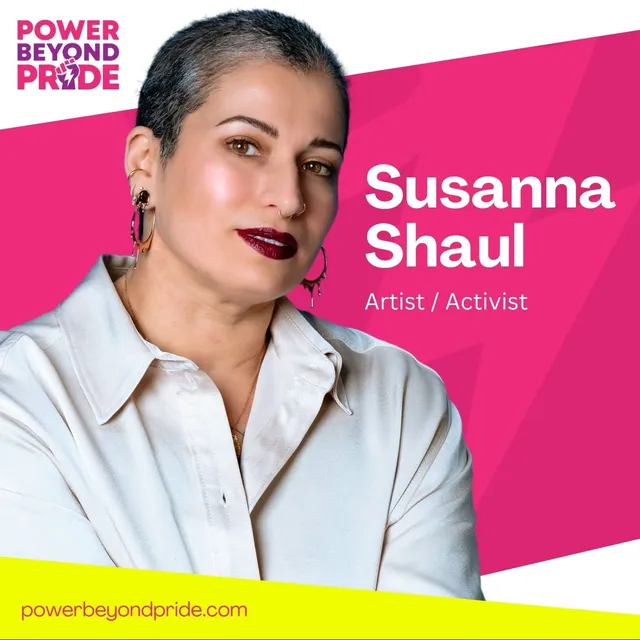
Episode #36 · Jan 27, 2026
Design, Dissent, and Education with Susanna Shaul
50 min
Listen or watch
In this episode
On Power Beyond Pride, Melodie KG and Shane Lukas welcome Susanna Shaul, a NYC-based art director and designer with deep roots in immigrant advocacy and LGBTQ+ community support. Susanna describes how queer and immigrant justice work often runs on parallel tracks, even though many asylum seekers are fleeing anti-LGBTQ+ persecution. She shares sobering examples of how fear is shaping community life—from immigrants being discouraged from attending Pride for safety reasons, to ICE showing up at a Queens high school.
TranscriptRead the conversationAbout 58 minutes to read · 8,684 words · Susanna Shaul, Melodie KG, Shane LukasOpen
- Susanna Shaul
- For me personally, it's a matter of equity. It needs to be taught to everyone. Design thinking, uh, they don't need to come out graphic designers, we don't need everybody to come out of this program, and this is their future career in life. But speaking of empathy, what is the first pillar of design thinking of human centered design? It's empathy. So that's how I feel. I can truly can contribute to the next generation.
- Melodie KG
- Hello and welcome to Power Beyond Pride, a weekly queer change making podcast bringing you voices and ideas from across our fierce and fabulous spectrum to transform our world. I'm Melodie KG, your Minneapolis based queer provocateur.
- Shane Lukas
- And I'm Shane Lukas. He him his I am one of a great idea. A very big peanut butter jelly, American cheese, sweet pickle sandwich enthusiast, much to the chagrin of those around me. And we are your co hosts on today's queer cast journey. In this episode, we are talking to the phenomenal Susanna Schall, art director, brand designer and artist from metropolitan area of New York. Welcome, Suzanne.
- Susanna Shaul
- Thank you.
- Shane Lukas
- Glad to have you here.
- Susanna Shaul
- Glad to be here. I'm excited about this.
- Melodie KG
- Thank you so much for being here. I'm so excited to get to know you. Do you want to just start with a little intro of who you are, what you're doing, what you're feeling? How are things going for you?
- Susanna Shaul
- Yeah. What am I? I am. I started at the beginning, I guess. Born in Odessa, Ukraine. Came to America almost 40 years ago, quite a while. I'm an art director and designer here in New York City. Been doing this for the last 25 years with a pretty diverse kind of client base, but public private sector, but also focused on work with a lot of mission based work, volunteer work in with immigrants, asylum seekers, and in the, uh, queer community in the LGBTQ community. So I think that's a surest, uh, way of saying that.
- Shane Lukas
- Yeah, I mean, again, I think it's really powerful, especially in this moment where we're talking about immigrant refugee communities. Do you feel like it's a conversation happening in the queer sector? Do you feel like it's happening among queer professionals, talking about their investment within the conversation around the xenophobia and the things that are going on around anti immigrant sentiment?
- Susanna Shaul
- I think that the conversations are actually really siloed and understandably so, where we all kind of deal with issues that are very personal to ourselves. So the queer community has a lot of its own issues that it's dealing with, especially right now with transphobia, with the current administration, uh, and the asylum seeking, the refugees the migrants, whatever language we're using today is a whole separate conversation. I really haven't seen any overlap. Even though a lot of the asylum seekers are seeking asylum due to being part of the LGBTQ communities from wherever, uh, they come from. And unfortunately there are organizations that deal with it, but there isn't a wider conversation around it.
- Melodie KG
- That's so interesting, especially because I think so I come from mostly sex worker rights organizing. And in, in that realm, we talk about migrant justice all the time, especially as it intersects with, with trans and LGBTQ folks. And in this moment, we are seeing some folks pull away from conversations because of safety reasons. Right. They're scared of, uh, lifting their voices in certain ways or being extra public about their stances. How do you feel being both a queer person and an immigrant in this moment? Are you feeling safe? Are you feeling worried?
- Susanna Shaul
- Do you.
- Melodie KG
- How are. How is that living in, in your body and in your work?
- Susanna Shaul
- One of the organizations that I work with puts on a pride parade every year. Unfortunately, I couldn't be there this year, but they specifically were asking. A lot of the people in this organization are immigrants, asylum seekers of various levels of documentation, and they were specifically told not to come to this parade due to safety concerns. So that's incredibly sad. It's the first time that this has happened since the beginning of this organization and it happens to be almost 20 years old. It was started because there were no queer spaces for us in our community. So it's. And um, it really wasn't as one of the only ones where we can speak our own language and have our own culture. And this was the first year that they told them not to come because you can't have that many people in one space. And it uh, would true concerns for their safety. Am I concerned for my safety? I want to say I'm not because I'm a citizen. I've been here for so many years. But I think in the back of my head I really am because I don't believe that things that are happening are quote unquote by the books as they should be. So I think that I really, I don't want to be too outspoken today. Uh, not today, but I mean today in our parents climate, I don't want to my name to be too out there one. But also I'm more concerned for these folks that are here on. In Russian, we call them birds rights, meaning they're so delicate and so fragile, these rights that they're here on. And they're even more fragile with the current administration. So Overall anxiety for everybody around.
- Shane Lukas
- Thank you for sharing that. And that's incredibly powerful in hearing that. I'm curious what your thoughts are on how others can step up. Right. So as you talked about, there are community members for whom speaking up is a risk. Like, there's a different set of vulnerabilities that are present, but there's so many queer community members for whom I would say they don't perceive themselves at that level of risk. Again, we're not talking. We understand that trans rights are under attack. We understand many communities are under attack. A lot of community members are not feeling those attacks. Anything. Are there ways that they can step up into this conversation? Are there ways. Are there things that you see could be done that people just might not be aware of that they can step into to. To use the power they have to have an impact?
- Susanna Shaul
- In this particular instance, what we did was we called people individually, and there's. It's a triangle, not muscles triangle, but there's a different triangle here where there are people who are the safest at the top. They're American born, they're white, they're male, they're the safest. So whoever I knew that fit there, we would. I would call them and I would say, hey, can you please come to this pride parade? We just need people there. We don't want nobody showing up. We don't want it empty. We don't. We want to show that people are coming, but we also want to fill it with people who are not at risk. Okay? So those are the people. So if you're at the top of that triangle and you're the safest and you feel the most confident, show up. Be there as a body, be there as a presence, be there as a visible president. Right? And then we know how that triangle goes down. White women and immigrants and people of color and so on and so forth. I don't want to put anybody in or ask anybody to go out and be unsafe. Not in today's day and age, because I don't know what safety even means with everything that's happening. It's a small tangent. I live in Queens. It's the most diverse place in the country, I think. M. My son goes to high school, ninth grade freshman. He had ICE at his school and ICE show up. Questioning the kids. My kids are kids, of course, or brown kids. They're mixed. So they're. I have concerns. Uh, yeah, they're born here. I. I know they're born here, but they don't have American names. They don't have American last names. They're. They're not as light skinned as I am. They're not. I'm ice, showing up to the high school stamping world side. So is that legal? No, I know it's not. I mean there I lived next to. We, uh, had a heart center down block. For me, ICE was here all the time. Wow. I'm concerned for everybody around this. It's so in terms of how can people stand up. That's the only way I really can think of. But I also don't want to put it on anybody into, to be in an unsafe position because if you are putting yourself at risk today, you won't be there tomorrow to help us out.
- Shane Lukas
- So I guess I hear that. But I also feel like a lot of people have taken a step back since the marriage movement from so much of this work. And so I guess I feel like people have a false sense of confidence about their position, their role, who they are. Right. Like it. Obviously we've all seen the memes coming out and looking at parallels to the Holocaust and other obviously very horrendous historical experiences. And we could talk, you coming from Ukraine, like looking at what Russia has done historically to Jewish communities, looking at all of these different travesties that have happened over time. I think people absolve themselves of the seriousness or the idea of the security that their queerness is somehow protected somewhere when there really isn't a protection. So I guess, uh, I feel like uh, I don't want to encourage people to put themselves in harm's way. That's not the intention. But I think society is putting, putting harm and has historically put harm in many people's ways. And there has to be a way to encourage other communities to step into that conversation. And I do hope that people think about what that might mean for them. There's different ways to dissent and there are ways to dissent, private and public and ways to do it. So I certainly want to keep people in it. But I definitely appreciate your desire. And some of that desire I think comes from you. I mean again, it feels like I get this vibe about you really like having a community around you and thinking about the well being of others around you. Can you share a little bit about your journey as a queer person and kind of, kind of what that has been and kind of helps inform the way that you think about others, the way that your empathy is itself informed.
- Susanna Shaul
- I think that coming from a culture again where queerness didn't exist. And let me explain what I mean by that. Obviously it Existed. It always existed. It didn't exist in the sense where we don't talk about it, we're not going to talk about it. It just. It doesn't. If we don't talk about it, it doesn't exist. You can go do whatever you want, the behind closed doors, but. So it was kind of like that. And then I started working again with this organization where we started getting refugees from former Soviet countries that are escaping persecution for being queer. And yes, it came out of Putin's law, homophobic laws, under the guise of you're perverting children by holding hands in public. But also, they weren't just from Russia. They were also from Central Asia, and they were from the caucus region. So there were people, uh. So when I say former Soviet countries, I'm talking about the whole block, and they're all coming from that space and they're coming here. And I think that what really activated that with me was they were children to me. They were closer to my children's age than to me, to my age. I had two girls here who just turned 18 in Mexican detention centers, Right. Who I was talking to. And I mean, how do you not find empathy or take on as a parent, that maternal role? Was there paternal or as a parent to care about people? I think it's not very hard to find that empathy when you see people like that. Especially, uh, when I started working with them and talking to them and kind of having them in my house and having these conversations. I mean, we went. My family went through the same thing. And no, we weren't in detention centers, but we had to go through other countries to get here. We had a different journey. The asylum process in the 80s was different than it is right now. And it brought that up with me that we had a support system from Jewish organizations that really helped us, uh, step by step, both financially and more and emotionally and helped us settle here. And these people don't have that. So it was more about. It was less about, I have the resources in terms of medical or legal, and it was more about, come over for a holiday, come over for dinner, let me take you out, let me get you some clothing, which I think is a drop in the bucket compared to the support they needed, but it was also necessary because, again, these are children. I know that 18 is legally an adult, but to me, I. I can't. I'm not looking at them as adults. And a lot of them had. Their parents had turned away from them. They were ostracized by their families, by their communities. They're a new country. They haven't fulfilled their education. They don't have careers. What do they do? What. So in terms of empathy, and it's really the same empathy that I have for the kids here at the Herc center who. I don't know. I don't. I had no relationship here with them. They were from all over. They were. The Venezuelan from Venezuela. We had a lot from Africa. M. We had some from here, from Russia as well. But I look at them and I see children. So, uh, this whole conversation about their criminals and they're this and they're that, I don't see that. I have. I really just have pity for them. I want to make sure they're all fed.
- Melodie KG
- Yeah, absolutely. And I mean, you're talking about essentially the next generation, whether they identify as kids or young adults. And what I hear you saying is that you're really focusing and have been focused on the community care aspect of kind of trying to raise these folks, not necessarily with big displays of dissent, but really just like feeding folks, making sure that they have community, that they know who to turn to in tough times, that they have their basic needs met. And that's such a core part of organizing, and especially organizing within queer and immigrant communities is like finding your people and trying to make sure that we all kind of level up together or at least stay safe together. And that's really beautiful.
- Susanna Shaul
- So, I mean, I think within the queer community, that's how it's been. Yeah. Uh, whether they're from outside the country or inside the country or whatever the situation has been, queer communities have always had to come together to support each other, because if we didn't, who would? Who's interested in us, if not us, if not ourselves? And so it's the way I look at raising kids. If you raise them with empathy, if you model that empathy by, uh, politics, then, um, if you. Then they will show that they will continue that. I hope. I might be wrong. It didn't come with a playbook, but that's my theory on it.
- Melodie KG
- No, absolutely.
- Shane Lukas
- I think it's powerful. I think, again, like you mentioned, community care models, from Sylvia Veda to so many, to the radical fairy movement to so many movements, it is certainly a demonstration of queer people showing power, but also just humans showing power. There are many examples of communities coming together and demonstrating that. I just, again, hearing your heart in that is so powerful. And we're going to talk more about this. We're going to take a short break right now. We're going to come Back to hear more from Susannah Shaw and really share about her amazing projects talents. We're excited. More about that. We're in conversation with the amazing creative Susanna Shaw and we'll continue right after this break with Power Beyond Pride.
- Melodie KG
- Welcome back. This is Power Beyond Pride, a queer change making podcast and I am Melodie KG here with my co host Shane, talking with the amazing Susannah Schall.
- Shane Lukas
- Hey, Susanna, you have been the art director and designer of, uh, Sugo Design in New York for close to a decade now and you've worked with a lot of really amazing partners. And again, uh, I am really grateful to have seen and witnessed your expertise at work. But I'm also excited that as a designer you're going to start sharing more of your experience. Can you share a little bit about this new part of your trajectory?
- Susanna Shaul
- Yeah. So I wasn't sure when, at which point in my career this was going to happen, but this felt like the year to do it and to just dive right in. I always thought my whole career, I knew that I would eventually end up teaching. What that was going to look like or when it was going to happen, I was never quite sure. And I would dip my foot in here and do facilitations and trainings and I would speak at conferences and this and that, but I never quite thought that I was even 25 years into it. I was like, do I have enough experience to share this? And, um, this year I said, you know what? I think I do. I think I've been doing this for long enough. And I love teaching, really truly love teaching. But I thought it was so, like, arrogant on my end to think, what do. Who am I to be teaching? And I said, no, you know what? And I was, I said, where am I going to go? I have a master's degree, so I can teach on the, in, on the college, university side. And, um, that looked like fun. And I started developing my curriculum and I started developing my syllabus. And I get this email from Jan, from my partner, and she's like, I know you want to teach at a college. And she's, have you ever thought about New York City high schools? And I'm like, I would love to. That would be my dream, to teach in the New York City high school. I love high school students. I know that this is a controversial topic. I love high schoolers. And I said, but how? I don't have a New York State teaching license. I can't right now. Go and come and spend. It takes about, I believe, a year and a half to two years to get another, uh, degree, pass the test, this. And then she goes, no, they're looking for CTE teachers and you can start right away. You just need to get a certificate because you have a master's and you have X amount of industry experience. I said, no, that can't be. I know how the city works. It's going to take me five and a half years. It's going to have this stuff. She was right. I submitted my certification and called up an acquaintance of mine from the doe, and he walked me through the whole process. And I was like, oh, this isn't overwhelming. This is amazing. And I started emailing principals and I was like, and my whole spiel is, I want to teach specifically graphic design. I want to teach it at a high school level. And they all ask me, why do you want to do it at a high school level? And I said, hey, for me personally, it's a matter of equity to be able to teach this at a high school level where everybody has access to it and not teach it at the art, uh, school level. Because we know that art schools are expensive. We know that art schools are not accessible to everybody. We know that the median kind of salary in New York City for people living in New York City, I'm not talking about coming from other places. It's not accessible to go to a private. To get a private arts education where graphic design tends to be taught. We do have city programs, but there are X amount of programs and there are X amount. There are more people who want to learn this than there are programs in the city. And I said, there's no need for this to be taught as something at a higher level, theoretical, and so precious. I think it needs to be taught as a trade. It needs to be taught to everyone. Design thinking, uh, they don't need to come out graphic designers. We don't need everybody to come out of this program. And this is their future career in life. But speaking of empathy, what is the first pillar of design thinking of human centered design? It's empathy. And I want. So that's what I want to do and wanted to do and how I feel I can truly can contribute to the next generation. So I. My paperwork is in. I've been speaking to Prince of Films. Hopefully something will go through. I had my first demo lesson last week. They invited me for my third level, like, third interview with the school. Wow, really amazing place. The school itself spoke to the principal. I did my demo lesson. I love the kids. I was so sad that I only got 35 minutes with. I was so sad. They did these great, like, logos and we have, uh. And we have to. We really underestimate high schoolers. They're capable of really higher thinking than we think they are. It's the. I believe in, uh, Pygmalion. It's called in business and in education, there's a different term for it. People will rise up to your expectations of them.
- Shane Lukas
- So I love that you're raising design thinking, which does in its. In its own way, like you said, it's kind of like one of the. It's the first pillar. So bringing human again. Part of that, part of what makes empathy is the ability to imagine the world through someone else's eyes. To be able to say my lived experience is not the lone truth, but that it is one of many truths. Right? And so part of being able to be a good designer is to be able to step outside of yourself to do that and so much of social justice Is that right? Like, it is this idea about, hey, not only do I have my lived experience, which is going to inform my decisions, but I also want to recognize other people that have very different lived experiences. And my values are going to live into my decisions on how I act in this world to affect other people's lived experiences. Am I going to advocate for justice, even if it doesn't benefit me directly, but benefits those I love because they're experiencing suffering or that all of that, or experiencing challenges. I just think it's really powerful to think of design thinking in a way as this conduit to encouraging empathy and encouraging another way of being in the world. Is there a teacher who kind of inform that. Who kind of influenced you?
- Susanna Shaul
- My grandmother. My grandmother. Oh, I'm starting from my grandmother. And I've had amazing teachers along the way and that. That could be all podcast series teachers who influenced my life. My grandmother.
- Melodie KG
- Starting with the, uh, Babushka.
- Susanna Shaul
- Starting with babushka, who. Who was not. I lived with her as a child. So who raised me. And she was an English teacher back in Ukraine. I very loved English teacher. And to my. My first demo lesson, I wore a ring of hers. And it was a ring, gold ring that was given by her first homeroom class. And inside there is an engraving and said to our favorite teacher. Now in the Soviet Union, you understand for children to raise enough money to buy a golden ring with two rubies in it. How much they. It's. And it. Two little rubies and a star and on the inside to. To our favorite teacher. So that tells you enough about what kind of person she was. That, uh, so that's the reason why I always thought I would end up teaching.
- Melodie KG
- That's amazing. That's such a beautiful story. And again, I see you here going back to this, like, raising of the next generation, giving them the tools and support that they may need to step into the world. And high school is such an incredible time to be implementing some of these, some of these teachings because I remember the queerness and the radicalization started in middle school, but like, it really came to fruition for me in my activism in high school. Like seeing examples even in curriculum of here's where you as an individual get to make the change that you want to see happen in the world, while also learning that the world, the way that it's designed, is deeply fucked and deeply not designed for us queer people.
- Susanna Shaul
- Right.
- Melodie KG
- And so I love that, that you're taking your 25 plus years of experience doing all of this and bringing it.
- Susanna Shaul
- Back to the kids.
- Melodie KG
- That's beautiful.
- Susanna Shaul
- Yeah. I mean, I really hope that I can support them in because they're the ones who are going forward. They're the ones we're gonna have to count on. I mean, I hopefully still have some time on this planet, but we need to raise, to, to raise the next generation and give them the tools and to know that there are people supporting them. I, I don't like this perception of teachers as just, uh, kind of not keeping down, but just giving knowledge. Uh, you can give knowledge, you can give knowledge in many different ways, you can pass down knowledge, it's very important. But to give support, to give knowledge as a form of support for them to move forward and to continue bettering this world, which is going to need a very strong generation.
- Shane Lukas
- So I have to ask. Yeah, so I have to ask this as a, as somebody who's moving into education, as somebody of your own lived experience of parenting. No one knows how to connect, I think, to the younger generations, like what motivates them, what is interesting to them, what world it is that they want to build. Any suggestions or pointers for, I guess, all the different people working across movements who are looking at young people and being like, I don't do TikTok, I don't know how to speak to these younger generation. I don't know. They're not interested in this. I don't believe it's true either. And I hear in what you say, like, they are invested, they are interested. Are there any pointers that you've learned or that you feel like you, you're comfortable sharing that help everybody else understand better.
- Susanna Shaul
- You know what? I wish I had something smart to say right now, but it's pretty basic. You speak to them with respect.
- Shane Lukas
- What? I'm sorry, what's that?
- Susanna Shaul
- I know you. I. I didn't come prepared. Hold on. I thought I would come out with something a lot grander than this. You speak to them as you do not. Was the. Another peer with not speaking at. But speaking to. You're having. Have a conversation. Talk to them. You don't know how to talk to them because of TikTok or this. You're speaking the same language. It's not. It's not that. I mean, no. Uh, some of the stuff they say is really.
- Shane Lukas
- I mean, skibidi. We'll just put skibidi m. It's zero sense.
- Susanna Shaul
- Zero.
- Shane Lukas
- Zero. But, you know, whatever. Like, I mean, we have our own terms. We all had our terms. So I'm gonna go and Skibidi's a thing.
- Susanna Shaul
- And so there. I mean, just for a second. Bring yourself back. The stuff I used to do as a teenager. Oh, my God. I grew up on the New York City punk scene. Like, you want to talk about. Um, different podcast, but I. What do you mean you can't speak to the other generation? Are you really that far removed? So maybe that's not an issue with them. Maybe that's an issue with you already.
- Shane Lukas
- I'd give two snaps for that one. That would. That. That for sure. Because, I mean, the rebellion's important. And I think there's always. Every generation has its rebellions. I think we just need to figure out in this age of technology, what does that rebellion look like? And I really appreciate what you said there. Like, it's not about speaking to or at. It's or not speaking at, but. Or speaking with. Right. Just connecting to and realizing that they're bringing. In some ways the advantages they have at access to narratives is beyond anything I could even imagine growing up. And so they were able to reconcile a spectrum of identities and gender expressions that we didn't even have language for. They've got all that down. Like, they're talking about racial identities and, like the complexity of racial identities and heritage and legacies and traditions and ancestry that I think is gorgeous and as a multiplicity, that is beautiful in a way that, again, I think was just so reductive among my generations.
- Susanna Shaul
- I think they're a lot more nuanced. And maybe that's where the dissonance is happening between our generation and theirs, is that we didn't Grow up that nuanced. We grew up very much black, white, and maybe a few shades of gray. Somewhere in between, they've got a whole rainbow happening there.
- Shane Lukas
- And we love a good rainbow.
- Susanna Shaul
- Yeah, I mean, we have. A rainbow's fine. It's fine. But there's this. It's not. I grew up again, we had gay, lesbian, and maybe androgynous somewhere in between. The spectrum, the gender spectrum that is currently happening is amazing. It is. It's fluid. It's fluid in the best sense possible. And it really gives everybody their space without questions. And there really should be no questions here. You are who you are. It's accepted. It's that radical acceptance that, uh, is nobody's business but your own. And that's something that we really can learn from them.
- Melodie KG
- Amazing. Let's talk more about that after a really short break. Please stay tuned to Power Beyond Pride as we continue our conversation with the creative and fiery Susanna Shaw.
- Shane Lukas
- Welcome back to Power Beyond Pride, where we are talking with the creative activist and artist Susanna Schall. I'm Shane Lukas and, um, I'm here with my amazing co host, Melodie KG. I just feel like a little rainbow should just pop up after you say that, I think Melodie KG and then a good rainbow. Now, Susanna, before going into the break, we were talking about generational influence, really understanding the power. Different generations and many people may not know this about you. And I was really excited to be able to learn this and see some of your work, but you actually do, uh, some amazing artwork on your on of your own. Can you share a little bit about your artistic journey and kind of what's influenced that?
- Susanna Shaul
- Sure. I don't know if it was a journey because, uh, it start. It's been a part of my life for as long as I had the fine motor skills to do this. It was something that was taught to us as children. My mom taught me to knit. Somebody else's grandmother taught me how to cross stitch and then how to bead and what we now call fiber arts. I spin it, weave can take from shearing. I don't shear the sheep, but raw wool, take it all the way to the final woven product and raise my own silk moths as well. For silk. Let's see. I'm trying to remember. I like everything that goes into fiber arts. Uh, and again, I like the journey as much as I like the final product. I like growing the plants and collecting the plants for the dye making, but.
- Melodie KG
- Not sharing the sheep.
- Susanna Shaul
- I do not share the sheep.
- Melodie KG
- Top of the sheep.
- Susanna Shaul
- You know what? Apparently uh, that's a whole different kind of occupation that I haven't yet gotten into yet.
- Shane Lukas
- There's still time.
- Susanna Shaul
- There's time. There's time. There's. I do go. I go to the sheep fiber festivals every year, multiple times a year, and I do watch them get sheared. And I take the sheep that whose fleece I want and it's a whole experience.
- Shane Lukas
- Can you share what you mentioned that you've been doing this for? Was this, is this something that came from generations? Is this something that you mentioned, how influential your grandmother was? Like, is there something in it that kind of speaks to you?
- Susanna Shaul
- Came full circle where I think that doing this really makes me question what we consider fine art. Right. I don't like that term. Fine art is a patriarchal construct that was created. It's a European, Western European, white man made, not human made, but specifically male made construct that has nothing to do with me or what I create. What I do is called and has been traditionally called as a craft. No, in a, in patronizing tones, a craft that women do. It's not legitimate art. And uh, even when I went to art school, I would try to pass it off as art. And it was like, oh, you brought a craft in to art school. How nice. How quaint. Now it has, a movement has been established and developed. It's been a number of years since this has happened. But this is something we did in my family, we always did. And we didn't do it as an art because if you ask anybody else in my family, nobody's an artist. They're engineers, they're economists. We have no artists in our family. But everybody knew how to do this. They knew how to sew, they knew how to knit, they knew how to cross stitch because it was a skill. And it was a skill that you knew how to do just as much as you, you could. So it was taught to me as a skill. Reading, writing, sewing, knitting. I picked up a few more along the way as I dove deeper into it. But for, especially in Ukraine, it's a language, it's a narrative, it's a storytelling device. So. And for me, it's resistance. It's resisting the idea of what we consider fine arts. So why I continue it, I love it.
- Melodie KG
- That's amazing. So why don't we move into our, uh, rapid fire round where the audience will get to know you a little better.
- Susanna Shaul
- Sure. I'm nervous. Should I be nervous?
- Melodie KG
- Don't be nervous.
- Susanna Shaul
- Okay.
- Melodie KG
- It's going to go great. But, uh, just say the first thing that Comes to mind. And try not to think about it too hard.
- Susanna Shaul
- Okay, first question.
- Melodie KG
- What's a piece of art that inspires you?
- Susanna Shaul
- Currently Bisa Butler. Bisa Butler. Bisa Butler. It's a. She's an artist. I mean, all her art, it's not one piece. Everything she makes, she, uh, please look her up. Anybody who's listening, please. She's quite well known. Uh, she's actually from the same town as my partner's from, but quilting with quilts. She makes portraits. Portraits that talk about the black lives in this country. And she. Please look her up. Bisa Butler. B. I S A. She's stunning. Her work is amazing. If you ever get to see it in person, it's an even better experience than anything that can be printed.
- Shane Lukas
- All right, now. I love it. I love learning about new artists and that sounds amazing. Okay. Your biggest pet peeve from a designer.
- Susanna Shaul
- Uh, um. I really try to be gentle with everybody. Not know. Oh, not knowing how to do proper paragraph and character styles and indesign.
- Shane Lukas
- Fair enough. That is a very. That is very. That is very industry specific thing.
- Susanna Shaul
- But Shane wouldn't feel me.
- Shane Lukas
- I feel it. I feel it. It is, it is. So, yes, I, uh. Sympathy for those of us who are designers. This is one where we can all, ah, kind of give you a big amen at the end of that. Or a big two snaps for that one.
- Susanna Shaul
- No, that was very specific. But it's. I think I'm very understanding of almost anything. Yeah, that one is speaking of intergenerational.
- Melodie KG
- Stuff, us younger millennials with a indesign. I've never met her. We use Canva. What are you talking about?
- Shane Lukas
- And we would ask you, how do you control your text? And that is. It is a. It is. You can't control your text.
- Susanna Shaul
- You can't. I was given a whole project for this high end, high end real estate developer. I mean we're talking about multi tens of million dollar project. I'm not naming the project very high profile. And the thing was given to me on Canva two days before it grew. And they were like, we don't like how this looks. Can you redesign it on Canva? 30 pages. It's due at two days.
- Melodie KG
- That's a $30,000 rush fee, sir.
- Susanna Shaul
- Thank you. You're not wrong. It might have been something close to that. I got it out, I got it done. I did the rest of that campaign. No, no.
- Shane Lukas
- Controlling text in Canva is a nightmare. I don't care what anybody can do. It is a nightmare. So I'm glad all you canva lovers out there, that's great. I'm glad you're using all those templates.
- Susanna Shaul
- Because it looks like you are.
- Shane Lukas
- It looks like you are.
- Susanna Shaul
- And we know.
- Shane Lukas
- And we see you and we know what you use, because they all look the same, but text control. Um, Suzanne are gonna. We're gonna create a club, and we're gonna. We're gonna create a styles club just.
- Susanna Shaul
- For no proper naming specifications. I know.
- Melodie KG
- Amazing.
- Susanna Shaul
- Melodie is looking at us, and she's giving us side eye.
- Melodie KG
- I'm. Look, I have my own small business and I'm constantly hitting Shane up for. Can you please help me with a design thing? I don't even know what control your text means, so that's where I'm at.
- Susanna Shaul
- I just.
- Melodie KG
- So it's more just like my being confused and in awe.
- Susanna Shaul
- Ah.
- Melodie KG
- Of all of y'. All. So thank you for dealing with my millennial side eye. That's going to be the name of my podcast.
- Susanna Shaul
- Love that. I do.
- Melodie KG
- I love it.
- Susanna Shaul
- Okay. I am on the cusp of millennial. Can I be on it? I'm like, right in Millennial side eye. Thank you.
- Melodie KG
- Yes. Okay. Susanna.
- Susanna Shaul
- Yeah.
- Melodie KG
- What was your favorite moment as a dancer?
- Shane Lukas
- People may not. We should probably front this, too. And say again, Susanna, you have a great career as a dancer, so we didn't talk about it at all, but you. You've crossed many different styles all these years.
- Susanna Shaul
- So. Yeah, that. I mean, that again, that's a whole different conversation. But I have danced in so well in so many amazing places for really amazing events and in people's happiest moments. I. But by kind of one that stands out is, uh, dancing in a restaurant. Lebanese restaurant in Bay Ridge for one of the Saudi princes. Whoa.
- Shane Lukas
- No pressure.
- Susanna Shaul
- That's incredible. Shipping was great. Yeah.
- Shane Lukas
- Did you get a plane?
- Susanna Shaul
- Okay. Got rent.
- Shane Lukas
- You got rent.
- Susanna Shaul
- Okay, I heard that. Not ashamed.
- Shane Lukas
- I, uh, know it sounds amazing. That sounds like an amazing. And that was so. In terms of the type of dancing, was that, uh, because you've done ballet, you've done all types of dancing, right?
- Susanna Shaul
- No, this was ballet. This was ballet dancing. It was in the middle of my ballet dance career, and again, I was doing that as a, uh. What are we calling it now? As a side hustle. At night, I worked at Morgan Stanley, and they're designed marketing. During the day, my costume in my bag, and at night I'd go off and dance. Amazing.
- Shane Lukas
- Phenomenal. I love it. Okay, so your favorite queer icon.
- Susanna Shaul
- Clear icon. Where we. Where I. It's going to have to be. Who threw the first brick? Right. Who threw the.
- Melodie KG
- Marsha P. Yeah.
- Shane Lukas
- Yeah. Marsha P. Ms. Major. Was it Marsha B. Who threw the first brick? Okay. Marsha P. Johnson.
- Susanna Shaul
- Yeah. The fight came later, but that was the first brick thrown because it all went uphill from there, kind of. Yeah. Yeah.
- Shane Lukas
- That's awesome. Yeah. Ah, Stonewall. Stonewall icons again. We have Ms. Major with us still today. We have some of that. We have very few of the icons left with us today, so.
- Melodie KG
- Yeah. Amazing. What's the best date you've ever had?
- Susanna Shaul
- Oh, what's the first date? With my current partner. We went hiking. I know. I'm the Thousand. That's so cheesy. You wanted something spicier, right? No, we went hiking. We went hiking. It was Yipuri. We couldn't do too much of a hike because I fast on the empty pour. So I was fasting the next day and. Or rather that night into the next day. And, uh, we did five miles in the Palisades, and it was amazing. And. Wow. It was. And Shane met her. She's great. I love her.
- Shane Lukas
- Awesome. Yep. No, Phenomenal. Phenomenal.
- Melodie KG
- That's such a cute. Classic lesbian story. We went hiking on our first date.
- Susanna Shaul
- It was like. I loved. I know. I. We are a bit of a cliche.
- Melodie KG
- Her night. Like.
- Susanna Shaul
- We are. Me and my Subaru in her Jeep. We're, um. She's necademia. I'm the artist. Right, Right. I. We're.
- Shane Lukas
- I'm here for it. I mean, I think. You know what, it's gorgeous. It's beautiful. It is joyful. I could see it when you see both of you. So, yeah, we're all about it. I love it. I'm glad. That's the best dates. I want to know what the best piece of advice is that you would give to your future self.
- Susanna Shaul
- Oh. Uh. I'm never going to take it. I'm gonna tell you right now. I'm never gonna. I'm gonna tell it to myself. It doesn't have to be perfect. It doesn't. You could. You can just go ahead and. Just go ahead and do it. It doesn't have to be perfect. I'm already not taking it right now as it's coming out of my mouth. I'm worried, but I really wish that is that I could just kind of let go a little bit. Things don't have to be perfect for me to go ahead and do them. Um, it's something I think, that all artists, first of all, struggle with. Yeah. That anxiety of starting a Project and ending a project and showing a project. And it's not only about art, it's about even this whole teaching thing. I didn't need to be a perfect designer who doesn't make mistakes at them. It's not achievable in order to go and teach somebody. And, um, I don't need to make a piece that's perfect. I think that is something that really holds me back on a regular basis to this day. So, yeah, don't wait. Just do it. Jump. Close your eyes. Jump in. Take the lead.
- Melodie KG
- Just do it. Nike.
- Susanna Shaul
- Nike. Just do it.
- Shane Lukas
- Yeah.
- Susanna Shaul
- You know, I love it.
- Shane Lukas
- I love it.
- Susanna Shaul
- Thank you.
- Shane Lukas
- That's great.
- Melodie KG
- Are you an extrovert or an introvert?
- Susanna Shaul
- I believe recently there's been a new term for what I am. I'm not an extrovert because extroverting does not give me energy. I might. So I love people and I love being around people and talking and being. And this is amazing for me, this experience. I'm, um. I love it. But for the rest of the day, I'm going to be in a bunker. I'm going to go hide in the basement for my children. Or I might go to the gym and just kind of hang out there for a few hours with my headphones on. So I don't know what category that puts me into.
- Shane Lukas
- I love it. I sympathize with that. I think that's. I very much share that experience. I think we will find one together. I think it's whatever category that is, Suzanne is. We're gonna. We're gonna. We're gonna rock it. Because, uh, I feel that. I feel that energy now. I know you're an amazing cook. I've not had yet to enjoy your cooking, but I know you've shared that. You cook a lot for your family. You cook a lot. So what is your favorite thing to cook?
- Susanna Shaul
- Oh, my God. One favorite. No, I don't just like to cook for my family. I like to cook for my friends. I love to throw holiday parties. I recently had a ton of people over for Mamuna, which is a Moroccan celebration of the last day of Passover. I'll send you a photo of what was on the table. But, you know, we have. I'm not.
- Shane Lukas
- I want an invitation. I don't want to foul.
- Susanna Shaul
- You have an invitation. You are somewhere off in a different state. Whose fault is that? Everybody's always invited. It's an open door policy here. I cook enough food for the whole neighborhood to eat for the next week. It is something I do not for them. I do it for me because I derive so much pleasure of just watching people eat and do all of that. So I have that. I'm not even answering your question. Do you know, it's not one thing. It's all the Soviet standards of the type of potato salad. We have Olivia and crepes. And it depends on the holiday. There's going to be, like, lamb with rice. There's going to be a bunch of Middle Eastern dishes, because my kid's dad and his side of the family, they're Iraqi, corsi, and Moroccan. So I got a ton of food from their side of the family. And plants. I make my own hummus, ganoush. There are different type plant salads from where I come from because the part of Ukraine I'm from is very specific. It's a port town and it's the south, so we have a lot of different regional cuisines there. It's not, uh, what you think of as traditionally Ashkenazi food. It's. There isn't one dish I like to make. I just like to cook and I like to feed people. That's my big thing.
- Shane Lukas
- I love it.
- Susanna Shaul
- I love it. So open invitation next time there's a holiday. I do it usually about twice a year. Once for Passover and one during winter holidays. Whatever day it works out. Amazing. Awesome.
- Melodie KG
- Uh, all right, last question. What is your toxic trait defense?
- Susanna Shaul
- Okay. Which one? Oh, boy.
- Melodie KG
- It doesn't have to be perfect.
- Susanna Shaul
- Just pick one toxic trait. Oh, God. It's the same thing. You know what? It's the same for myself as for other people. I expect sometimes more than people can or have or my. Sometimes my expectations of myself are very high, and they are of people. That's something that really. I feel it has failed me often.
- Melodie KG
- Yeah.
- Susanna Shaul
- And that I try to. I really try to remind myself people don't need to have my ethics or my standards or my. There's no need for that there. It's not normal for that. So I really try to remind myself of that quite often.
- Melodie KG
- Yeah. That's a tough one. I struggle with that myself as well. And, uh, continue to sit in judgment of people, even when it's unwarranted.
- Susanna Shaul
- But, um, I totally get it. My daughter's name in Hebrew is judgment. I didn't think about it. I named her. It wasn't intentional. I named her in honor of my grandmother who I was telling you about earlier. Yeah. Because I said, if I ever have a girl, she will definitely carry my grandmother's name. But her Name means judgment.
- Melodie KG
- I kind of love that. That's extraordinary.
- Susanna Shaul
- She looks up to it. Yes. That's so funny. So, yeah, I think that's that.
- Melodie KG
- Uh, Susanna, thank you so much for this wonderful chat. We're unfortunately out of time but I know people are going to want to continue the conversation with you. Where can people find you and follow you?
- Susanna Shaul
- Um, um, LinkedIn is probably the best option because a lot of my, like my Facebook is closed and my Instagram, I, I'm not very active on LinkedIn. My first name, my last name. You'll see my photo there. It's pretty distinct and a blue background. But yeah, feel free to reach out. I love conversations and meeting new people and chatting. So very open to anybody following me there.
- Shane Lukas
- Thank you Susanna so much. I appreciate it. And uh, if you also, if you have a project and you want to work with Susanna from a design perspective, certainly feel free to reach out, check out their amazing work. So go Design is the name of Susannah's firm and uh, just an amazing person to know and an artist to certainly follow and stay connected with through any channel. And we're really grateful to have you here today. We hope you will come back and join us again as you continue on your journey. Thank you for sharing all these insights. It's certainly just your leadership and trying to connect to younger generations, trying to also model just what it means to be there for immigrant rights is so important and critical in this current stage, in this current era. And just being again, just a queer leader, a queer, uh, just embracing all the things that it means to be inclusive and bring people into the conversations. So it just means so much. So I want to say again, thank you for joining us today at Power Beyond Pride. I'm your co host, Shane Lukas. I am as I mentioned before, a peanut butter and jelly cheese and pickle enthusiast as well as a harm reduction activist and owner of a great idea. You can follow me@shanelucas.com and also on.
- Melodie KG
- LinkedIn and I'm your co host Melodie KG, a uh, Minneapolis based provocateur and you can follow me on Instagram melodykg M E L O D I E kg. Please remember to subscribe and get your friends to subscribe to Power Beyond Pride on um, Spotify, Apple Podcasts or wherever you get your podcasts and check out our site@ah.powerbeyondpride.com Power Beyond Pride is a.
- Shane Lukas
- Project from a great idea, a queer owned design and content agency. You can learn more about them atagreat.
- Melodie KG
- Idea.Com this episode is produced by Shane Lukas. Sameitra Sarkar is the project developer. Our editor is Jarrett Redding with support.
- Susanna Shaul
- From Ian Wilson and we are both.
- Shane Lukas
- Part of this podcast awesome host team and they are awesome and we invite you to send in your questions and comments for our monthly Reply all episode@powerbeyondpride.com.
- Melodie KG
- Check out our new episodes each week and we look forward to Queer Change making with you next time. Thank you from all of us at Power Beyond Pride.
Transcribed automatically and lightly checked. If something is wrong — a name especially — tell us and we will fix it.
Episode #36
Design, Dissent, and Education with Susanna Shaul